Step Outside ‘Labor Replacement’ Box
To design a truly successful system, processors must expand their thinking beyond viewing robotics and vision systems simply as labor-replacement tools.
|
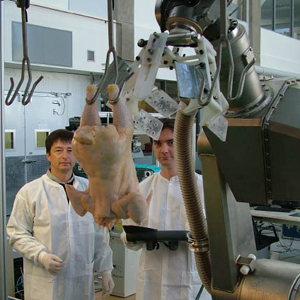
| Gary McMurray and Matt Marshall, a Ph.D. candidate at Georgia Tech, observe the actions of a robot arm used for rehang of chickens after they pass through the chiller, at GTRI’s facility. Photos courtesy of Georgia Tech Research Institute |
project (including inspection) is labor replacement. You cannot start any conversation with a system integrator or a representative of a plant without someone bringing up the question, “How many people will this system replace?”
The question is not intrinsically wrong, but it does bring with it a fair number of assumptions, and it constrains the problem-solving ability of everyone on the team. While this approach can yield some positive benefits for the company, it is missing the larger potential benefits of automation — including higher throughput, safer product and more efficient utilization of natural resources.
When the starting point for any discussion about automation begins with the labor replacement question, this immediately puts a box around the manual worker, and all solutions are based on replicating exactly what the person would be doing while trying to do it better. There is no opportunity to ask if an automated system can do more than just this one task; if the process can be changed to facilitate automation; or what data is required to do the task and what other tasks need the exact same information?
The basic product flow and process for a poultry plant has not dramatically changed from the manual process used by Jesse Jewell in the 1940s and 1950s. This inability to change the process has lead to several unintended consequences. The addition of each robotic system to replace the manual worker almost without fail increases the footprint of the work cell.
This is a big expense to the company.
It has also created islands of automation where each cell functions as a completely independent entity. The addition of each independent piece to the line only increases the overall complexity of the system, and this leads to more potential failure points and more cost.
Finally, improving the throughput of a single cell in the production chain will only incrementally improve the throughput of the entire system. This concept was at the heart of Dr. Goldratt’s Theory of Constraint. To achieve the radical change in the system, you must redesign the system.
Is labor replacement the right measure to justify robotics? It is a component, but in order to truly capture the value of robotics, the plants must be looking at the entire system.
A simple example (and I agree, a somewhat naïve example) of this is the dishwasher. If you were designing a robot to replace the manual dishwasher, then you would probably start by trying to design Rosie from the Jetsons. However, we know that the modern dishwasher has been tremendously successful, and it looks nothing like a human worker. It achieves the goals of the work, but the process is completely different.
Let me use an example from some of my own work in this area to show how this thinking can lead you down the wrong path. For years at GTRI, we have looked at automating the rehang of the birds after the chiller. We looked at industrial robotic arms and we looked at novel fixed automation concepts that utilized advanced imaging for controls. Each of these systems went to great length (and floor space) to solve the problem by looking to directly replace the manual worker.
While our systems were technically successful, none of them really solved the problem in a manner suitable to the processing companies. We have now taken a step back and looked at the process including the chiller. The key questions are now: Why did you let go of the bird in the first place, and how do you get the proper cooling of the bird while still maintaining control of the bird? As you can see, the real problem was upstream to the rehang task — not the rehang task itself.
When the post-chiller rehang problem is posed from this new system-oriented point of view, you can also begin to see how other problems can be solved at the same time. If you can maintain control of a bird through the chiller, then you can also track an individual bird all the way through the process.
This means that a single bird from a grower could be tracked through deboning, and yield and product quality could be traced all the way through the system. This could have a significant impact on food safety as well.
This is, of course, just one simple example, but it shows how easy it is to get trapped into this labor-replacement box. How should we automate the back end of a poultry-processing plant? It would be simple, and I think wrong, to begin replacing every person with a robot.
Why do we have to touch the product so many times after it is removed from the bird? It is touched at trimming, manually placed on a conveyor for marination, replaced on a conveyor for cooking and freezing, and then manually loaded into a tray.
Can we redesign the system to eliminate the need to handle it all these times as opposed to trying to design robots to perform each of these tasks? I think so, and I would be willing to bet that the integrated system design would require less floor space and improved throughput.
The task of automating a plant is something that should be a team effort between the plant, the system integrator and the equipment companies. Each partner needs to play an active role in the design process. The plant representatives need to challenge the designs and process. The system integrators and equipment companies need to fully understand the process and actively look for ways to address the system needs.
The research community has a role in this process as well, and it is one that I think has not been fully accepted by the academic community. It is the job of the academic community to envision the future and develop the new processes or systems.
We must no longer be accepting of a process that is 60 years old, but look for new methods to process food that facilitate and enable automation as well as food safety. We must begin to envision a new future for the industry that provides a path forward to completely automate the entire production process.
In order to achieve this lofty goal, we must challenge the accepted norms and look for new ways of doing things. If we can do this, we can work with the equipment companies and industry to provide a product that is reasonably priced and safe for the consumers, and also allows the industry to produce a reasonable profit.
Looking for a reprint of this article?
From high-res PDFs to custom plaques, order your copy today!