Environmental Excellence
Environmental Excellence
By Barbara Young
Editor-In-Chief
Editor-In-Chief
Social responsibility is more than altruism to Smithfield Foods, because corporate citizenship is an invaluable business tool yielding a payback that keeps on giving.
The Smithfield Foods’ corporate administrative building overlooks the Pagan River in the historic southeastern Virginia town that bears the company’s name.
Under the watchful eyes of the company’s top management team members, the river meanders on a path leading to the Chesapeake Bay. This river is more than a pleasing site and the pathway for sailboats moored on its bank, to be sure.
For Smithfield Foods, the Pagan River represents a critical factor in its overall business accomplishments. This global meat-protein operation, founded 70 years ago as a small regional ham business, has endured its share of hits concerning environmental pollution violations – in large measure beginning and ending in the Pagan River, adjacent to two of the company’s 24 plants in the United States and around the world. The firm’s 51,290 worldwide employees contribute to its coffers at a rate of $11.4 billion in annual net sales.
Thanks to award-winning environmental projects born of concerted efforts by management and employees throughout the organization, bolstered by substantial financial investments and input from independent scientists and engineers, Smithfield Foods is no longer struggling with environmental pollution matters but rather is floating in the pristine streams of its own making.
“As we aggressively grow our business, we believe the continuous improvement and communication concerning our social responsibility-related programs will help us build good relationships with communities, governments and other important stakeholders,” confirms Joe Luter III, whose professional credits include steering the company his father and grandfather seeded through all manner of rough waters over the years. Luter has spent the past three decades providing the vision behind Smithfield’s rise to a multibillion-dollar global enterprise.
At the behest of the company’s board of directors Luter, Smithfield’s chief executive officer since 1975, plans this year to hand over that title and the accompanying responsibilities to C. Larry Pope, currently president and chief operating officer. Luter retains his position as “non-executive” chairman of the board to mainly focus on acquisitions and long-term strategic development.
A scenic view
The Pagan River is the backdrop of a recent photography shoot on the grounds at Smithfield’s corporate headquarters. It was a Norman Rockwell moment on that balmy late spring morning in Smithfield, Va., the tableau of which — despite Smithfield Foods’ modern brick office building — remains essentially rural in character. The river turns to glass under the glare of sunlight. A crab fishing boat, carrying pot traps from a recent catch, seems to glide across the surface. Meanwhile, native birds, flying overhead or taking a dip in the river, complete the scene. The water tower at the Smithfield Packing plant looming in the distance further authenticates the agricultural vista.
Rockwell’s classic American illustrations, spotlighting ordinary people ably captured the flavor of small town life. In that regard, people represent the missing piece in this Pagan River scene.
Enter Pope, Henry Morris, vice president of operations, and Dennis Treacy, the chief architect of the company’s environmental action programs as vice president of environmental and corporate affairs.
As the three men — whose credentials and job experiences amount to a wealth of training and business savvy — assume various poses for the camera’s eye, they also engage in friendly banter about the river. Their professions represent one side of their lives, in the sense that they live and play in the communities where Smithfield operates its business ventures. Thus, the Pagan River is a two-fold concern. In a serious moment, its past environmental tribulations come up.
“This is not the same river of a few years ago,” notes Pope as he points to the fishing vessel as if to support his statement. The Pagan River, once closed to shellfish harvesting for more than two decades due to high coliform levels, now is a clean reservoir for aquatic wildlife. If people associated with Smithfield Foods have their way, it will remain ever more so.
“When you grow as rapidly and as large as Smithfield has, people expect different things from you,” Treacy says. “They expect that you will behave like a responsible citizen. The good news is that executives here realize that under the leadership of Mr. Luter, who is moving the company in a positive direction of creating programs to make people proud of us in the communities where we live and work. It really is that simple.”
Indeed, the Pagan River is a remarkable example of corporate social responsibility in action. Unlike the 1990s, during which Smithfield wrestled the largest water pollution fine the Environmental Protection Agency (EPA) had ever levied against a company in Virginia, the 21st century is smiling on the company. The major issue in that $12 million fine concerned certain effluent limitations contained in wastewater discharge permits for plants under the operating jurisdiction of Smithfield Packing and Gwaltney, both in hometown Smithfield. Under Luter and his handpicked management team, Smithfield has since made giant strides concerning the preservation, management and care of water resources. Its energy-conservation programs also stand out. Moreover, its manure handling and other waste-treatment programs for hog farms and processing plants around the world have earned a mark of distinction within environmental action groups and governmental agencies.
“This is an exciting time to be at Smithfield, which has gone from being a company at times maligned to one that is respected as a leader in our field, not only concerning meat sales but also in terms of corporate responsibility,” Treacy says.
Environmental warden shifts sides
Agriculture as a business sector is the custodian of land and water with farmers carrying the major responsibility. Although Treacy — who came to Smithfield from the regulatory and activism sides of environmental matters — is no farmer, he is a lifetime defender of the environment. He grew up in West Virginia under the influence of the temper of the times — the make-a-difference decades of the ’60 and ’70s.
“People make a difference in different ways,” he notes “My way has always been a much more practical endeavor. I like to make things better, but not by name-calling, which is why I much prefer solving environmental problems.”
Treacy holds a law degree and a bachelor’s degree in fisheries and wildlife. His older brother, a marine biologist, also influenced Treacy’s career choice.
“Everything goes back to your family. I spent summers at a hunting camp with my grandparents in rural Virginia,” he recalls. “That is where I learned to love nature.”
The former director of Virginia’s Department of Environmental Quality actually prosecuted Smithfield for pollution violations during his tenure. When he decided to retire from government work, Treacy sought new professional opportunities and ended up on staff at Smithfield.
“I was under the impression that Smithfield needed help,” he says. “I discovered that Smithfield was doing most of the right things, just not talking about it.”
Treacy is a man on a mission these days, with a clear intent to safeguard the land, water and air where Smithfield conducts agricultural business, while also spreading the word about the company’s core environmental policies and its proactive programs. “I’m often asked what we get out of all that we do,” Treacy says. “Is it just the ability to tell a nice story? The answer is no. When you become your own environmental police and begin operating your company in ways that are good for everybody, you don’t have issues. You have fewer lawsuits and your neighbors have fewer concerns about your business.
“We have something our competitors may not have, which is certainty. We know where we are heading. We are in good standing with regulators, and our employees are proud of our programs. We don’t wait for regulators, environmental groups or the press to come to us. We go to them and tell them about our programs.”
Smithfield's recent environmental feats include:
• FTSE4Good Global Index Series award for demonstrating globally recognized corporate responsibility standards. Eligibility for the honor bestowed by The FTSE Group, owned by The Financial Times and the London Stock Exchange, calls for accomplishments in working toward environmental sustainability; developing positive relationships with stakeholders; upholding and support of universal human rights; ensuring good supply-chain labor standards; and countering bribery
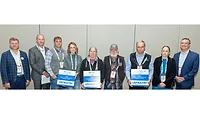
• Virginia Governor’s Environmental Excellence Awards in 2005, targeting eight Smithfield Foods’ subsidiaries, including Smithfield Packing Company, Gwaltney of Portsmouth, Gwaltney of Smithfield and Smithfield Transportation Company
• Gwaltney of Smithfield and Smithfield Transportation Company’s Smithfield Division inducted into the EPA’s exclusive program for companies exceeding routine compliance with environmental laws
• Farmland Foods Inc. wins 2005 Governor’s Iowa Environmental Excellence Award for leadership and innovation in protecting Iowa’s natural resources
• In 2005 ISO 14001 certification achieved governing the operation at each U.S. hog production site and all U.S. processing facilities, except recent acquisitions. The international “gold standard” for environmental management certifies state-of-the-art environmental managements systems that include formalized practices to protect the environment.
Looking for a reprint of this article?
From high-res PDFs to custom plaques, order your copy today!