Watching The Detectors
Watching The Detectors
BY Jennifer Zegler,
contributing editor
contributing editor
Advancements in technology allow for more automation and improved results in metal detection processes.
It may be a hassle at airports and building entrances, but metal detection is an essential part of food-safety measures in the meat and poultry industries. Suppliers are releasing state-of-the-art machinery that allows for more automation — and more importantly — more precise detection. Technology is yielding much advancement to help plants adhere to strict safety regulations.
“Most food today is processed on metal machinery, whether it’s sliced, diced, sieved or mixed,” says Oscar Jeter, national sales manager for Mettler-Toledo Safeline, Tampa, Fla. “The machinery can default. For example, a mixer can swipe the side of a bowl, or a slicer or dicer could knick itself and create big or small pieces. Big pieces … can be seen by the human eye or blocked from production. It’s the small particles that might make their way to the consumer.”
In addition to malfunctions of machinery, metal can come from injection needles, wayward buckshot from hunters or other contaminant sources. Metal detectors have become an essential part of food-safety procedures during the production process of meat and poultry. Checking early and often can decrease the risk of wasted product, lost income and broken machinery, among other benefits.
Construction principles
Similar to the foundation of a building, equipment manufacturers must make sure to use the right materials and design to manufacture a useful metal detector. Meat and poultry safety regulations require that these machines endure rigorous cleaning and regular testing. Companies are answering the call with more rugged, durable machines.
The most fundamental feature for many metal detectors is a stainless-steel construction that can withstand the high-pressure washdowns required for meat and poultry plants. New technology includes welded joists instead of screws for less vulnerability to bacteria.
“The E-Z Tec DSP conveyer aperture units are always manufactured out of stainless steel, not epoxy painted aluminum,” says Ray Spurgeon, assistant product manager of the metal detection division for Eriez Magnetics, Erie, Pa. “When you are processing beef or poultry, and adhering to strict USDA guidelines, you need materials of construction that are robust, [and] easy to maintain and clean.”
Heat and Control’s CEIA THS/3F model is HACCP (hazard analysis critical control points) compliant and enclosed in a 316 stainless-steel case with a very high IP69K rating for resistance to the aggressive washdown procedures required in meat and poultry plants, says Kevin Jesch, product manager of inspection systems for Heat and Control, Hayward, Calif.
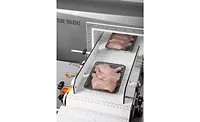
Metal detectors can have a variety of layouts depending on the product being tested. Conveyer belts offer benefits to the manufacturer because they are mainly automated and therefore do not require an operator. In addition to metal detectors mounted on conveyors, CEIA metal detectors are available for every application, including freefalling products, granular products, liquids or slurries, Heat and Control’s Jesch explains. “For pumpable products such as ground meats and sausages, CEIA offers the PL and PLV models in a range of sizes, (where) the product is pumped through the metal-detector head,” he says.
Touchscreen interfaces also are becoming more popular for metal-detection equipment not just because of durability, but also to allow for multiple language formats. Older machines have membrane keyboards that may not stand up over time to the high-pressure cleaning required in meat and poultry plants. New touchscreen technology is not only more flexible, but also adaptable to today’s work environments.
“The E-Z Tec DSP has a touchscreen interface like that on an ATM machine,” Spurgeon explains. “This enables our units to offer multiple languages with the touch of a button. Accordingly, a Spanish-speaking operator could switch the interface to the preferred language. This adds to the comfort level of working with the technology, and it reduces costly operator errors.”
Automatic for the people
Since each plant has different needs, new metal-detection equipment is becoming more sensitive to contaminants. Equipment now includes various options in automation that do not need an operator, including multiple frequency choices and self-testing. In short, metal detectors are becoming more sophisticated.
“(The Power Phase Pro) has a number of features that processors like, including the ability to find smaller particles,” Mettler-Toledo Safeline’s Jeter says. “It is also extremely automatic and has an early warning that will detect electrical problems.”
Multiple frequency options have become popular because a machine can automatically test the conductivity, which can be affected by its temperature or the content of salt, moisture or blood of a product, and choose the right detection frequency for it.
Heat and Control’s most popular machine for meat and poultry production, the CEIA THS/3F horizontal metal detector, has three frequencies and auto-testing options. It will test a product’s conductivity and automatically select the most sensitive frequency from the three available. In order to ensure optimum sensitivity, the machine has Auto Tracking and Auto Learn features that can adjust to accommodate product effect variations due to temperature or conductivity changes during the production run.
Lock Inspection Systems, Fitchburg, Mass., also offers multi-frequency and a product-filtering system that provides maximum sensitivity for a variety of products. “The Lock 3F is popular because of it’s flexibility with various products,” says David Arseneault, national sales manager for Lock Inspection Systems. “This capability gives our customers flexibility to run all of their products today and the ability to adapt to future products.”
Safety regulations often require frequent testing of metal detectors with controlled samples known to contain metal. New technology is allowing for companies to set up a schedule on the equipment which will alert workers when it is time to test. Eriez Magnetics’ E-Z Tec DSP is one such example, explains Spurgeon.
“There is also a calibration or auto-test feature that signals to operators when the detector needs to be tested,” he explains. “[If] the plant has a policy that the metal detectors must be tested every hour, you can set this feature to alert you when it’s time.”
The E-Z Tec DSP also has a self-check feature that automatically checks critical circuits and alerts if not working properly. This feature ensures that the machine is functioning properly between testing intervals, avoiding product quarantine.
Networking
It should be no surprise that metal detectors are following broader technological trends and being made more digital and network ready. The CEIA metal detectors from Heat and Control have complete Digital Signal Processing that allows very high sensitivity to all metals, including stainless steel, by superior filtering of the signal.
Connection to networks is one of the hottest trends in metal detectors because it not only allows for less human interaction, but also automatically tracks detection. Mettler-Toledo Safeline’s newest machine, the Power Phase Pro, includes Ethernet connectivity among other advanced options. “The Power Phase Pro also has the ability to connect to the company’s Ethernet, which allows the company to document the safety measures and record any events so they can keep a complete record,” Jeter says.
Monitoring the equipment is important and an integral aspect of safety regulations, Jesch explains. “CEIA has optional Ethernet availability. With more and more processors implementing supervisory control and data acquisition systems, some plants are now requiring that all equipment be integrated to these networks,” he says.
Another benefit of Ethernet connection is the automation factor that allows the machine to work without constant monitoring from human operator.
“We’re seeing fewer and fewer people on the production floor and more plant automation than ever, which makes it more important for a metal detector to have the ability to communicate with a company’s network,” Spurgeon comments. Eriez’s E-Z Tecs use an external RS 485 interface that allows the detector to be quickly and conveniently connected to a host network. With the accompanying free E-Z Link Software, “Meaningful information can be gathered, stored and used by managers and quality assurance personnel,” he adds.
On the horizon
One technological advance looming large over the metal detector landscape, currently populated by radio frequency machines, is X-ray technology. X-ray machines offer the detection technology and benefits that traditional metal detectors may not.
“X-ray doesn’t have the problem of having to be tuned down in sensitivity because of the high iron content in blood, so we can find smaller contaminants,” explains Steve Dowd, FA product manager at Smiths Detection’s Product Inspections Division, Alcoa, Tenn. “X-ray can also perform weight calculations, foreign object detection, such as bone, glass, stone and fat analysis. These combined benefits mean smaller space is needed to perform multiple tasks with better results than conventional metal detection.”
Smiths Detection uses X-ray technology in innovative ways, such as the aforementioned ability to analyze fat content in meat. “We have a new bulk-meat fat-analysis system that can determine the fat content in loose meat on the belt,” Dowd says. “The system is capable of weighing the meat as it passes through the system and [calculating] a chemical lean value for a customer determined batch.”
With technology moving quickly toward “added-value” types of metal-detection equipment — machines that can handle multiple processes and analyses — consumers can feel safe that their meat and poultry products will be free of dangerous foreign objects. And the next time they’re pulled aside at an airport or building entrance, they can thank the suppliers of metal detectors for keeping them from biting into metal in their meats as well. NP
Looking for a reprint of this article?
From high-res PDFs to custom plaques, order your copy today!