
Meat Industry Hall of Fame: Class of 2024's Barb Masters reflects on induction
During summer 2025, the Meat Industry Hall of Fame welcomed Barb Masters, D.V.M., Tyson Foods vice president for regulatory policy, food and agriculture, into the Class of 2024.
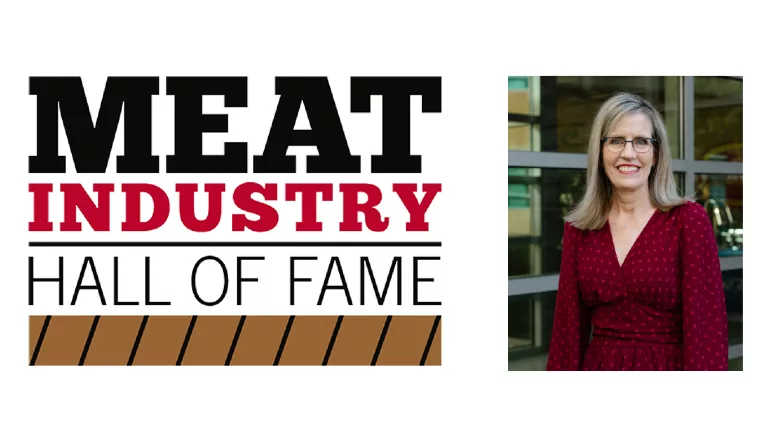
Barb Masters, D.V.M., Tyson Foods
The Meat Industry Hall of Fame Class of 2024 featured the following inductees:
- Barb Masters, D.V.M., Tyson Foods
- H. Glen Dolezal Jr., Cargill, retired
- Robert Meyer, Meyer Natural Foods
- Frederick Usinger IV, Usinger Inc.
- Roger H. Ball, King B Jerky/Golden Valley Natural Jerky
- Craig W. Hess, Speco Inc.
Barb Masters is the vice president for regulatory policy, food and agriculture at Tyson Foods. She provides regulatory vision and support across the business enterprise at Tyson Foods.
Masters came to Tyson from Keystone Foods, where she served as the global vice president for food safety and quality.
Prior to joining Keystone Foods, she was a senior policy advisor at OFW Law. Before joining the firm, Masters spent 17 years at the USDA's Food Safety and Inspection Service. She held a variety of positions throughout the agency, both in the field and at headquarters, including serving as an in-plant inspector and the administrator for the agency.
Masters graduated from Mississippi State University with a Doctor of Veterinary Medicine in 1987 and served in a food animal internship at Kansas State University in 1988. She continued to further her education by taking advanced coursework in biotechnology at Texas A&M University.
Masters served on the nominating and foundation committees for IAFP, and she received the Silliker Lecture Award from the association in 2021. She serves on the Beef Industry Food Safety Council and was chair in 2021. Masters is also an active member of the Partnership for Food Safety Education, serving as chair of the board. She is a past member of the Steering Committee for the Global Food Safety Initiative, and a past member of the American Veterinary Medical Association.
Masters received the Food Safety Magazine Distinguished Service Award in 2007, and the Mississippi State Alumni Fellow of the Year for 2004.
Masters' publication contributions include "Advantages of Traceability Beyond Connecting Consumers to Their Food," CIOReview. Masters and Williams, 2022; "The Direct Relationship Between Animal Health and Food Safety Outcomes," CAST Commentary, Hurd, Masters, Mathew, Oliver, Preston, and Singer, 2012; "Food Safety and Inspection Service Update on Food Safety of Animals Derived from Biotechnology," Journal of Animal Science, 1993; "Physical Examination of Swine," Veterinary Clinics of North America Food Animal Practice, July 1992.
Masters said her passion throughout her career has been teaching and stakeholder collaboration.
The National Provisioner spoke with Barb Masters to follow up on her induction into the Meat Industry Hall of Fame, exploring how the recognition has impacted her on both a personal and professional level.
Looking back on your induction into the Meat Industry Hall of Fame, what did the recognition mean to you both personally and professionally?
Barb Masters: I couldn’t be more honored—or humbled—to be inducted into the Meat Industry Hall of Fame. While the recognition is deeply meaningful to me, I view it not as a personal accolade, but as a tribute to the many incredible colleagues who have shaped my journey. This industry is truly a team sport, and I’ve had the privilege of working alongside some remarkable teams.
On a personal level, it was especially meaningful to share this moment with my family. They’ve sacrificed weekends, dinners, and vacations while I dedicated time to this work. I’ve always made a point to share stories with my daughter so she could understand the importance of what we do in this industry. When she heard about the honor, she began recalling many of those stories and the roles I’ve played—and that moment meant the world to me.
Reflecting on your career, what pivotal moments or decisions do you feel were most influential in shaping your journey in the meat industry?
Barb Masters: I often say I was either in the right place at the wrong time—or perhaps the wrong place at the right time. My career has been shaped by a series of high-profile events and the bold responses that followed. Each challenge became a turning point.
From the devastating E. coli O157 outbreak that led to the development of HACCP regulations—where I had the opportunity to help write the rules, develop training, and support the industry through a dedicated hotline—to the infamous "cow that stole Christmas," which spurred critical regulations around specified risk materials. I was also involved in the response to the massive Listeria outbreak linked to lunchmeats, helping shape the regulatory framework that followed. Beyond domestic issues, I’ve had the privilege of traveling internationally to support market access negotiations, and more recently, working to keep facilities operational during the pandemic to ensure food security.
What continues to amaze me is the courage and decisiveness of industry leadership and the resilience of our teams. Time and again, challenges have been transformed into opportunities—and that’s what has truly defined my journey.
What lessons or experiences have been most rewarding as you’ve grown in the industry?
Barb Masters: The most rewarding aspect of my journey has been witnessing—and being part of—the unwavering determination and persistence across the entire industry. No matter the challenge, this industry consistently finds a way forward, united by a shared commitment to ensuring the availability of safe, wholesome food for people around the world. That collective resilience and purpose is what makes this work so meaningful.
Over the years, how have you seen the meat industry evolve, and what trends or changes excite you most today?
Barb Masters: The meat industry has undergone tremendous transformation over the course of my career. We've moved from reacting to food safety crises to proactive, science-based systems that prioritize prevention and transparency. The evolution of HACCP, the integration of advanced microbiological tools, and the industry's ability to adapt during global events like the pandemic all reflect a growing resilience and sophistication.
What excites me most today is the increasing collaboration across disciplines to address a growing emphasis on areas such consumer trust, health and wellness and use of technology to drive improvements - all of which are shaping how we produce and communicate about food.
What advice would you give to the next generation of industry leaders who aspire to make a meaningful impact?
Barb Masters: One of the most remarkable things about our industry is how many different roles contribute to its success. From plant floor workers, supervisors, mechanics, sanitation teams to microbiologists, food scientists, veterinarians, researchers, administrative support, economists, lawyers, farmers and ranchers, animal welfare experts, regulators, and consumer advocates—every role matters.
To future leaders: recognize that meaningful impact comes from collaboration. It takes all of us, working together, to move the industry forward. Regardless of your specific role, by showing up as your best self and valuing the contributions of others, you help ensure that our industry continues not just to be strong—but to be the very best.
Looking for a reprint of this article?
From high-res PDFs to custom plaques, order your copy today!



