A little help from some carbs
For all the hype that low-carb dieting received during the past decade, you would think that center-of-plate proteins would avoid carbohydrate ingredients in order to not tarnish their good name. But many processed meat and poultry products cannot do that, as they rely on select carbs to assist with improving yield and ensuring product quality throughout shelf life.
|
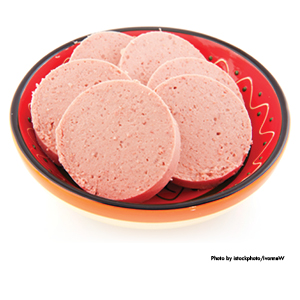
In particular, the increasingly popular category of pre-packed, deli-style sliced meats not only requires good sliceability, but moisture control is imperative, as the natural juices and marinade must stay in the meat and not weep out into the package. This is where select gums and starches are quite useful.
These carbohydrates belong to the broad ingredient category called hydrocolloids. The primary function of all hydrocolloids is alluded to in the name, where the prefix “hydro” means water and “colloid” means a gelatinous substance.
Some hydrocolloids form thermo-reversible gels, where gelation occurs after the hydrocolloid dissolves in solution and is cooled. When heat is applied, the gel melts or dissolves. This is best exemplified by gelatin dessert, which melts in the mouth at body temperature. Gelation temperature and melting point varies by hydrocolloid.
Others hydrocolloids form non-thermo-reversible gels, also called thermally irreversible gels, and will not liquefy when heated. They may soften or shrink, which is also referred to as retrograde. In other words, the gel remains mostly intact once formed.
There are also some hydrocolloids that do not form any type of gel on their own, but will do so in the presence of other compounds. The challenge is in finding the right balance between the different gelling characteristics. This allows for products with superior moisture retention and desirable mouthfeel and texture.
One of the more common gums used in processed meat and poultry is carrageenan. Derived from red seaweed, there are three different types of carrageenan: kappa, iota and lambda. They differ in their chemical structure, which impacts their ability to develop viscosity and form gels.
For example, kappa-carrageenan, the most common type to be used in processed meat products, requires heat to dissolve into solution. Upon cooling, it forms a very firm, brittle gel structure, which contributes to good sliceability. Iota carrageenan also requires heat but produces a softer gel, which results in the type of spreadable consistency one would expect in an emulsified product such as pate or liver sausage. Lambda carrageenan, which is cold-water soluble, is the least likely to be used in processed meat, as it is incapable of forming a gel on its own. It can, however be used to control viscosity in emulsified and formed products.
Based on the application and desired finished product characteristics, ingredient suppliers will often blend the three carrageenans to achieve the desired results. In the United States, there is no distinction on how the three types are declared on ingredient statements. The hydrocolloid is simply known as carrageenan.
Xanthan gum, which is produced by microbial fermentation, is a non-gelling hydrocolloid. It hydrates rapidly in cold water to give a reliable viscosity, with a little going a long way. Its consistent water-holding ability makes it a very effective tool for controlling syneresis. When used in combination with carrageenan, xanthan contributes synergistically to the formation of a thermo-reversible gel, meaning that less carrageenan is required to form the gel.
Guar gum, which is obtained from plant seeds, will disperse and swell almost completely in cold water to form a highly viscous solution. Like xanthan, it is not self-gelling. Guar gum has an extremely high water-binding capacity, which also makes it an attractive additive to meat products.
Gum solutions are mostly pseudoplastic, which means viscosity reduces with agitation or shear, and then returns to the same thickness when it is still. Depending upon the application, this may or may not be useful.
In general, native starches form non-thermo-reversible gels and will retrograde over time, which results in syneresis. Hence, historically modified food starches have been used to enhance processed meat, as modification adds stability and resistance to retrogradation and syneresis. With the trend towards cleaner labeling, formulators are revisiting the use of native starches in their tumbled and pumped products and have found that new and improved options exist.
In particular, native waxy rice starches are being used in a number of pre-packaged, deli-style lunch meats, alone or in conjunction with other hydrocolloids. They have excellent water-binding capacity, a very fast thickening speed and creamy mouthfeel, qualities attributed to the starch’s small granule size. The granule size of rice starch is 2 to 8 microns, which is much smaller than other commonly used starches such as corn (15 to 25 microns), tapioca (20 to 35 microns) and potato (15 to 100 microns.) Using native waxy rice starch helps to eliminate the gel pockets and “tiger striping” that can be associated with other starches of a larger granule size. The petite size of the granule enables it to better penetrate and bind water deep within the muscle fiber.
Just remember, depending upon the application, sometimes a synergistic blend of hydrocolloids provides the most desirable gel, as well as enhanced water-binding properties. The latter is particularly important in comminuted meat products and vegetarian analogs. Further, hydrocolloids have a greater impact on low-fat products, where the retained moisture contributes to juiciness and mouthfeel, two attributes that suffer when fat is reduced. Visit us at IFT Booth #7219
Looking for a reprint of this article?
From high-res PDFs to custom plaques, order your copy today!