-300x215-wht-border.webp?t=1774048870)

The Green Light: New Data Shows 12-to-1 Support for Pork from PRRS-Resistant Pigs
New consumer intelligence conducted by Decision Analytica Consulting, LLC, reveals that the market for pork from Porcine Reproductive and Respiratory Syndrome (PRRS)-resistant pigs is significantly more receptive than traditional food-tech "backlash" narratives suggest. As one of the most economically devastating viruses in global pork production, PRRS cripples herd health and inflates input costs through increased mortality and antibiotic reliance. But PRRS resistance can be achieved by precisely removing a specific portion of a gene in pigs’ DNA, while maintaining no difference in growth and meat quality compared to other hogs.
The hurdle has never been the science of production, but the specter of consumer rejection. I have witnessed firsthand how selective interpretations of prior consumer research, including commentary of my own peer-reviewed studies, have contributed to exaggerated assumptions of broad consumer backlash, even when the underlying data reflected far more nuance and openness than critics often acknowledge.
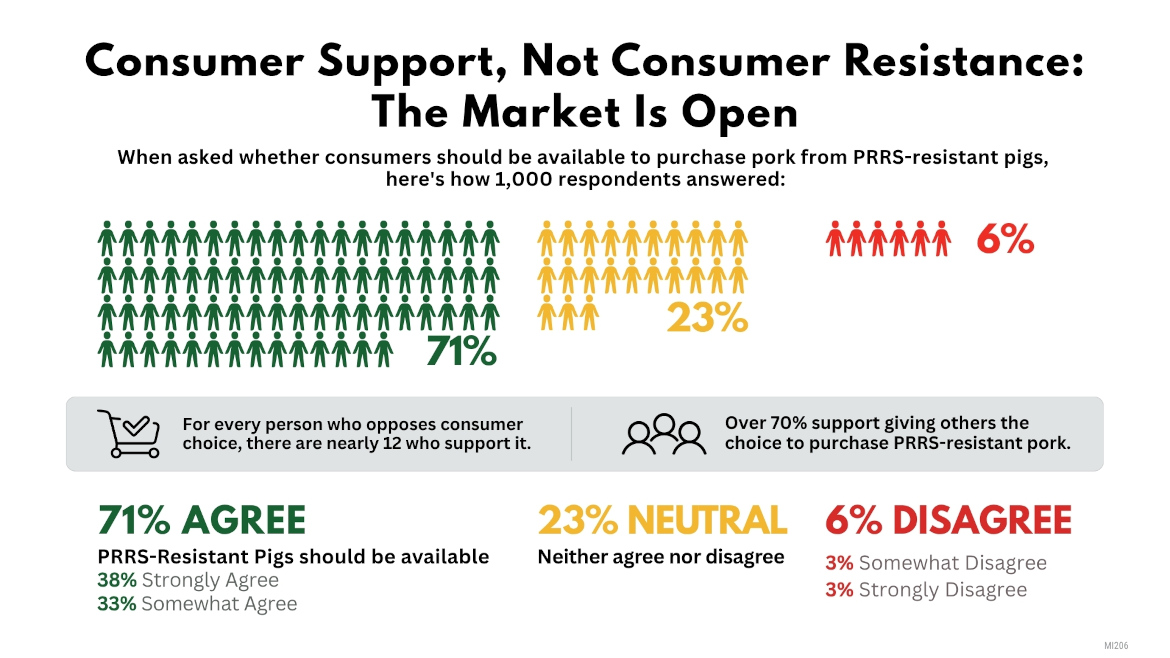
Infographic was produced by PIC
For more than a decade, my research as a behavioral scientist has focused on risk perception, public trust, and emerging technologies, particularly how consumers interpret biotechnology in food and agriculture. This work has included collaborations with leading universities, federal partners, the National Academies of Sciences, Engineering, and Medicine, and international efforts tied to NATO initiatives on biotechnology development and responsible innovation.
New research reflects a notable shift in consumer openness to gene editing in food
More than five years ago, I authored some of the first peer-reviewed academic studies that systematically examined the public’s willingness to eat or purposefully avoid gene-edited foods. At that time, gene editing was still largely unfamiliar to most Americans, and public understanding of the technology was heavily shaped by decades of highly visible GMO debates. This newest research reflects a notable shift. Consumers are increasingly evaluating products like the PRRS-resistant pig through practical questions about animal health, food affordability, sustainability, and consumer choice rather than reflexive opposition to the technology itself. Over multiple years of research, one finding has remained remarkably consistent: consumers rarely respond to biotechnology based on technical science alone. They respond to whether the product feels useful, understandable, trustworthy, and aligned with the values and expectations they already hold about the food system. While the industry has historically operated under a cloud of assumed opposition, data from this new study of 1,000 U.S. pork consumers gathered in April 2026 suggests that such caution may actually be distorting commercial decision-making.
Consumers broadly support making PRRS-resistant pigs available
With 71% of respondents agreeing that consumers should be free to purchase PRRS-resistant products, the support-to-opposition ratio stands at a staggering 12-to-1. Only 3% of consumers polled express firm opposition, signaling that "consumer resistance" is more of a ghost story than a market reality and is certainly not the dominant market signal. Instead, consumers are clearly aligned around the principle of choice and broadly support making pork from PRRS-resistant pigs available for those who want it.
From my perspective, this reframes the commercialization playbook. Typically, in markets where opposition is strong, companies are forced into defensive communication and risk containment. In markets where support is already established, the task is different: building familiarity through proactive engagement, reinforcing confidence, and allowing adoption to develop over time. These data suggest that pork from PRRS-resistant pigs falls firmly into the latter category.
For the pork supply chain, this is significant. Perceived consumer backlash has long functioned as a gating constraint, often slowing adoption before products ever reach the shelf. Packers, processors, retailers, and foodservice operators tend to treat consumer uncertainty as a material commercial risk. The survey results indicate that this risk remains relevant, but it should not be overstated. The more immediate priority is clarity and coordination: ensuring consistent messaging across the value chain, addressing practical questions from downstream partners, and reinforcing a simple principle for consumers that the product is no different than other pork.

© Adobe Stock/Andrey Bandurenko
Firm opposition represents only 3% of the market
For industry stakeholders across the pork value chain, these data yield several high-stakes conclusions that reshape the conventional wisdom regarding consumer acceptance. The most striking revelation is the marginality of the opposition; the total percentage of disagreement sits at a mere 6%, with firm opposition representing only 3% of the market. This suggests that the vocal "anti-tech" contingent is far smaller than many industry risk assessments have historically assumed.
Furthermore, the findings highlight a substantial "movable middle" composed of the 23% of the public that remains neutral. This segment represents the primary frontier for the industry, offering a clear opportunity to build confidence through active listening and engagement to address their values and needs that form a definitive stance. This openness is anchored by a large majority of respondents who firmly support the availability of PRRS-resistant products, providing a solid foundation of early adopters.
Reducing the burden of PRRS has considerable economic, animal health, and environmental implications, including estimated reductions in greenhouse gas emissions, alongside reduced antibiotic use and improved resource efficiency. Such benefits position PRRS-resistant pigs not as a new category of pork, but as an improvement within the existing pork production system. I believe these implications are primary drivers of public optimism and desire for making pork from PRRS-resistant pigs available in the market, reflecting a broader tendency for consumers to evaluate biotechnology through shared values and practical benefits.
The primary challenge facing the sector is not the threat of consumer rejection
While the data provides a green light, the path toward full commercialization should remain a deliberate and phased process. Although regulatory hurdles for the underlying technology have been cleared within the United States, the industry is wise to align its rollout with the complexities of global trade and the practicalities of supply chain readiness. This gradual phasing should not be viewed as a sign of hesitation or a response to market constraints; rather, it is a strategic advantage. By introducing the product incrementally, the industry gains the necessary bandwidth to address technical questions from retailers and processors while allowing consumer engagement and confidence to mature at a natural pace.
In an environment where active resistance is low, but product familiarity is still being established, this measured exposure is the most effective way to ensure long-term stability. Ultimately, the data indicates that the primary challenge facing the sector is not the threat of consumer rejection, but the logistical precision required for a coordinated rollout and the maintenance of clear, consistent communication throughout.
Taken together, the evidence supports a clear conclusion that the U.S. consumer market is supportive of pork from PRRS-resistant pigs. It is signaling openness for its introduction under a framework of safety and benefits. For industry stakeholders, this reframes the path forward. Success will depend less on persuading a skeptical public and more on reinforcing a simple proposition: the product performs as expected, fits within existing consumption patterns, and is available for those who want it. The market signal is clear— consumers are not closing the door. They are holding it open and the industry now determines what happens next.
*All opinions expressed are those of the author alone and do not represent the views of any institution, agency, or organization with which he is affiliated. For more information on Dr. Cummings’ work visit: decisionanalytica.org
Looking for a reprint of this article?
From high-res PDFs to custom plaques, order your copy today!