Processor of the Year
2016 Processor of the Year: Foster Farms
Innovation, investment and major expansion have helped Foster Farms catapult itself from a regional poultry leader to a high-flying national contender.
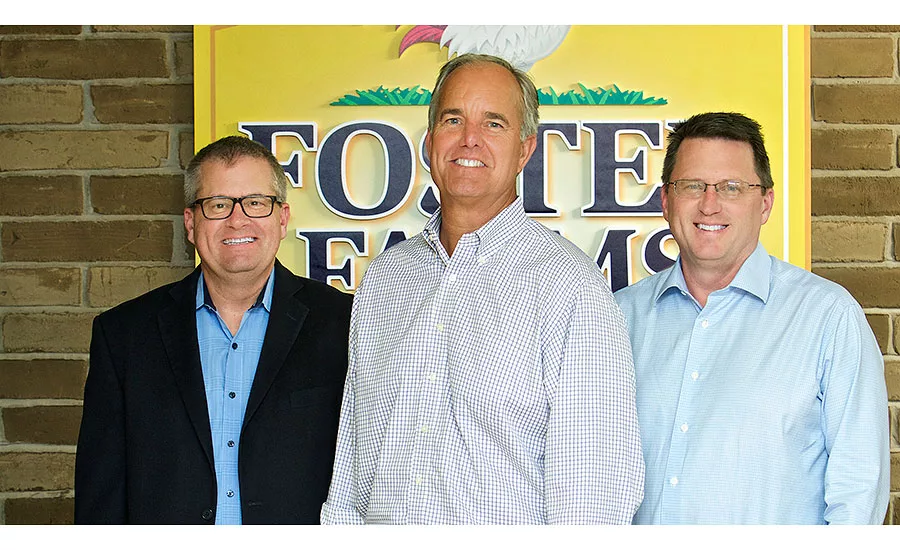
Dave Hansen, group vice president, Retail Sales; Ron Foster, president and CEO; and Dan Huber, COO; of Livingston, Calif.-based Foster Farms
PHOTO COURTESY OF FOSTER FARMS
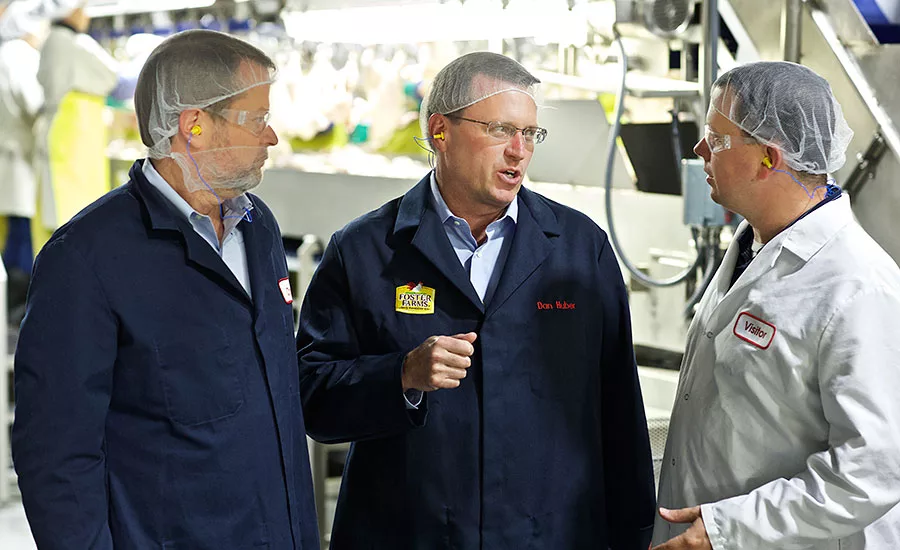
Chris Carter, vice president of operations, and Dan Huber, COO, discuss the renovations at Foster Farms’ Livingston, Calif., processing facility, with Andy Hanacek, editor-in-chief of The National Provisioner during his visit to the plant.
PHOTO COURTESY OF FOSTER FARMS
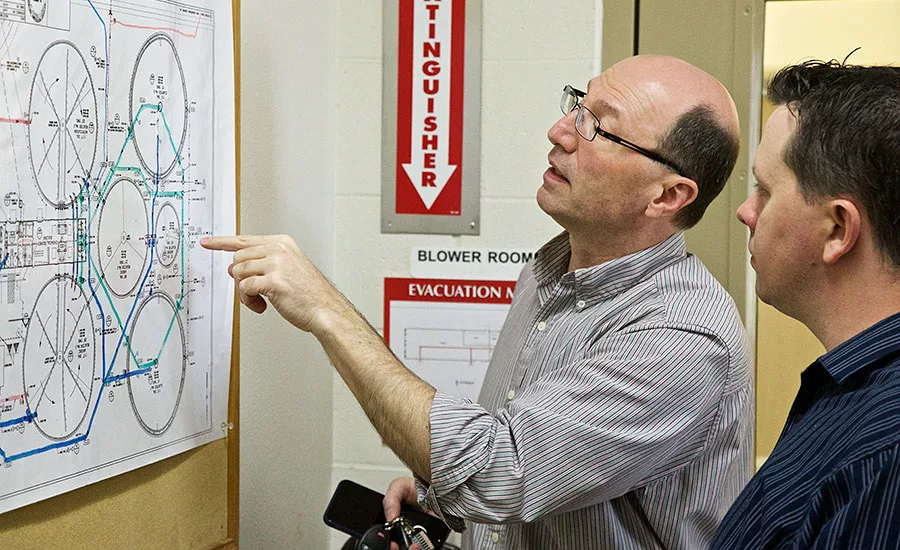
James Marnatti, director of Environmental Affairs for Foster Farms, walks Hanacek through the schematic of the BNR (biological nutrient removal) system built to treat the Livingston facility’s wastewater, which is then recycled and reused, allowing the company to reduce its water consumption in drought-stricken central California.
PHOTO COURTESY OF FOSTER FARMS
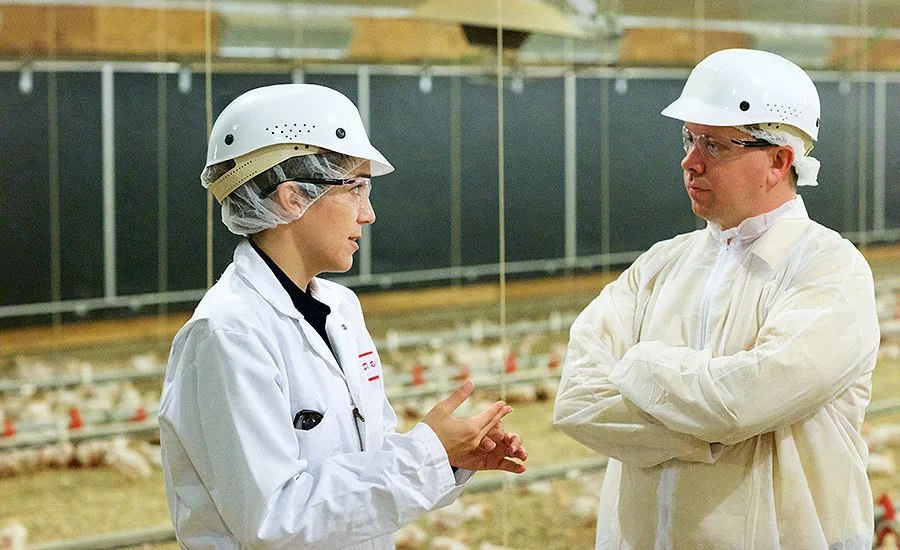
Hanacek tours a Foster Farms organic chicken house with Diana Robinson, superintendent for Foster Farms, during his visit to several Foster Farms’ California facilities in April 2016.
PHOTO COURTESY OF FOSTER FARMS
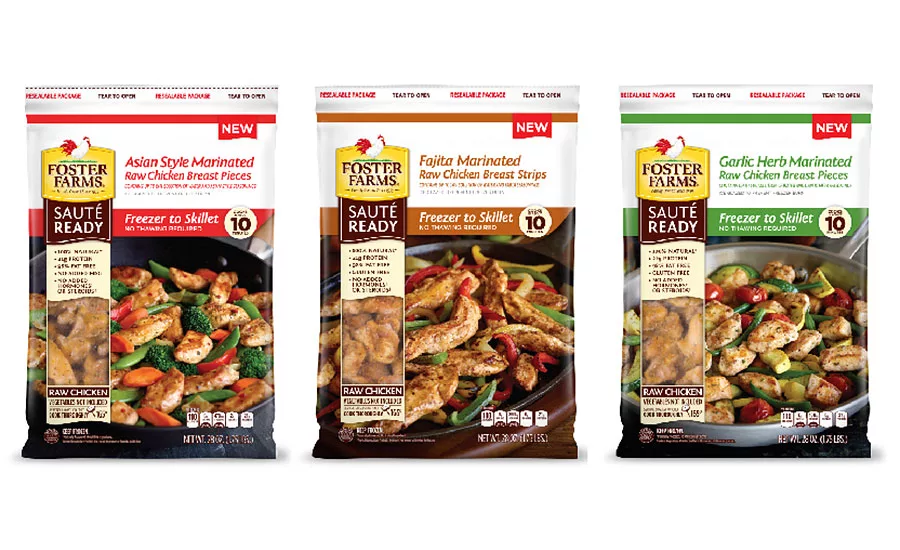
In September 2015, Foster Farms launched Sauté Ready, a pre-cut and pre-marinated, ready-to-cook frozen chicken product that goes from freezer to skillet and is ready to combine with pasta, vegetables or other ingredients to make a meal.
PHOTO COURTESY OF FOSTER FARMS
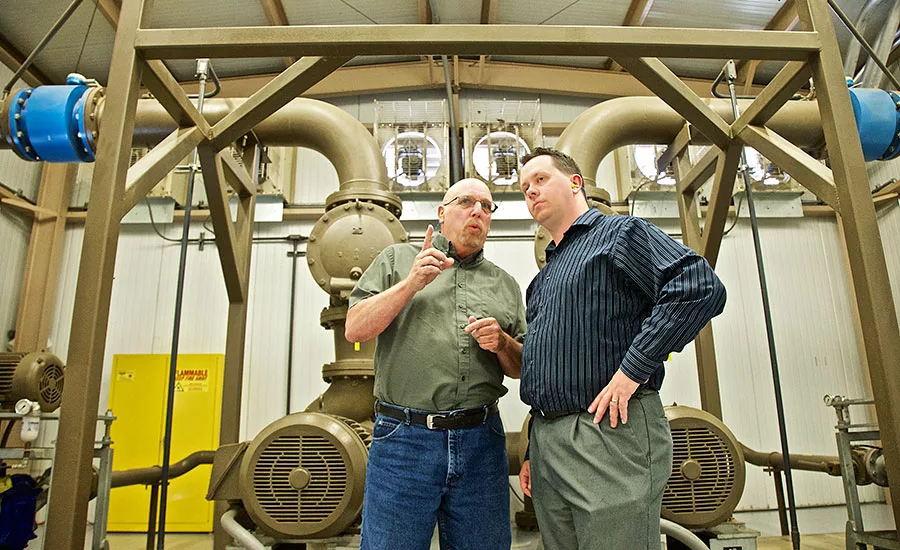
Dan Chaffee, director of Engineering and Construction for Foster Farms, explains to Hanacek the inner workings of the BNR system at the Livingston plant.
PHOTO COURTESY OF FOSTER FARMS
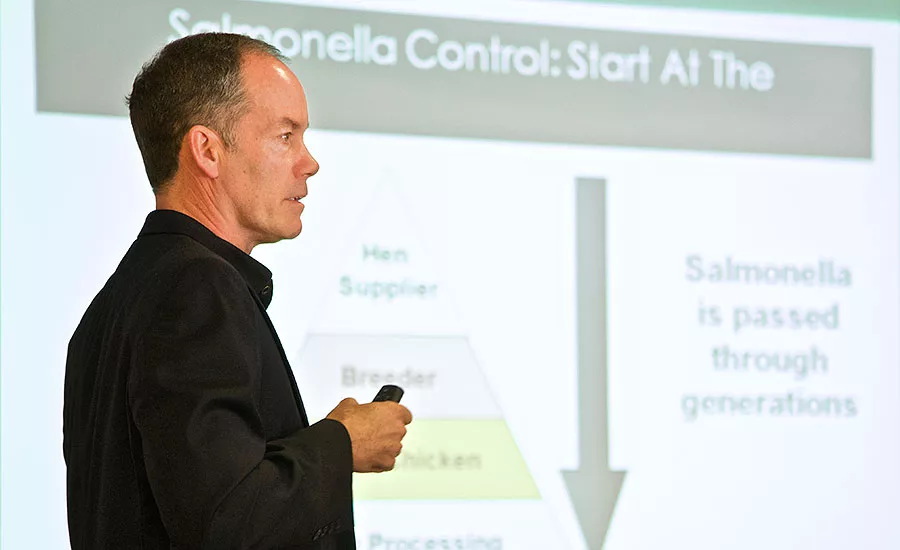
PHOTO COURTESY OF FOSTER FARMS
A new chapter can be written in the playbook of the meat- and poultry-processing business — how to stay the course and drive a positive, swift-but-methodical, major expansion of business in spite of a highly publicized foodborne illness outbreak.
In the summer of 2014, as Livingston, Calif.-based poultry processor Foster Farms was wrapping up its work to further enhance its food-safety programs, Ira Brill, director of communications, told The National Provisioner (published in October 2014): “Foster Farms cannot be a leader in some areas. It has to be a leader in all areas.”
Additional Content:
Video interview with Ira Brill - Watch Now
Q&A with Bob O’Connor - Read Now
That statement could have served as an unofficial rally cry for the next 18-24 months, during which Foster Farms aimed to complete an immense transition from a regional poultry leader to a national contender. It had already developed, and in many cases implemented, significant plans to innovate, invest and expand the company’s leadership role in several areas: frozen cooked chicken, corn dogs, and organic and antibiotic-free chicken. The multifaceted battle plan expanded fresh organic and antibiotic-free product offerings in the western U.S., and frozen cooked product nationwide. Additionally, the company entered the breakfast category with new products serving consumers’ needs.
Foster Farms had begun to aim farther than it had in the past — catapulting itself eastward. Ron Foster, president and CEO, whose grandparents founded the company 77 years ago, says the approach wasn’t different, but the boundaries were.
“Our company has always looked at how to satisfy consumer needs [and] wants,” Foster explains. “It’s just taking what we’ve done with success historically and expanding the reach of it. Our intention is to grow our branded products across the United States.”
Foster Farms is now the No. 1 brand in the West across all three fresh tiers — conventional, organic and antibiotic-free; a top-selling corn dog brand; and the No. 1 frozen cooked chicken brand in the West, with national distribution steadily increasing.
The success of the company’s ambitious journey to category and industry leadership and overall excellence has earned Foster Farms the distinction of being named The National Provisioner’s 2016 Processor of the Year.
Four primary initiatives have driven Foster Farms on its journey: (1) strategic and rapid growth of product lines and national distribution, (2) massive investment of more than $120 million in product, process, operations and food-safety infrastructure at all facilities, (3) innovative initiatives in water conservation at its facilities in the face of the devastating California drought, and (4) continued sharp focus on setting the gold standard in food safety.
“Foster Farms cannot be a leader in some areas. It has to be a leader in all areas.”
Ira Brill
Building out
The company’s steady innovation and infrastructure changes combined with new distribution opportunities helped catapult national growth of its frozen and prepared product lines and expansion east — with support of dedicated television advertising — into previously unchartered markets. Dave Hansen, group vice president, Retail Sales, says three key catalysts have spurred the success of the brand thus far.
“We’ve added employees on the eastern side of the U.S., who came with strong CPG backgrounds and a lot of knowledge, especially around the fixed-weight side of the business,” he says. “Our product quality speaks for itself on our corn dogs and the fully cooked frozen chicken products we’re marketing out east, and our service levels are among the best in the industry.”
While there have been several successes within these segments, two innovative new product lines have stolen the show thus far.
In September 2015, Foster Farms launched Sauté Ready, a pre-cut and pre-marinated, ready-to-cook frozen chicken product that goes from freezer to skillet and is ready to combine with pasta, vegetables or other ingredients to make a meal. Greta Remington, director of Innovation, explains that Foster Farms was aiming high during product development — building upon popular trends rather than simply mimicking what others had done.
“We didn’t want to go to market with the 18th skillet meal out there, and we don’t make vegetables or rice, [which] are expensive to source from the outside,” she says. “So we said, ‘Let’s just take the frozen chicken breast and reinvent that.’”
Also in 2015, Foster Farms pushed its way into the frozen breakfast segment, introducing two Sausage and Pancake Wraps products. Remington says the breakfast items meet several demands from a variety of sources.
“The Sausage and Pancake Wrap [represented] a perfect lineup of giving consumers a better-tasting product that was cleaner and with lower fat, giving category buyers another product to compete in the category and fitting perfectly well within our corn dog operation,” she explains. Remington and Hansen each mentioned the excitement around future product launches, and Hansen believes innovation will continue to drive Foster Farms’ approach.
“First, what you see from Sauté Ready in terms of innovation, more of that will come over the next several years in multiple categories throughout the store,” he says. “Second, expansion will not only leverage the brand for product in the west, but also drive those products east. Finally, I see the no-antibiotics-ever and organic, fresh side of the business continuing to grow at double-digit-plus rates for several years to come.”
Building within
Foster Farms’ successful expansion of its product lines and distribution footprint has been supported by massive operational upgrades and expansions across the board. In the last 18 months, Foster Farms has invested more than $120 million in facility operations and equipment upgrades companywide.
This includes a stem-to-stern, $50 million renovation of the Livingston flagship facility. Dan Huber, chief operations officer, says employees had squeezed every possible measure of improvement out of the equipment in Livingston, and it was time to take the next step forward.
“As we started dialing in deeper to some of the [food safety] performance we were trying to achieve, we saw some areas where we could have better control of some of the processes,” he says. “And it has helped with efficiency, quality and food safety — really, it has helped across the board.”
Capital investment hasn’t stopped now that the Livingston project is finished. Foster Farms is currently building an organic feed mill to support anticipated growth in organic chicken (a segment in which the company has made enormous strides in the past year-plus — and which was covered in the July 2015 issue of The National Provisioner).
“As an organization, we’re very proud of our people and our facilities.”
Ron Foster
Meanwhile, Belgravia (in Fresno, Calif.) was undergoing upgrades at presstime, and plans are in place to renovate and retool the Cherry (also in Fresno), and Kelso, Wash., fresh processing plants to increase efficiency, improve yields, lower costs and automate where applicable to address a tightening labor market. Finally, planned line expansions at the Farmerville, La., and Porterville, Calif., plants will address further anticipated growth in the cooked and frozen segments.
Sustainable and safe
On the environmental side of things, Foster Farms stared down yet another serious obstacle and then toppled it, undertaking an aggressive series of water-reduction initiatives in the face of increased production volume and increased pressure around implementing excellence in food safety and sanitation. According to the company, those initiatives collectively achieved an estimated 20-25 percent reduction in water use from the company’s 2013 baseline.
Dan Chaffee, director of Engineering and Construction, says the project began with an extensive installation of 52 water meters at different points in the process and areas in the plant.
“This complex has three city wells feeding it, and they’re metered, but our goal was to be able to understand exactly what water is being used where,” he explains. “You could look at the three main meters and say we saved 10,000 gallons a day, but you wouldn’t understand what drove [the reduction], how it was accomplished.”
The ability to drill down to specific initiatives that saved water was “huge,” Chaffee says, but an additional investment at the Livingston plant helped push the water-reduction results even higher, says James Marnatti, director of Environmental Affairs.
“We’re constantly evaluating water quality, and we realized that we needed to build a facility that would allow us to manage our water discharge,” Marnatti says. That facility is a biological nutrient removal (BNR) system, which treats the wastewater from the plant and brings its quality up to California Title 22 levels (meaning the water can be reused or recycled in specific ways). Chaffee mentions two projects under way to further water-conservation efforts based on the BNR’s capabilities.
“One is what we call process water reuse, where we take water from our final [inside-outside bird wash] — which is very clean water — and we move that way back down the system internally, reusing that water in the process in the plant,” he says. “The second is what we call ‘purple water,’ which [meets Title 22] but is not good enough to drink. Our goal is to reuse all that water in non-food-contact applications.”
Chaffee and Marnatti add that the BNR and water-reuse programs have worked so well that the company occasionally has had to search for and reassess discharge uses for all the recycled water it has produced.
Even more impressive, despite using less water — possibly the most crucial component to sanitation in any facility — Foster Farms has kept its food-safety programs blazing along and succeeding. The National Provisioner has reported previously on Foster Farms’ attitude shift around food safety and the capital investment in it following the 2013 outbreak. Still, the company continues to push the standard of food safety higher, in the interest of setting a higher benchmark of success on behalf of the industry (see “Unrelenting food-safety commitment” for more details).
The road ahead
Ron Foster believes the organic and antibiotic-free lines could see a positive bump as they are pushed out to foodservice and prepared, value-added segments. And as Foster Farms continues to grow its brand out east, Foster says the processor is likely to require additional facilities in various locations across the country — but he has the confidence that Foster Farms employees, who have dedicated themselves to conquering new frontiers, will be able to guide Foster Farms down the right path.
“As an organization, we’re very proud of our people and our facilities,” Foster concludes. “We’ve been tremendously blessed by having many employees spend their entire careers helping us build and grow our business. Our people are crucial to our success and we embrace employee tenure with the company.” NP
Ira Brill, director of communications for Foster Farms, discusses the transformation the company has made over the years. Read the full interview.
Unrelenting food-safety commitment
During his visit to Foster Farms, editor-in-chief Andy Hanacek spoke with Bob O’Connor, senior vice president of Technical Services, discussing the company’s ongoing commitment to food-safety leadership, as well as O’Connor’s vision for Foster Farms’ next steps.
What follows is a portion of their conversation:
Hanacek: Has Foster Farms reached any recent milestones or made any major advancements in food safety, beyond what was instituted after the 2013 Salmonella outbreak?
O’Connor: We moved out of the outbreak, but we also still have a goal of being five percent or less prevalence on our Salmonella parts. The USDA standard … is approximately 15 percent, but we have not given up on that goal. I would also say, we are still acting differently than the rest of the industry in terms of interventions, and that’s not an exaggeration. We spend a lot of money on the live side and do things there that others don’t do. For example, we vaccinate our broilers for Salmonella. I don’t know any other company that’s vaccinating broilers for Salmonella. People vaccinate their breeders, their breeder pullets — and we definitely do that — but we’re vaccinating our broilers. … And we’re still investing in interventions.
Hanacek: Is the majority of Foster Farms’ intervention efforts right now focused on the live side versus the processing side?
O’Connor: We focus on both — live and processing. You absolutely have to put a lot of focus on [both]. My vision of where I want to be on the live side is, I would like a diagnostic test that enumerates the Salmonella in a poultry house prior to us processing that house. That’s not a test for prevalence, that’s not presence or absence — that’s easy to get today — but on the live side, there’s not a good, quick, almost real-time diagnostic test to predict how much Salmonella that ranch or house may be bringing into the processing plant. If a processor knew that, it could modulate up or modulate down some of the interventions. People might think that you never want to modulate down, but why overuse interventions and antimicrobials if they’re not absolutely necessary? The flip side is, if you know you have what I would call a “hot” house, well then you’d better turn [every intervention] on. With [two vendors], we are in the process of developing that diagnostic tool to enumerate Salmonella on the live side, and I think within about a year we might have that tool.
Hanacek: Can you give an example of something that was improved based on the Food Safety Advisory Board’s observations or suggestions?
O’Connor: One area we want to improve is the traceability on the live side from the pullets, to the breeders, to the hatchery, to the broilers, and ultimately to the plant. Mike Doyle of the Center for Food Safety is on our Food Safety Advisory Board, and he has a researcher (Xiangyu Deng) that put a lot of work into a project that involved whole genome sequencing on the live side. That was one thing we wanted to actually look at: What were the connections from a whole genome sequence standpoint between pullets, breeders, hatchery and broilers?
Hanacek: What was the biggest lesson learned from that project?
O’Connor: Everybody theoretically talks about [the connection between the live side and processing], but this absolutely proved it. We were able to look back retrospectively on Salmonella Heidelberg and look at that flow from a whole genome sequence perspective, such that it was, in a sense, a fact, versus me saying theoretically Salmonella flows from the breeders to the hatcheries. This showed it to be a fact.
Hanacek: Has Foster Farms continued to share its findings with industry?
O’Connor: Some of the problems that we have to solve are much more complex than others would like to think. We can’t change things necessarily overnight, but all of us are working together. I’m very open about just sharing what we learned from our outbreak, and what we did to get out of it, and my colleagues in the industry have been very supportive as well. There are good people working in food safety at poultry companies in the U.S.
Looking for a reprint of this article?
From high-res PDFs to custom plaques, order your copy today!