Production Tech: Adding value
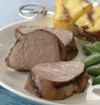
Value-added meats have become a favorite of consumers. And a couple of processes that helps take advantage of that demand are injection and marinades.
The benefits are well known. Both methods add flavor, can add tenderness to the meat and help products stand out.
Injection and marinades can also benefit foodservice, says Mark Seyfert, senior food technologist at Bob Evans Farms of Columbus Ohio.
“Until my current position, I never realized the importance of this technology to foodservice,” he says. “Again, unique products can be created for customers while the plant essentially is making the same item for multiple customers.” He adds that only the brines need to change.
Also, since foodservice products may be placed under more stress, such as long holding times and being frozen and thawed, it can help maintain the quality of the product. In fact, Seyfert says that he sees its use increasing as a way to control costs in the face of rising commodity prices.
Options vary depending on what product a processor is making. “A juicier product requires salt, water and phosphates,” says Seyfert. “Gives a little more flavor. Do you need 45 days shelf life? Better add antimicrobials.”
Processors also need to consider if they want a unique flavor profile, if it will be cooked at the plant and by the customer, and how long it will be held, especially in foodservice. There are also options of having the product fresh or frozen or including gravies and sauces. And finally, the all-important cost.
“Each of these questions helps you zero in on what ingredients you will need in your solution to ensure that the end goals are met,” Seyfert says.
Plenty of choice
Luckily, the growing variety of solutions can help address all of these. Experts say that in the early days of using injection or marination, it was usually used on hams. The needs were basic: water, salt, sugar, phosphates and cure. Today, antimicrobials, flavorings water binders are all available.“It really allows for a customization of products that wasn’t available before,” says Seyfert. “It’s much easier to provide a foodservice customer with a unique signature item or provide a retail customer with a variety of products that limit ‘me too’ feelings, or feelings of boredom with choices available.” Plus, product can be tailored to fit different tastes in different parts of the country or during different times of year.
Some of the ingredients also have regulations governing their use. Seyfert says, for example, phosphates are limited to no more than 0.5 percent of a final product under federal law. Curing agents must also be monitor to follow regulations. Salts are more customer-driven, but he says that one to two percent is a good rule of thumb in your final product.
Food safety is of course a top priority. It starts with having good quality water and maintaining sanitation at its top level. A processor then needs to have solid cold-chain management during distribution. Lactates, which can protect against bacteria such as Listeria monocytogenes, can be a part of the solution.
“Other companies are beginning to come out with their versions of antimicrobials as well,” says Seyfert. “In every instance, all meat products should be cooked to a degree to ensure any pathogen destruction, should they be present.” This follows whether the product is cooked at the plant as part of a ready-to-eat meal or with case-ready meat cooked by the final consumer.
The solutions used for either process are considered direct food additives and are closely monitored by the Food Safety and Inspection Service (FSIS). According to the agency, injections of any type must also be included on the label.
The FSIS also says that to be labeled “marinated,” a product must use a marinade that is a mixture in which food is either soaked, massaged, tumbled or injected in order to improve taste, tenderness, or other sensory attributes, such as color or juiciness. Time allotted in a marinade depends on many factors, including thickness and size of the meat and strength of the marinade. Marinades should be that amount necessary to affect the finished product, and limited 10 percent pickup in red meat, 8 percent pickup in boneless poultry and 3 percent for bone-in poultry.
Making a choice
The first two decisions that must be made are the size of the cut of meat and what the ultimate goal is. With large cuts, injection may be the best way to go. It allows a larger amount of solution to be delivered into the meat than with marination alone.The type of solution can also be a factor in which method is best. “I know of some people who have used ingredients that result in a very thick brine,” says Seyfert. “It tends to plug their needles and put production in a [not] very good mood.”
Tumble marination, one of the more popular methods, does have the benefit of allowing a rub to be included. Some materials can’t be injected simply because of size. However, they can be introduced on the outside to add to a products appearance or flavor.
“Injection really seems to improve distribution particularly in large whole-muscle cuts (think beef loins, pork loins in case-ready type applications), simple tumbling marination works better with items such as chicken breast and pork tenderloins,” says Seyfert. He adds he’s heard stories from the early days of the process where someone tried to tumble-marinade hams rather than inject them. Sometimes the cure solutions would not migrate to the very interior of the product resulting in undercured “gray” areas.
“My personal rule of thumb is, large stuff gets injected, smaller stuff gets tumbled,” he says.
According to Seyfert, both processes can help meats that have a lower base quality. That isn’t to say that high-quality meats can’t benefit, but there is more return for the money spent. He uses pork as an example.
“The continual strive for lean hogs have bred much of the intramuscular fat out of pork,” he says. “As a result, it is often drier and less palatable. Injection and marination helps make the meat more desirable to the consumer.”
Ingredients can help keep water in the meat and allow for a juicier end result. There has also been rapid development by some companies to introduce new flavors and making the use of the solutions more of an “art,” says Seyfert.
“The primary example to me is the pork tenderloins you find that have garlic rosemary flavors, lemon pepper, and so on,” he says. Suppliers introduce solutions such as a water-soluble applewood-smoked flavor that can be injected into a pot roast.
According to the National Cattlemen’s Beef Association’s Research and Knowledge Management (RKM), ingredient use levels and the amount of solution delivered into the products vary, and are often proprietary. Since the solution is added directly to the product, the amount which is added will affect ingredient levels in the final product. Because of this, processors must be careful to formulate solutions that provide the desired amount of each ingredient in the meat at a given injection level. According to the RKM, injection levels in beef are expressed in percentages, which reflect the percentage increase in weight after solution injection. Injection levels among beef products typically range from eight to 12 percent.
A natural flavoring like rosemary extract is generally used at levels of 0.05 to 0.2 percent in the end product, depending on its source, the RKM says. Levels will vary by product and by injection level, so it is best to read the package label on the solution used to determine the ingredients used and the level of enhancement.
At the end of the day, Seyfert says, injection and marination can simultaneously improve meat product quality and allow for the creation of a new generation of meat products. It can also create the added benefit of helping to extend yields in the process.
Looking for a reprint of this article?
From high-res PDFs to custom plaques, order your copy today!