White Papers

The National Provisioner's White Paper Collection provides an opportunity for online visitors to access timely and focused research from industry experts. The White Paper Collection offers insight to a variety of pertinent industry issues in downloadable format giving readers the freedom to study and learn on their own schedule. By clicking to read the gated white papers you are allowing for your registration information to be given to the respective advertiser.
Understanding Challenging Applications for Improved Metal Detection
In the food industry, certain products can act like metal contaminants, a phenomenon known as ‘product effect.’ This is where the type of product being inspected can hinder the ability of inspection technology to correctly identify metal. At best this can lead to unacceptable false reject levels, at worst it can result in metal contaminated product leaving the production facility.

From Farm to Fork, The Right Response at the Right Time
There is an increasing awareness of and demand for Campylobacter testing in food. To protect consumers from this public health threat, regulations and policies are being implemented to shift the focus from contamination response to prevention. Rapid immunodetection of Campylobacter enables earlier detection of contamination at poultry farms and processing plants.
Using Quality Tools and Metrics for Comparison of Error Potential in E. Coli Testing Methods
The food industry has made significant strides in increasing the quality and safety of the food supply. Food companies often utilize rapid pathogen detection methods to evaluate the effectiveness of their food quality and safety programs. Failure modes and effects analysis (FMEA), a systematic technique for failure analysis, was performed on several E.Coli detection methods to determine the number of process steps and the risk priority number (RPN) of each method. This FMEA analysis indicated that decreasing required process steps and sample touches during pathogen detection analysis results in a lower RPN. Download the full white paper analysis today.
Improving Food Safety Inspection of Pumped Products
The white paper entitled ‘Improving Food Safety Inspection of Pumped Products’ begins with an introduction to metal detection and x-ray pipeline inspection, including an explanation of how both technologies work and their differing contamination detection capabilities. The paper then goes on to discuss factors affecting the sensitivity of product inspection equipment on pumped food lines.

Understanding Food Label Regulations
This white paper examines the impact of the recent BRC Food Safety Issue 7 changes on global legislation standards and regulations in respect of the statutory information displayed on packaging and labels. It details all relevant labeling information a manufacturer needs to know to minimize the threat of product recalls and potential end customer serious health issues cause by mislabeling.

Improve OEE With Inline Metal Detection
To remain competitive, you must continuously look for new ways to improve the Overall Equipment Effectiveness (OEE) of your production line. In addition, governmental regulations require the use of product inspection technology to protect consumers. These two concepts don't have to oppose each other – it's a mistake to think product inspection will lower your OEE. A properly configured, well managed and validated system is your ally in the fight to improve OEE.

Traceability: Vision Inspection Is Vital For Brand Protection
Companies are increasingly using vision systems as a critical component of their traceability and recordkeeping protocols. This whitepaper outlines new industry regulations, the impact of traceability and recordkeeping on the supply chain and the use of vision systems to minimize product liability.

White Paper Documents Successful Use of PURE's SDC Antimicrobial in Closed Processing Plant -- Equipment and Plant Now Deemed Safe for Production by FDA. Contact: Additional information on PURE is available at www.purebio.com. p>

Image depictions of King Arthur and his Knights of the Round Table draped in chain mail garments and gloves. It was then that the concept of metal mesh gloves was born - in the Middle Ages when European knights wore gloves made of chain mail to protect them from puncture of the swords and lances used in jousts and battles.

Protein-processing concerns, today and tomorrow
At the Pack Expo 2011 show in Las Vegas, The National Provisioner sat down with PMMI’s Vision 2020 Focus Group, which brought together representatives of several meat- and poultry-processing companies to discuss the state of the industry from their unique perspectives.
This study was designed to determine the effectiveness of a lactic acid; and citric acid; based antimicrobial product on reducing Salmonella on whole broiler carcasses and on reducing Salmonella and Escherichia coli O157:H7 on beef trim.

The Essential Guide to ERP Solutions for Meat Processors
10 Essential ERP Features For Meat Processors Running the right ERP solution can streamline your processing and packaging operations, expedite recalls, and accurately predict yields and cost products. This practical guide links many of the unique business processes for the meat industry to specific ERP software capabilities. Avoid the pitfalls of running the wrong ERP application for your business.

GFSI Reaches Beyond Food Processors
A survey of food safety authorities at food companies shows broad support for more stringent safety programs, at both the plant and on suppliers' premises. While the Global Food Safety Initiative (GFSI) means more rigorous and lengthy food-plant inspections by third-party auditors and potential demands on their suppliers, manufacturing professionals believe GFSI will help raise U.S. food safety standards and provide greater assurance to customers.
Traceability and Food Safety: Go for the Record
Consumers now demand more information on the quality, origin and handling of the food they eat. On one hand, news of recalls and exposure of unsafe practices has made consumers wary. On the other hand, food choices make lifestyle statements and represent ethical stances such as “keeping kosher,” humane treatment for animals or vegetarianism. Traceability keeps many food company executives awake at night, yet most companies are not willing to invest heavily in traceability until they have a problem.
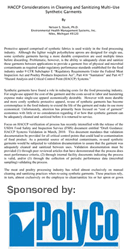
An automated laundering system has been developed to clean and sanitize multi-usesynthetic garments composed of PolyConversions, Inc. VR™. An extensive evaluation of an automated washing and drying process with VR™ garments has demonstrated that an automated laundering program can provide the poultry and meat processing industries with a process that can assure consistent and quality performance in cleaning and sanitizing multi-use VR™ garments.

Driven primarily by economic factors, multiple use of synthetic protective apparel has increased dramatically in the food processing industry during the last decade.
HACCP Considerations in Cleaning and Sanitizing Multi-Use Synthetic Garments
Protective apparel comprised of synthetic fabrics is used widely in the food processing industry. Although the lighter weight polyethylene aprons are designed for single use, some synthetic garments having a more durable composition are used multiple times before discarding.

The Drive for a Global Food Safety Standard
The Global Food Safety Initiative is quickly gaining momentum and is certain to make a big impact on the auditing practices of food processors and their suppliers. This whitepaper provides a thorough overview of GFSI and differences among prominent GFSI-approved auditing organizations. Download now to learn about the rising expectations.
Getting Started With Certification to Global Food Safety Standards
In beginning, it is important for facilities to understand the steps to certification and how to approach them. Some steps are mandatory and some are optional. The optional steps can be valuable tools to help a facility succeed in attaining certification.
Certification to the Global Food Safety Standards
Historically, suppliers have been subjected to multiple types of Food Safety audits to meet the expectations of multiple customers. The Food industry is now experiencing a significant shift away from “audits” to more comprehensive certification programs for continuous improvement in food safety management and to ensure confidence in the delivery of safe food to consumers.

The Cold Hard Facts — Using Mobile Computers in Cold Environments
Which mobile computing equipment works best in food and cold storage environments? Read The Cold Hard Facts – Using Mobile Computers in Cold Environments, a new whitepaper, and learn what you need to know to pick the most reliable, performance-proven devices.

Wireless Technology Migration: Mitigating Risk and Increasing Supply Chain Efficiency
How can food manufacturers and distribution operations make the most of the latest wireless technologies? A new white paper, Wireless Technology Migration: Mitigating Risk and Increasing Supply Chain Efficiency in the Food Industry, provides proven strategies and best practices for selecting and deploying solutions designed for long-term value.