The National Provisioner's 2010 Deli Report
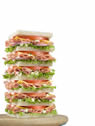
The supermarket deli is becoming an increasingly attractive protein destination.
While delis have traditionally been venues for shoppers seeking fresh lunchmeats from service counters along with pre-sliced and pre-packaged offerings, departments now are evolving into multi-faceted meal repositories with a plethora of protein options.
Such elements as hot and cold prepared foods, made-to-order and pre-made sandwiches, buffets and grab-and-go meals, as well as more flavorful and healthy lunchmeats, are becoming prevalent.
Indeed, deli operators are expanding and enhancing selections in a quest for greater revenues and to attract and retain shoppers who might otherwise visit foodservice locations for their meals.
“Supermarkets over the last two years have competed very well for the infamous ‘share of stomach,’” says Peter Redmond, former vice president of deli and seafood for Wal-Mart Stores Inc., and current vice president of deli sales for Rupari Food Service, Deerfield Beach, Fla. “This is quite evident with the fall-off in numbers from foodservice and casual dining. What remains to be seen is what this customer will do once we emerge from the recession.”
The majority of deli dollars are being generated by prepared foods and meats, which in 2009 accounted for 50.1 percent and 25 percent of department sales, respectively, reports the Perishables Group, a Chicago-based fresh-foods consulting firm.
The figures represent data from 13,000 grocery stores with annual sales volume of more than $2 million and do not include activity from Wal-Mart, club stores, franchise stores, small independent chains and alternative format retailers, such as Whole Foods Market Inc. and Trader Joe’s.
Within the deli meat sector, bulk offerings accounted for 86 percent of category dollars and 88.3 percent of volume.
Pre-sliced meats generated 9.1 percent of dollars and 7.5 percent of volume, and specialty meats accounted for 4.9 percent of dollars and 4.2 percent of volume.
Deli meat revenues were flat from the year-earlier period and Mintel International Group Ltd., a London-based research firm, reports that price is inhibiting growth.
In a nationally representative Mintel online survey of 2,000 consumers conducted last October, two-thirds of respondents indicated that they would buy more deli meat if the products cost less.
Bill Patterson, Mintel senior analyst, notes that the average retail price of lunchmeats is more than $4 a pound.
“Retailers need to offer lower-cost items and basic private-label brands while also maintaining a balance of meat options,” he states.
A study by Manassas, Va.-based Thomas Opinion Research also reveals that price is a key purchase factor.
In a Thomas Opinion Research online and telephone survey earlier this year of 2,000 deli shoppers commissioned by the Madison, Wis.-based International Dairy-Deli-Bakery Association (IDDBA), 52 percent of respondents noted that prices in their in-store delis increased in the previous three months, and 30 percent indicated that there were not enough value-priced choices in the self-service section.
Rosita Thomas, Thomas Opinion Research executive director, says many shoppers perceive the deli as being overly expensive and, as a result, some are purchasing their meal components from other store departments.
The Thomas Opinion Research study also reports that 34 percent of respondents are buying less from the deli than in 2004; 20 percent are purchasing more; and 45 percent are buying about the same amount.
This greater focus by consumers on cost is triggering added interest in store-branded deli meats.
Sales of private-label lunchmeats, for instance, grew 6 percent to $839 million in 2009, according Chicago-based Information Resources Inc.
The rate is higher than the 4.3 percent growth rate of the entire lunchmeat market and makes private label the third-largest lunchmeat brand, Patterson says. He notes that private label sales are up in all deli meat segments.
Mintel reports that private label accounts for 12 percent of pre-sliced lunchmeat sales, trailing only market-share leaders Kraft Foods Inc. (21 percent) and Sara Lee Corp. (18 percent), and ahead of Smithfield Foods Inc. (8.5 percent).
“The range of private label has expanded with high-, medium- and low-end options available in many categories,” Patterson states. “Consumers also generally perceive private label as being of good quality and many say they will probably not go back to the supplier brands. They realize they have not given up much in taste and convenience by switching to store brands.”
W. Frank Dell, president of Dellmart & Co., a Stamford, Conn.-based retail consultancy, agrees.
“Many baby boomers who are nearing retirement will not return to their free-spending ways,” he states. “And there is less of a stigma today in buying store brands.”
Turkey, ham, beef, salami, chicken and bologna are the most popular bulk deli meat varieties by dollar volume, reports Hoffman Estates, Ill.-based FreshLook Marketing Group.
Top pre-sliced proteins are ham, turkey, salami, beef and pepperoni, according to the Perishables Group.
In addition to price concerns, consumers also are increasingly seeking newer meat flavors and healthier options.
That trend is revealed in Mintel’s analysis of 580 restaurants and about 380 chains, where the fastest-growing sandwich flavors on foodservice menus include Pepper, Applewood Smoked, Spicy, Mesquite Smoked, Buffalo, Hickory Smoked and Savory.
The most popular restaurant menu items typically gravitate to delis within two years, Patterson says.
“The popularity of complex and sophisticated flavors at foodservice should be a big wake-up call for delis,” he states.
Indeed, such options will likely spur greater restaurant traffic.
While delis benefitted from the recession”as more cost-conscious consumers “brown bagged” their meals”an improving economy and attractive menu options are expected to lure many consumers back to foodservice outlets, analysts say.
In response, deli operators and suppliers should encourage shoppers to keep focusing on frugality in order to maintain the deli lunchmeat sales momentum, Patterson says.
Messages that spell out the yearly cost savings from consuming homemade sandwiches, and that ask shoppers if it is worth giving up those dollars for the convenience of eating out, are effective tactics, he states.
Redmond, meanwhile, encourages operators to create value meals, such as bundling meat entrées with side dishes and beverages.
“There also are retailers that have created theme days or evenings in which they take a very aggressive pricing stance for a short period and blow the doors off an item from a sales point of view,” he says. “As long as retailers continue to try new ways to create meal-type values, the supermarket will win.”
Offering more “better for you” proteins in delis also can be a powerful consumer magnet.
The Mintel survey, for instance, reveals that 41 percent of shoppers purchased all-natural lunchmeats in the past year and another 36 percent are interested in doing so.
In addition, 41 percent bought low fat/fat free lunchmeats and 25 percent are interested in doing so; and 39 percent purchased low sodium/sodium-free lunchmeats and 31 percent are interested in the items.
Respondents also bought or are interested in purchasing lunchmeats that are low-calorie (36 percent and 29 percent, respectively), American Heart Association-endorsed (29 percent/36 percent), hormone-free (18 percent/36 percent), Kosher/halal (18 percent/22 percent), diet-plan endorsed (17 percent/26 percent), organic (16 percent/30 percent), free-range (15 percent/31 percent) and gluten-free (11 percent/24 percent).
Suppliers are helping to fuel the healthy eating movement as the top claims in new product launches include low/no/reduced fat, no additives/preservatives, and low/no/reduced trans fat, Mintel reports.
Enhanced lunchmeat packaging that accentuates freshness, meanwhile, also is becoming more appealing to shoppers.
Forty-seven percent of Mintel survey respondents indicated that they bought products in better resealable packaging in the past year, and 37 percent are interested in doing so.
“Freshness trumps everything when it comes to lunchmeat,” Patterson says. “And there is room for improvement, as twenty-five percent of consumers say lunchmeat packaging still does not seal appropriately.”
Indeed, more than half the respondents across all age segments indicated that they can taste the difference between lunchmeats sold at the deli counter and packaged products, with the majority noting that service counter proteins are fresher.
“Merchandisers of packaged lunchmeats should emphasize the terms ‘fresh,’ ‘deli quality’ and ‘premium,’” Patterson states. “Such messages as ‘easy access,’ ‘easy open’ and ‘resealable’ also need to be pervasive.”
Mintel adds that other lunchmeat purchase drivers include variety packs that contain more than one type of protein, and packaging that enables consumers pick up individual slices of meat.

Sandwiches shine at meal time
Sandwiches are becoming more alluring deli sales drivers. The ability of operators to leverage fresh ingredients for store-made sandwiches helped generate a 1.9 percent revenue gain last year in an already buoyant market.Jennie-O Turkey Store Inc., Wilmar, Minn., reports in its 2009 Counter Intelligence Deli Consumer Study that more than 40 percent of shoppers in all U.S. regions bought a pre-made sandwich within the previous 30 days.
Made-to-order sandwiches, meanwhile, were purchased by approximately 17 percent of shoppers.
The NPD Group, a Port Washington, N.Y.-based research firm, notes that sandwiches are included in 36 percent of in-home lunches and 14 percent of in-home dinners.
Sandwiches also are positioned to drive greater sales of bulk and pre-sliced deli meats as close to 90 percent of in-home sandwiches served at lunch are homemade, the firm notes.
Along with stronger sandwich activity in delis, however, is added competition from foodservice outlets for sandwich customers, says Harry Balzer, NPD Group vice president.
Indeed, he notes that deli sandwich and lunchmeat sales growth is hampered by the perception of many shoppers that it is more convenient and often more appetizing to get sandwiches from restaurants.
“Consumers are looking to make life easier,” Balzer says. “And that includes easier food preparation.”
Foodservice outlets often have drive-thru windows, while deli shoppers typically must walk through large parking lots and the supermarket itself to purchase sandwiches and meats.
Still, there is a strong incentive for delis to enhance their promotions of lunchmeats and freshly made sandwiches as sandwiches remain the most frequently consumed lunch food and dinner entrée.
“A segment is always looking for new varieties of sandwiches,” Balzer notes. “That includes additional flavors and new versions.”
Among the most active retail merchandisers of freshly made sandwiches is Schnucks Markets Inc., a St. Louis-based operator of 106 stores in Missouri, Wisconsin, Iowa, Illinois, Indiana, Mississippi and Tennessee.
The chain’s menu of made-to-order deli sandwiches, that are intended to emphasize quality and flavor and which feature Boar’s Head-branded meats, include the Cattlemen’s Roast Beef Sandwich, which contains sharp provolone cheese, chipotle mayonnaise and onion straws on a baguette.
Among other offerings are the Muffaletta, which is made of turkey breast, Virginia ham and muffaletta mix on focaccia bread; Pesto Club Sandwich, which contains Virginia ham, turkey breast, provolone cheese and pesto mayonnaise on a ciabatta roll; and Ultimate BLT Sandwich, which features smoked bacon and garlic mayonnaise on focaccia bread.
Additional made-to-order selections are Ham & Turkey Panini; Italian Panini with Volpi-branded Genoa salami, Boar’s Head pepperoni, mozzarella and provolone cheeses, and muffaletta mix on peasant bread; Cubano Sandwich with Boar’s Head roasted pork, Virginia ham and Swiss cheese on French bread; and a Reuben Sandwich.
Shoppers can also “build their own sandwiches” by choosing from a wide variety of meats and breads.
A deli associate at the Schnucks-operated Culinaria supermarket in downtown St. Louis says the sandwiches are positioned to attract the large base of nearby office workers seeking quick meals.
Deli shoppers seek convenient options
Ready-to-eat and heat-and-eat selections are powering deli activity.With a plethora of shoppers seeking quick, flavorful and affordable meals, prepared proteins are becoming increasingly prominent as retailers and suppliers roll out added selections and merchandising initiatives.
Prepared foods account for more than 50 percent of deli revenues and the NPD Group, a Port Washington, N.Y.-based research firm, reports that approximately 20 percent of adults purchase a prepared item from retail in a typical week. Chicken and turkey recipes, and sandwiches, are the most popular choices.
The Perishables Group, a Chicago-based fresh foods consulting firm, reports that deli prepared foods dollars were up 0.8 percent in 2009.
Among proteins, chicken was the largest revenue generator, accounting for 28 percent of sales with revenues up 1.7 percent.
Wegmans Foods Markets Inc., a Rochester, N.Y.-based operator of 75 stores in New York, New Jersey, Pennsylvania, Virginia and Maryland, is among the retailers aggressively marketing prepared selections.
Wegmans is offering $6 and $10 deli meals which include an entrée and two side dishes.
Among the restaurant-quality protein recipes in the $6 deal are Grilled Lemon Garlic Chicken Breast, Meat Lasagna, Parmesan Crusted Chicken, Homestyle Meat Loaf, BBQ Pulled Pork, Chicken Marsala and Chicken French.
Entrées in the $10 meal deal include Asian BBQ Boneless Short Ribs and Honey-Brined Boneless Turkey Breast.
Such offerings are helping to entice more budget- and convenience-minded consumers to obtain prepared meals from delis instead of foodservice outlets.
Indeed, in a recent consumer survey by Manassas, Va.-based Thomas Opinion Research, just 7 percent of respondents indicated that they are most likely to purchase prepared foods from a full-service restaurant, down from 25 percent in 2004.
And the potential remains for even greater deli prepared food revenues. The key, analysts say, is for merchandisers to emphasize the price of store meals.
“Prepared foods had the most SKUs added to the product mix over the last year, but price perception drove some shoppers away from the deli to the refrigerated food aisles,” says Jana Mickie, Perishables Group director of account services.
–Richard Mitchell
Deli award winners
Tyson Foods Inc. launches Rotisserie BakesTyson Foods Inc., Springdale, Ark., is marketing Tyson Rotisserie Bakes, a new product line that is designed to enable deli operators to increase margins and control shrink by assembling second meals with their excess cooked rotisserie chicken.
Once assembled, Rotisserie Bakes allow retailers to either cook the meals to sell hot, or package the foods for cold grab-and-go sales.
Each meal features hand-pulled rotisserie chicken along with sauces and ingredients. Sauce varieties include Classic Pot Pie Chicken Bake, Creamy Enchilada Chicken Bake and Bacon Alfredo Chicken Bake.
The baked entrées are intended to appeal to consumers’ love of comfort food and convenience, the company notes.
Creta Farms USA LLC Replaces deli meat fat with olive oil
Creta Farms USA LLC, Lansdale, Pa., is rolling out a line of Gourmet Deli Meats that are produced under a proprietary method that removes animal fat by hand from lean meat and infuses extra virgin olive oil. The procedure is designed to increase the nutritional value of deli cuts.
The company’s Gourmet Deli Meat line includes Oven Roasted Turkey Breast, Hickory Smoked Turkey Breast, Honey Roasted Turkey Breast, Rotisserie-Style Turkey Breast, Black Forest Ham, Honey Roasted Ham, Hardwood Smoked Ham, Extra Lean Cooked Ham, Lightly Seasoned Roast Beef and Oven Roasted Chicken Breast.
Creta Farms also is developing extra virgin olive oil-infused hot dogs, bologna and sausage.
Butterball LLC offers easy-open Deli meat packaging
Butterball LLC, Garner, N.C., is introducing easy-open packaging that will be available on all Butterball deli products.
The supplier is leveraging an innovative, tear-to-open bag that features pull-apart tabs in the bottom center of the product. It is designed to enhance deli employee safety by eliminating the use of scissors or knives.
The tabs also will enhance deli efficiency by enabling employees to open meat packages in seconds with one clean tear, the company states.
Looking for a reprint of this article?
From high-res PDFs to custom plaques, order your copy today!