Processing Technology
Training, engagement drive worker safety
A variety of tools and methods help employees improve their own workplace safety.
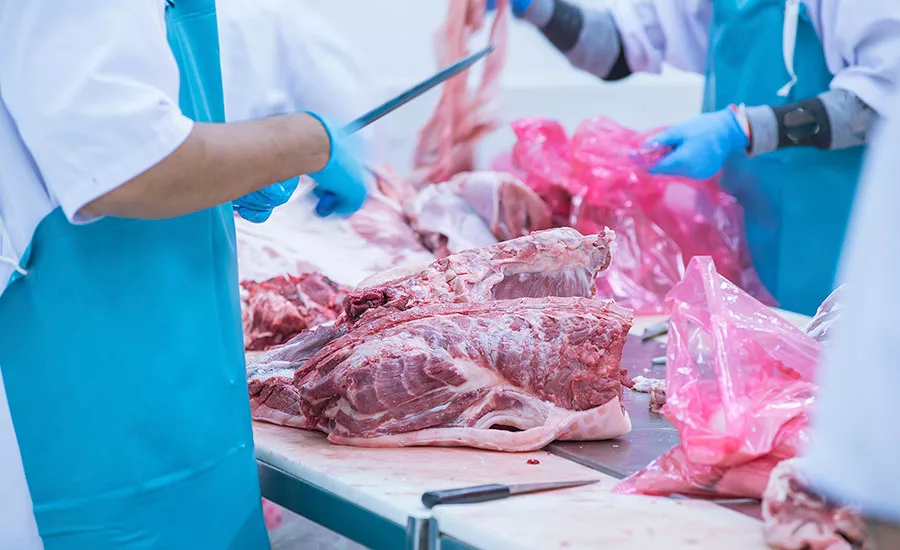
A variety of tools and methods, such as innovative technologies and employee education, can improve workplace safety for meat processing workers.
According to the Department of Labor (DOL), workers in the meat and poultry slaughtering and processing industries are experiencing fewer injuries and illnesses. In fact, from 2004 to 2013, these rates declined from 9.8 cases per 100 full-time workers in 2004 to 5.7 in 2013.
Despite these improvements, the meat and poultry industries remain more hazardous to work in compared with other manufacturing jobs. The Centers for Disease Control and Prevention (CDC) found dangerous conditions such as tasks connected to musculoskeletal disorders, exposure to chemicals and pathogens and traumatic injuries from machines and tools remain.
Workplace safety is a constantly evolving target. The key? Companies need to use a variety of tools and methods to improve worker safety.
“At Smithfield Foods, well-designed and regularly updated procedures, an engaged workforce, and continued investments in innovative solutions that drive workplace safety support a proven record of employee safety with injury rates below the national average across all industries,” says Gary Walters, senior director of safety and health, Smithfield Foods, in Smithfield, Va.
Increasing employee engagement in safety activities is critical.
“Education on safety and ergonomics starts on Day One with new member orientation and is frequently reinforced,” says Paul Rutledge, director of environmental health and safety at Johnsonville Sausage, based in Sheboygan Falls, Wis. “This knowledge is applied to the job through our standard work documents, which are job aids to ensure work is performed correctly.”
Peer-to-peer coaching is also conducted with all members to reinforce safe and ergonomically correct work practices and correct any areas of opportunity on the spot, Rutledge says.
“It also gets everyone involved in owning their safety and the safety of their coworkers,” Rutledge says. “We do it because we care about our coworkers and it’s the right thing to do.”
Last year, Smithfield expanded its Behavioral Risk Improvement (BRI) training, which encourages processing facility workers to observe their peers and discuss safety measures and methods to prevent at-risk behavior and continue reducing injury rates.
Minimizing risk
Innovative technologies can minimize risks to meat processing workers.
“For example, Smithfield recently implemented BladeStop Technology, a saw with a sensor that shuts down the machine within 15 milliseconds of operator contact — a timeframe that can mean the difference between a minor cut and a potentially life-changing injury,” Walters says.
Automation, tools and job rotation can reduce the ergonomic hazards associated with lifting, pulling, scraping and scrubbing.
“We’ve expanded our use of automation, which allows us to reduce the ergonomic hazards associated with physically demanding positions,” says Shawn Lynn, environmental health and safety director at Land O’Frost, in Munster, Ind.
Johnsonville’s Safety Management System uses robotic technology to make work easier and more efficient for its members, says Rutledge.
The company has also developed region-specific anthropometric data from members who work in its facilities since the national data has not been updated in decades, Rutledge says.
“This data is used to develop workstations and tools that fit and adjust to our members,” Rutledge says. “We work diligently to deliver interactive learning to our members to enhance the understanding of safe work practices and keep it top of mind.”
Educating employees
Employees should be engaged in safety processes at all levels of the organization.
Safety and ergonomic measures are communicated to Land O’Frost employees, for example, during orientation, department and quarterly meetings and bi-annual ergonomic re-training.
“Additionally, we host tool box talks for employees that are tailored to our safety programs,” Lynn says. “In these talks, department supervisors can deliver a specific message to their employees that reiterates worker safety training and awareness.”
Land O’Frost also works closely with the North American Meat Institute (NAMI) to implement worker safety programs, Lynn says.
“Through the organization’s Safe Equipment Design Checklist, we’re able to partner with our machine manufacturers to ensure that safety requirements for machinery/equipment are met before the machine is purchased and delivered,” Lynn says.
Safety activities, program reviews and development of innovative systems are all important tools to improve worker safety.
“Smithfield continually invests in ways to educate new and current employees including maintaining facility safety teams, hosting behavioral risk improvement (BRI) trainings and annual safety conferences that include safety professionals, as well as management personnel from operations, engineering and maintenance,” says Walters.
Communicating across all levels
In 2013, working closely with the business units, Maple Leaf Foods developed a comprehensive Occupational Health and Safety (OHS) strategy that focuses on employee communication. The key elements of the OHS strategy are: improved OHS communication; proactive activities; accountability through all layers of the organization; strategy implementation, which includes robust training; integration with Maple Leaf Foods’ “Safety Promise Award;” and ongoing skills development and training, according to Maple Leaf Foods’ Occupational Health and Safety program materials.
“Going back in time a few years, a change in the approach to the execution of the OHS program was needed,” says Teresa Wong Tooze, BScN, RN, CRSP, COHN(C), manager at Occupational Health and Safety, Maple Leaf Foods, based in Toronto. “The stakeholders needed support with hands-on resources to the facilities to provide safety expertise. An OHS Strategy with a stretch target was also needed to support our OHS Policy and Safety Promise — the elimination of occupational injuries and being global leaders in job safety, respectively.”
One of the key elements of the OHS strategy is enhanced OHS communication at all Maple Leaf Foods facilities. Communication tools recognize the need to both create and capture knowledge in order to transfer this shared knowledge to others.
The key elements of Maple Leaf Foods’ OHS program are also analyzing losses — through incident stratification, investigation and mapping — risks and measuring culture, says the Maple Leaf Foods plan.
Standardizing best practices
Despite employees’ best efforts, challenges remain with workplace safety issues such as effective communication styles among different generations, musculoskeletal disorders and equipment made overseas without U.S. safety regulations.
“Johnsonville Sausage continues to find ways to ensure that our safety message reaches all members from the younger Millennials to our most tenured members,” Rutledge says. “Through the implementation of robotics, a formalized program to reduce ergonomic hazards, daily stretching and strengthening programs during production and general ergonomic improvements of workstations, we have been able to minimize the impact of MSDs on our members.”
Rutledge says when it comes to machine safety, it holds all manufacturers, installers and integrators of machinery to a high standard of safety performance.
Sustainability within the labor force, safety management and control systems and technology are three key areas Smithfield, for one, is dedicating resources to and keeping in focus, says Walters.
Training methods certainly play a big role in decreasing injuries.
“Currently, our worker safety training encompasses video, Power Point presentations and hands-on activities, and we’re continuing to explore additional ways that allow employees to better retain the information presented,” Lynn says.
Standardizing best practices and increasing employee engagement help improve workplace safety efforts across all operations, Walters says. NP
Looking for a reprint of this article?
From high-res PDFs to custom plaques, order your copy today!