Fortress puts frequencies under close scrutiny
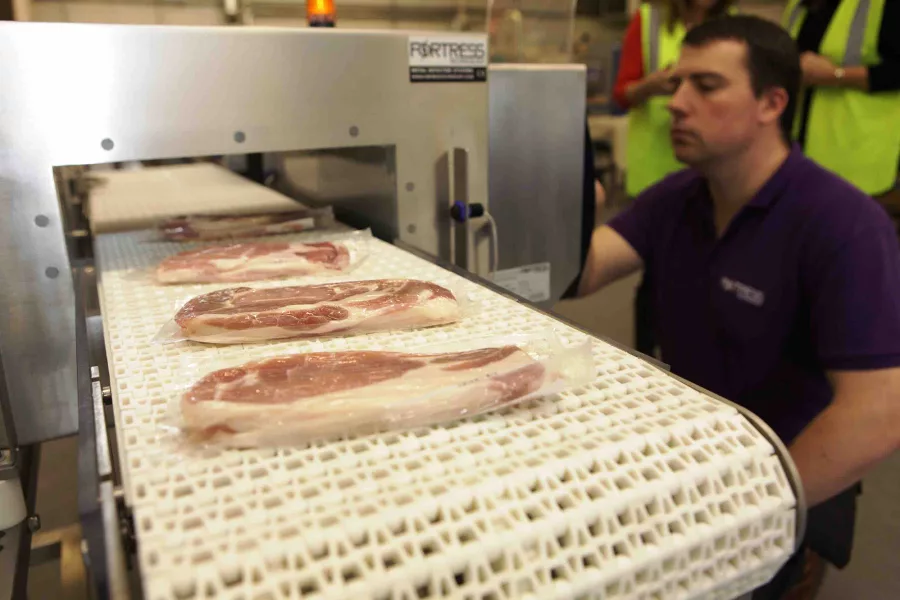
The most widely used type of metal detector in the food industry functions on the principle known as the ‘balanced coil’. With a general-purpose search head, these can detect ferrous, non-ferrous metals and stainless steels in fresh and frozen products, whether unwrapped, wrapped, or in metallized films. Yet, unlike metal detectors designed for specific applications, these general-purpose search heads are still unable to detect every particle of metal passing through them. For optimal performance and sensitivity, the search head should be sized appropriately to the product being inspected.
Many factors will determine the theoretical sensitivity of a metal detector. Among them are the aperture size (the smaller the aperture, the smaller the piece of metal that can be detected), the type of metal, product effect, and the type and orientation of the contaminant as it passes through the detector. Environmental conditions, such as airborne electrical interference - static, radio or earth loops - vibration and temperature fluctuation may also affect performance.
Reducing false rejects caused by product effect
A large volume of food applications that are inspected inherently have electrical conductivity and/or magnetic permeability within their makeup. For example, any product that has a high moisture and salt content, such as bread, meat and cheese, is electrically conductive. This means sensitivity levels suffer, as you have to deal with the signature of the product. Even wet products will exhibit a very different product effect. For example bread and meat are both conductive, but meat typically has higher water content and thermal changes caused by thawing or warm products cooling can affect the products signal quite significantly and cause a false reject. In addition, meat cuts are different densities, so again the product effect will differ.
Conversely, any product that is iron enriched, such as fortified cereals, supplements and breakfast bars, creates a large magnetic signal that the detector must overcome in order to detect small pieces of metal. These are referred to as ‘dry’ products and tend to be a lot easier in terms of detection capability, because you do not have to worry about the product effect.
To identify a metal contaminant within conductive products, the detector must remove or reduce this ‘product effect’. The solution is to change the frequency of operation to minimize the effect of the product. The downside is this can impact your ability to find different metals. When you drop frequency, you tend to enhance your ability to find ferrous metals, yet this limits performance when it comes to non-ferrous metals, since the lower end of the frequency is more responsive to magnetic effects of the contamination. By the same token, the reverse happens when the frequency is taken higher - it starts to limit the ferrous detection capability but enhances the non-ferrous detection.
To reduce metal contaminant risks, it is essential to identify the ideal frequency on the metal detector for any product and set it to the right level for your specific food application. There are generally three technology options - fixed frequency, multi-frequency and simultaneous frequency. Experts will tend to know what the frequency bands are likely to be. However, it's always dangerous to be too presumptuous as similar product types sometimes behave in different ways. So, what frequency and technology are the best?
Single fixed frequency
With a single tuned frequency device, the operating frequency must be picked to suit the product. A machine with a fixed frequency is good if inspecting the same product day in day out, for example sliced white bread or a chocolate bar. However, with difficult conductive products like meat or cheese, or a larger product, the frequency must be set low to deal with the product effect. That makes the system less sensitive to the detection of stainless steel and non-ferrous metals.
Multi-frequency
Multi-frequency metal detectors perform well on a range of products passing down the same production line, although the sensitivity and performance may be compromised, increasing the risk of metal contaminants going undetected. Machine operatives on the food production line may have to select the frequency from a menu, raising the issue of what they are basing a decision on. If it’s not tuned in exactly right, like a radio station, they might not select the frequency that delivers perfect clarity and sensitivity. However, automatic product learning does reduce the possibility of human error.
Simultaneous frequency
With simultaneous frequency, it’s more sensitive as you can ignore the product effect, making it ideal for wet products that vary in size and density, like cuts of meat, fish, wedges of cheese or ready meals.
This simultaneous frequency technology, which Fortress applies to its new Interceptor range, works by carrying out a real-time analysis of a low frequency and a high frequency signal in parallel. Using an advanced algorithm, the Interceptor splits the product and metal detection signals and then links the readings back together. Compared to the traditional approach of tuning into specific frequencies, this new methodology makes it possible to identify the product effect - most noticeable at lower frequencies - and eliminate it from the higher-frequency signal, where the potential effect of the metal is more prominent.
Critically, with any metal detector, there is no ‘best’ frequency. There are only ranges of frequencies, each better for different purposes. The sensitivity of your metal detector system will depend on a series of variables, from the potential size and composition of possible contaminants to the liquid content and consistency of the product matrix. In some applications it is obvious which system to opt for, since only one of them can reliably detect the contaminants that pose the risk you are trying to mitigate and your final choice may have significant bearing on the number of false rejects. Understanding how these frequency options work and differ is fundamental to selecting the right inspection machine for your food application. If in doubt, seek expert guidance.
For more information, visit www.fortresstechnology.com.
Looking for a reprint of this article?
From high-res PDFs to custom plaques, order your copy today!