CPW and CDA prepare for 2025 gray wolf releases with improved Livestock Conflict Minimization Program
CPW has been listening to the concerns and recommendations of all stakeholders throughout the first year of gray wolf restoration.
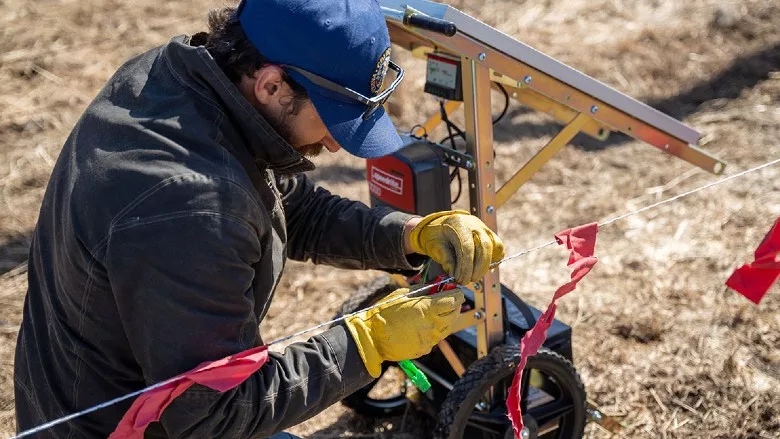
Photo credit: Colorado Department of Agriculture
Operational planning is underway for the second capture and release season in support of the Colorado Gray Wolf Restoration and Management Plan. The operation is focused on translocating up to 15 gray wolves from British Columbia to Colorado between January and March, 2025, as announced by Colorado Parks and Wildlife (CPW) in September 2024.
CPW has been listening to the concerns and recommendations of all stakeholders throughout the first year of gray wolf restoration. The agency has incorporated this feedback into an expanded and improved conflict minimization program for Colorado livestock producers.
“Through partnerships with the Colorado Department of Agriculture (CDA), the Colorado Wolf Restoration Ad Hoc Working Group, USDA-APHIS Wildlife Services, Colorado State University Extension, USDA Natural Resources Conservation Service (USDA NRCS) and NGOs, we are in a position to offer Colorado livestock producers an even more robust program that includes the tools, support and resources needed to minimize wolf-livestock conflict,” said CPW Director Jeff Davis.
The Conflict Minimization Program includes:
Site assessments — Site assessments are a critical tool for identifying the most appropriate and effective non-lethal tools and techniques specific to each individual operation. Site assessments are free and are conducted by staff from CPW, CDA, USDA-APHIS Wildlife Services, and USDA NRCS, in collaboration with the livestock producer. CPW has recently updated and formalized the site assessment process for 2025. CPW strongly encourages producers to enroll in voluntary site assessments by calling their Area CPW Office(opens in new window) or local CPW officer. Through multiple and ongoing joint CPW and CDA conflict minimization meetings across the Western Slope, 22 producers have signed up to receive site assessments since October 2024.
Conflict specialist capacity — CPW and CDA have significantly increased conflict reduction specialist staff throughout the first year of wolf restoration. Between April and June, CPW brought on five wildlife damage specialists and is recruiting for five more in December. These positions are currently based out of each CPW Region and are in addition to the Wolf Conflict Coordinator hired in 2022. In the summer of 2024, CDA hired a Non-lethal Conflict Reduction Program Manager. Two CDA non-lethal mitigation specialists started in their positions this month. These staff are available, along with CPW staff, to connect producers to available resources, including equipment, site assessments, and compensation claim submissions.
Depredation response — CPW has developed criteria for different levels of response as a guide for field staff to use when addressing wolf conflict and depredations, either proactively or reactively. The levels help assist in determining how much staff time and resources could be used for a depredation or from known wolf activity and risk for possible future conflict. The level will be site-specific and based on staff’s professional assessment, cooperation from the livestock producer, and evaluation of a site assessment. Many wolf depredations are a one-time event; however, more aggressive intervention may occur in scenarios with multiple depredations, nearby wolf den and rendezvous sites, and evaluation of pack territories or behaviors. Early and aggressive hazing efforts to change the behavior of depredating animals can be a very effective manner in which to alter the undesirable behavior. A site assessment is a valuable tool for understanding and assessing risk. It will be part of the equation for determining conflict response. Further details about the levels of response will be included in the CPW Wolf-Livestock Conflict Minimization Program Guide, to be published in December (see more below).
Range riders — Range riders are trained personnel with a specialized set of skills who spend time with livestock to monitor for the presence of wolves and deploy hazing techniques to deter wolves. The job requires working closely with livestock producers as well as a strong understanding of animal husbandry and stockmanship techniques. CPW is partnering with CDA to create the Colorado Range Rider program that will launch in early 2025. CDA and CPW staff members, as well as any future contract range riders, will go through specialized training to create a team of trained range riders with connections to local communities who can be deployed to support producers at short notice. The inaugural training will take place in January 2025 and focus on early-season conflict mitigation during calving and lambing season, which typically begins in late February. The second round of training will take place over a four-day period in April 2025 and will prepare producers and range riders for conflict mitigation on the open range during the warmer summer and fall months. “The Colorado Range Rider program will train skilled riders who will work alongside Colorado’s livestock producers to mitigate conflict, expand capacity on the range, and help support resilient ranches,” said Colorado Commissioner of Agriculture Kate Greenberg. “Through CDA and CPW’s partnership, this program will connect producers to state resources available to them as we work toward coexistence with wolves in Colorado.” Contractors for the Colorado Range Riding program will be hired for the high season on the range, which lasts approximately five months, from mid April to October. Livestock producers, farm and ranch managers, and other private individuals interested in a range rider contract position can express their interest via the Colorado Range Rider Program Interest Form.
Carcass management — CDA and CPW have worked with neighboring states to understand best practices for carcass management in wolf country. A list of best practice recommendations(opens in new window) compiled from lessons learned in other states can be found here.
Grant program
CDA and CPW have developed a grant program to assist with implementing non-lethal wolf conflict reduction measures. Grants of up to $20,000 are available(opens in new window) to entities and organizations, including but not limited to livestock associations, governmental entities, and tribes, that provide support to multiple producers.
Grant funds can be used to prepare, educate, and coordinate with producers to implement non-lethal conflict reduction measures and directly implement measures such as range riding and carcass disposal.
The first year of wolf restoration and moving forward
“I want to point out that our efforts this past year have resulted in seven surviving adult wolves and five pups from the initial release of ten adult wolves in December, 2023. This is remarkable from a biological perspective. The situation with the Copper Creek pack in Middle Park was very unique as the male was involved in multiple depredations and removing him at that time while the female was denning and he was the sole source of food would likely have been fatal to the pups and counter to the restoration mandate. The situation was resolved through a unique wildlife capture operation conducted by our dedicated staff and partners,” Davis said.
The remaining captive wolves, the female and four pups, appear to be healthy and will contribute to wolf restoration in Colorado when they are also released during this season. The fifth pup, currently in the wild, also appears to be healthy. CPW is currently having conversations and will be meeting with local community members before the release of the female and four pups occurs.
The six other wolves from the initial release have spent the past year exploring the new landscape and meeting each other and the other wolves in the state.
Some loss of wolves from the initial restoration was anticipated. Any reintroduction effort includes eventual mortality and was incorporated into the plan, which states that a review would occur if survival was below 70% in the first six months. Wolf survival was 90% for the first six months after translocation from Oregon. Wolf survival in Colorado is within normal margins for a wolf population in the Rocky Mountains.
The biological importance of continuing the releases of wolves to supplement the first round of releases done last season must be emphasized. Adding animals to the existing population will increase the likelihood of pairing, breeding and pack formation. This will create more consistent territories that allow CPW to monitor patterns within a territory. Thus, improving our ability to collaborate with ranchers on active behavior and coexistence strategies to best protect livestock.
“CPW staff and our partners have been working hard, learning and adapting throughout this first year of wolf restoration in Colorado. The deployment of this stronger conflict minimization program is critical as we prepare to release wolves this upcoming season. I want to reiterate that we take our responsibility for the wellbeing of the ranchers, their livestock and the wolves very seriously. We are confident we will be successful restoring a healthy, sustainable population of gray wolves to Colorado as mandated, while avoiding and minimizing impacts to our critical ranching industry and rural communities,” Davis said.
Looking for a reprint of this article?
From high-res PDFs to custom plaques, order your copy today!