Hagen updates FSIS progress
With Dr. Elisabeth Hagen,
Under Secretary for Food Safety,
USDA Food Safety and Inspection Service
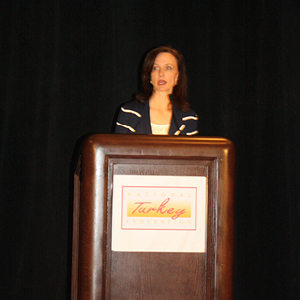
Prior to her Feb. 10, 2011, presentation at the National Turkey Federation’s annual convention, Dr. Elisabeth Hagen, Under Secretary for Food Safety for USDA Food Safety and Inspection Service (FSIS), provided updates to several agency initiatives in a one-on-one interview with Dave Lurie, publisher of The National Provisioner. What follows is their conversation:
Lurie: What is the status of the draft guidance for the validation for HACCP systems, which was released in 2010?
Hagen: We got a lot of comments on that, and that’s probably putting it gently. I think the message from our stakeholders was clear — particularly our industry stakeholders — that those guidelines were a necessary and important step, but that we probably had a long way to go in terms of making them more useful and more understandable. That’s what we’ve focused on: analyzing those comments and moving on to the next step. I can’t give you a date, but we’re pushing to get them out this spring sometime. I think what the industry will see is a reflection of the input they gave us — I think it will be a much more useful document for the industry.
Lurie: How did the industry respond?
|
Hagen: I would say the response was mixed. There were a lot of questions about specifics and the way it was rolled out. But this is something that industry essentially has been requesting for some time, some clarification on what validation means. And that’s one of the biggest misunderstandings about this, that it’s some kind of new set of requirements or regulations. It’s not at all; it’s part of the foundation of HACCP. It’s always been there, that a food-safety plan can work in theory and does work in practice. It’s always been a requirement, and there has been confusion around how do processors show that it can work in theory and does work in practice? That’s what these guidelines were meant to do, and if they were not received in that way, then we need to take a look at the way they were put out there. I think we’ll be in a good place with industry when they get out in the spring.
Lurie: Where does FSIS stand on the issue of non-O157:H7 varieties of E. coli?
Hagen: I’ve gone on record about this and I’ll say it again here: O157:H7 is what we’ve known about and targeted since 1993. That organism took entire nations and the world by surprise, and we had an outbreak that impacted as many as 800 people, and four children died. So we reacted and declared O157 to be an adulterant in ground beef, and that kind of evolved into ground beef components. And I think the industry has done great work. The agencies continue to build strong policies around that. But now it’s 2011, and we know an awful lot more about all the threats in ground beef. And we know that there are close cousins to this organism that cause the same range of illness and can kill people. These are dangerous actors, and we don’t explicitly address them in our policies. If we are a prevention-based organization with a prevention-based mission, we need to think about how to prevent as many illnesses as possible. So, our position is that we need to look at the risks as they exist today in 2011.
Lurie: Which of the additional subtypes fall into FSIS’ main focus?
Hagen: There are probably hundreds of subtypes of the shiga toxin-producing E. coli, so there are many, many subtypes that fall into that category. What we’re focusing on are those that are known to be pathogenic, those that are known to cause illnesses in humans, those that have been recognized by the Centers for Disease Control and the World Health Organization as emerging threats. So there are a number of them, but some of them may not cause any harm at all, so we’re focusing our efforts on how to detect those that do and prevent illnesses from those six.
Lurie: What is the latest news regarding FSIS’ progress on low-dose carcass irradiation as a processing aid?
Hagen: There has been a petition before the agency for more than five years now, and I think that’s more than enough time to make a decision. I can’t speak to why the decision has taken as long as it has, but it’s a tough issue, because on the one hand, we don’t want to prevent innovation. We want to innovate as an agency and promote that within the industry we regulate. This technology has some promise, yet it is an unproven technology. There isn’t a single company out there right now that could implement this tomorrow, and there are some concerns with this petition about whether we really could call this a processing aid. We’ve expressed this concern repeatedly to the American Meat Institute, we’ve asked for more data and still hope we can get more data from them, but right now there are things that would prevent us from moving forward, not the least of which is that we have a regulation that requires that meat products that are irradiated and then go on to be further-processed must be labeled. That exists. It’s a regulation. So there are a number of concerns about this, but at the same time, there is some promise in this technology and a lot of us, I think, would like to see this move further down the line. It’s just a matter of how we get there.
Lurie: Where does FSIS stand on high-pressure pasteurization as a food-safety tool?
Hagen: We don’t really take a stand on one technology versus another. It’s a technology that is highly effective in the ready-to-eat environment in particular, so there’s no barrier in place at all right now to using that technology in the industry. It’s very effective for pathogen reduction, so we don’t really take a stand on that compared to other technologies. It’s available, it’s out there, and companies can use it. We recognize it as highly effective, particularly on ready-to-eat products.
Lurie: What are the primary goals you have set for the meat industry and FSIS, in terms of preventing foodborne illness?
Hagen: Well, that answer is fairly simple, but it’s not simple to get there. Forty-eight million people get sick every year from food disease. That’s not all from the products we regulate as FSIS or the meat and poultry industry produce, but that’s a lot of people getting sick every year. So that’s our goal: to reduce that number. It just shouldn’t be a fact of life that American consumers accept that people will get sick and die from what they eat. That’s our only goal, along with how we bring down those numbers, particularly for key pathogens that we focus on —
E. coli, Salmonella and Listeria — and the products we regulate.
Lurie: What is the most challenging hurdle to overcome to reach that goal?
Hagen: I would say that dealing with meat and poultry, particularly raw products, there’s an inherent level of risk there. Not just with raw meat and poultry, but really with food products in general. Finding new ways every year to combat that risk and bring those numbers down as close to zero as possible, that’s an inherent challenge. There are so many good ideas out there about how to make food safer, how to make people safer, and for me the challenge is how do you bring all those things together, work with all the partners you need to work with, and how do you do that in the span of an administration. For me, that’s a personal challenge. But I think this is a unique time. We have an industry that wants to move forward and make food safer, we’ve gotten calls from consumers, Congress and everyone to do the same thing, to get ourselves to a place where we do not have 1 in 6 Americans at risk from the food they eat every year.
Lurie: Can meat processors get help from FSIS on some of the labeling requirements that have been enacted recently?
Hagen: We have every intention of providing help. We have webinars planned, we have all sorts of outreach activities planned. There will be label examples that will be available to be obtained from the agency, and we can — I think those things might be included somewhere in the press release, and we can give you that information and a link for people to go to see all the things that are going to come up. But we recognize that particularly for smaller processors, that’s going to be an issue. We focus all the time on how to reach out to small and very small establishments particularly. We have an entire office set up at FSIS that was created in the last five years that just focuses on outreach to small and very small plants, so we have every intention of making this transition as seamless as possible for them. I know they have a whole rollout of outreach planned.
Lurie: President Obama put forth an executive order after the first of the year to have agencies look at reducing the number of regulations and obstacles for businesses. Was FSIS included in that, and if so, are you in the process of doing that?
Hagen: I think this administration as a whole shares in this goal of how do we do the essential work of government? In my case, the most essential thing is keeping people safe from harm, and so how do we do that without unnecessarily burdening the businesses that do this work? So I think the entire administration is looking at that. In my case, Secretary Vilsack has said to me that we’re going to leave no stone unturned. We’re going to look at everything we have: our legislation, our regulations. There will be places where we may need new legislation, but there may be places where we need to look at what we’re doing, and see if it makes sense and is still effective and efficient. I’ve said over and over again, we’re not looking to get more laws, regulations and policies on the books just so we can have them. They need to make sense in today’s climate. One of the things that we talked about this morning was the Salmonella Initiative program. At FSIS, I think this is a great example of collaboration between industry and FSIS that allows the production of safe products without over-regulation of industry. So I think you’ll really see the administration not just in food safety taking positive steps in that direction.
Looking for a reprint of this article?
From high-res PDFs to custom plaques, order your copy today!


.webp?height=200&t=1742564842&width=200 "USDA's FSIS logo")