Provisioner logo
Provisioner logo
search
cart
facebook twitter linkedin youtube
  • Sign In
  • Create Account
  • Sign Out
  • My Account
Provisioner logo
Provisioner logo
  • NEWS
    • Industry News
    • Supplier News
    • Case Studies
    • Recalls
    • Regulations
    • New Consumer Products
  • EXCLUSIVES
    • Newsletters
    • Source Book
    • Sponsored Insights
    • Events
    • Webinars
    • Classifieds
    • White Papers
    • Provisioner Store
    • Market Research
  • MEAT PROCESSING
    • SUSTAINABILITY
    • Processing
    • Packaging
    • Ingredients
    • Formulation
    • Food Safety
    • Special Reports
    • Commentary
  • PROFILES
    • Processor Profiles
    • Processor of the Year
    • Top 100 Processors
  • MEDIA
    • Videos
    • Podcasts
  • DIRECTORY
  • MIHOF
  • INDEPENDENT PROCESSOR
  • EMAG
    • eMagazine
    • ARCHIVE ISSUES
    • Contact
    • Advertise
  • JOIN!
Meat and Poultry Processing

Smarter cutting and deboning
By Elizabeth Fuhrman
December 11, 2011
Cutting and deboning is a difficult process, but much is being done to improve the physical cut of meat to increase yield and to reduce risks associated with the procedure. 
Deboning
 

One yield improvement is deboning before full aging is completed, says Douglas Smith, associate professor and director of the poultry processing laboratory at North Carolina State University in Raleigh, N.C. While themeat is tougher, it releases cleaner from the rib cage area. The downside of this, however, is the potential increase of bones as the fan bone tends to snap off with the fillet, he says.

Physical cuts, sometimes yield and definitely reduced risks for deboners and portioners is aided by the use of equipment after the actual deboning process, Smith says. The most popular equipment for post-debone cutting and portioning are form cutters or water-jet cutters, both of which have replaced people with knives or scissors, he says.

Historically, pulling the breast and skinning the carcass was the most physically demanding portion of the line. Today, through job rotation and automation of the breast skinning process, this has shifted to other more finesse-related positions, says Brad Williams, operations manager for Wayne Farms’ Pendergrass, Ga.-based Fresh Processing Facility.

“Ergonomically designed work stands and stations have brought the work closer to the employee and made the jobs more comfortable,” he says. Virtually all tools today are designed with comfort and ergonomics in mind.

“Handles are contoured to fit the hand and made of lighter materials,” Williams says. “Blades are more consistent and designed to be sharpened by high-tech grinding equipment that requires much less expertise.”

Sharpening equipment and personal sharpening devices also have evolved over many years.

“Tool sharpening is no longer an art,” Williams says. “It is very much a science. Several systems exist today that, given an initial capital investment, require minimal training to produce consistently sharp tools in great numbers with few people.”

Man vs. machine

More thorough training and, in turn, higher levels of employee retention have become essential parts of any successful deboning operation.

“No company can afford to routinely start over with new employees and continue to compete,” Williams says. “Step-by-step, and in some cases videotaped, methods are employed to ensure consistent comfortable techniques are used to help people be successful.”

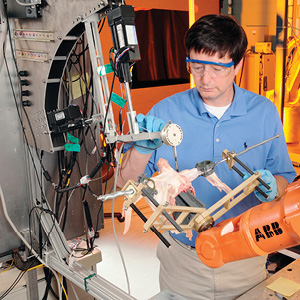
More imaging and better robotics also are aiding the cutting and deboning process. Machines that adapt to cut the bird are now on the market, rather than the old technology of automated deboners, which offered few adjustments and no individualization, Smith says.

In some areas of the country, automation is very prevalent for the large poultry companies. Automation is typically too expensive for smaller companies and is used where labor is short or too expensive, Smith says. The downside of automation is that the lines typically produce more bones than a well-trained cone line, he says. In terms of breast deboning, Williams agrees that automation remains a level below hand-deboning.

“Many operations have made the switch to fully automated systems only to return to the tried-and-true cone line hand-deboning [setup],” he says. “Opportunity for equipment manufacturers continues to be great, but quality and yield loss issues have yet to be overcome. Thigh deboning and breast skinning are two areas that have become reasonably successful.”

Gary McMurray, chief of Georgia Tech Research Institute’s (GTRI) Food Processing Technology Division, agrees that the predominant move processors are making is to return more to manual systems, while the industry continues to work on solutions for the front half of the bird.

“Back when the economy was going well and it was a matter of pumping out as much product as you could, there was more of an issue of the labor concern,” he explains. “But right now, yield seems to be more critical, so the company can still get a higher yield with the manual line than they can with the automated lines.”

Automation is more frequently used in processing dark meat, such as the leg and thigh, because the processing is a little more constrained, McMurraysays. Along with equipment suppliers, GTRI is working on its own boning system for the breast fillet to address the challenges the front half of the birds bring.

Deboning outlook

In the future, Smith would expect more robotics and imaging. More sophisticated automated yield-tracking systems, and further use and development of more economical X-ray systems are probably on the horizon for the deboning process, Williams adds.

GTRI is working on one such bone-monitoring system that might allow for a real-time yield monitoring. The system uses infrared light shown up from inside the bird, through the cone, with cameras mounted on the outside looking at the carcass.

“When you do the cutting, there is the issue of the yield, but there is also a food-safety issue,” McMurray says. “We are working on a system that, instead of looking for the proverbial needle in the haystack, we look for the needle to see if it’s missing in the first place. We have been looking at carcasses at the end of the process line to see if the bones are still on the carcass. An additional benefit of being able to inspect the carcass is to see how much meat is left on the carcass.”

“A real-time yield-measurement system is something that is always going to be important in all of these deboning systems,” he continues. “It’s closing the loop as to how do you really know how well you did and how do you really measure that in a significant manner.”

Advancements will continue to occur in the cutting and deboning process because it’s an area that attacks a problem, McMurray adds.

“In one sense, it’s very suitable to automation,” he explains. “It’s dull [work], it’s dangerous and it’s dirty, so it makes sense to try to automate. It’s just that right now, especially with the front half, it’s still such an unstructured problem. For the dark meat, I think there is a little more structure to it.”

Yield will remain a critical factor in driving the systems forward, however, as opposed to labor replacement.

“Once we get a system that can provide the right yield, the labor reduction is just going to be icing on the cake,” McMurray explains.

KEYWORDS: cutting deboning

Share This Story

Looking for a reprint of this article?
From high-res PDFs to custom plaques, order your copy today!

Elizabeth christenson 200x200
Elizabeth Fuhrman is a contributing writer.

Recommended Content

JOIN TODAY
to unlock your recommendations.

Already have an account? Sign In

  • Double Charburger

    Premiumization drives burger category

    Shoppers seek out premium meat offerings to fulfill...
    Ingredients
    By: Sammy Bredar
  • JJS Adult Pekin duck

    Poultry Report 2025: Convenience propels poultry at retail

    Despite continued economic pressures, the poultry...
    Chicken
    By: Sammy Bredar
You must login or register in order to post a comment.

Report Abusive Comment

Manage My Account
  • eMagazine Subscriptions
  • Manage My Preferences
  • Newsletters
  • Online Registration
  • Subscription Customer Service
  • Connect with The National Provisioner

More Videos

Sponsored Content

Sponsored Content is a special paid section where industry companies provide high quality, objective, non-commercial content around topics of interest to the The National Provisioner audience. All Sponsored Content is supplied by the advertising company and any opinions expressed in this article are those of the author and not necessarily reflect the views of The National Provisioner or its parent company, BNP Media. Interested in participating in our Sponsored Content section? Contact your local rep!

close
  •  two individuals standing by a farm gate
    Sponsored byPIC

    When PRRS Hits Home: The Chinn Family’s Story and a Hopeful Future

  • A smiling man carrying a grocery basket is reaching down to pick up a package of meat in a grocery store.
    Sponsored byPIC

    The Green Light: New Data Shows 12-to-1 Support for Pork from PRRS-Resistant Pigs

  • Close up of a grocery cart full of groceries, a cropped image of a couple pushing the cart and a blurred background of the vegetable aisle.
    Sponsored byPIC

    New Market Research Finds Consumers in Eight Key Pork Markets Are Likely to Purchase Pork from Gene-Edited Pigs

Popular Stories

JBS USA logo

JBS USA closing pair of processing facilities

Kroger logo

Kroger to acquire Giant Eagle for $1.65B

Justin Ransom interview

USDA's Justin Ransom discusses the Small Processors Action Plan

2026 Top 100 Meat & Poultry Processors Report

Events

July 16, 2026

Strengthening Food Safety Plans for Modern Processing Operations

The live webinar will explore the latest technologies, emerging risks, and practical strategies shaping food safety programs across meat and poultry processing operations. Attendees will hear from industry experts on key challenges impacting processors today, along with approaches for strengthening and updating food safety plans across their facilities.

January 1, 2030

Webinar Sponsorship Information

For webinar sponsorship information, visit www.bnpevents.com/webinars or email webinars@bnpmedia.com.

View All Submit An Event

Products

Food Crime: An Introduction to Deviance in the Food Industry

Food Crime: An Introduction to Deviance in the Food Industry

See More Products
From Fresh to Frozen in 3 Minutes Flat: Unlocking the Secrets to Temperature Control Webinar Sponsored by Air Products

Related Articles

  • Cutting, deboning: Adaptation … to the bird

    See More
  • Cut and Deboned Poultry Meat

    Benefits of automated cutting and deboning

    See More
  • Putting yield first in cutting and deboning

    See More

Related Products

See More Products
  • Handbook of Poultry Science and Technology, Volume 1, Primary Processing

  • handbookseafood.jpg

    Handbook of Seafood and Seafood Products Analysis

  • Handbook of Poultry Science and Technology, Volume 2, Secondary Processing

See More Products

Events

View AllSubmit An Event
  • August 31, 2022

    Improve Freezing Performance and Quality with Companion Cryogenic Systems

    On Demand The spiral freezer will remain the workhorse of your freezing operation, but using a cryogenic system in the proper location with optimized features for marinated products,  steamy, cooked products, or fast-growing products can reduce defrost downtime, reduce sanitation, improve yield, reduce waste, reduce batch times, and more.
View AllSubmit An Event

Related Directories

  • American Cutting Edge

    American Cutting Edge (ACE) supplies food processing and packaging machine knives and industrial razor blades. Founded in 1965, ACE simplifies industrial cutting by listening to client needs and offering tailored solutions. With a vast inventory, ACE provides off-the-shelf or custom products, ensuring efficient, hassle-free cutting for every application.
×

Stay ahead of the curve. Unlock a dose of cutting-edge insights.

Receive our premium content directly to your inbox.

SIGN-UP TODAY
  • RESOURCES
    • Advertise
    • Contact Us
    • Directories
    • Store
    • Want More
  • SIGN UP TODAY
    • Create Account
    • eMagazine
    • Newsletter
    • Customer Service
    • Manage Preferences
  • SERVICES
    • Marketing Services
    • Reprints
    • Market Research
    • List Rental
    • Survey/Respondent Access
  • STAY CONNECTED
    • LinkedIn
    • Facebook
    • YouTube
    • X (Twitter)
  • PRIVACY
    • PRIVACY POLICY
    • TERMS & CONDITIONS
    • DO NOT SELL MY PERSONAL INFORMATION
    • PRIVACY REQUEST
    • ACCESSIBILITY

Copyright ©2026. All Rights Reserved BNP Media, Inc. and BNP Media II, LLC.

Design, CMS, Hosting & Web Development :: ePublishing