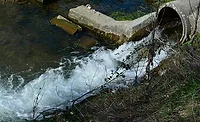
Wastewater treatment steps up a notch
Technology continues to catch up to need in the realm of wastewater treatment in protein-processing applications.
Every year, stricter wastewater restrictions push processors to advance their wastewater-treatment systems. While permit limits are driven at a federal level, processors deal with them in their local municipalities.
“We are going to constantly be underneath the permitting of the municipalities that we operate our businesses in — their wastewater facilities are not growing at the same rate [by] which the communities are,” says Gerald Lessard, vice president and chief operating officer of West Liberty Foods in West Liberty, Iowa. “As they continue to add residential property or commercial properties in these municipalities, they are going to be looking at the existing businesses as a means to limit the amount of expansion that they are going to have to invest in for their own wastewater-treatment facilities.”
West Liberty Foods’ greatest wastewater treatment challenges are biological oxygen demands (BOD) and Total Dissolved Solids (TDS) in its wastewater stream. The company’s other wastewater challenge is to maximize the effectiveness of its polymer usage rates and various chemicals that it uses to treat the water, so it can be safely discharged.
Permit renewal has become more stringent each year, agrees Bob Billingsley, director of development and engineering at Sanderson Farms Inc., Laurel, Miss. Currently, the industry has to watch total nitrates and phosphorus.
“It’s not something that we have limits on today, but it’s something that we know as a company … we will have to address and be able to meet,” Billingsley says.
Brad Alspaugh, maintenance and projects engineer of cooked meats at Cooper Farms, Van Wert, Ohio, adds that more stringent regulations from the Environmental Protection Agency on items such as phosphorus and ammonia present challenges. In addition, Cooper Farms deals with algae blooms in its lagoons.
“We have added a dissolved-air flotation (DAF) system and some more aeration on our lagoons to help enhance the treatment process,” Alspaugh explains.
Conservation and recycling
Cooper Farms currently is working on several water conservation projects. These include reusing some of the rinse water from its pan-wash machine to pre-rinse racks. The company also maintains sanitation limits on the use of large hoses for floors and other areas. In addition, Cooper Farms is exploring several projects for using recycled water in its cooling towers and boilers, Alspaugh says.
Although Cooper Farms has not yet seen a significant cost savings in its improvements to advance its wastewater systems, the processor remains hopeful that the projects will result in cost savings in certain areas. For example, the company is considering equipment for its wastewater facility to help reduce chemical costs, Alspaugh says.
Sanderson Farms tries to conserve water as part of its corporate responsibility program.
“It’s important to limit our footprint in this world that we live in,” Billingsley explains. “Our employees from the top down have fully embraced that. We’ve got targets that we look at every day. One of my big deals is that you can’t manage what you can’t see, … and we’ve got people that are accountable for meeting these objectives that our company set forth.”
West Liberty Foods has been certified ISO 14001 for many years. As a requirement to maintain that certification, the company must continue to demonstrate a reduction in the area of consumables, which includes water, natural gas and electricity.
“We already have pretty significant water-conservation practices in play as part of the ISO 14001 re-certification process,” West Liberty Foods’ Lessard says.
“We need to continue to advance technology in these areas, [and] … this is where we utilize our core teams in our facilities — active hourly employees that have ideas and concept strategies. We then start to advance those ideas and strategies, we reduce the water usage, and consequently we reduce the load on our own wastewater pre-treatment facility.”
Two of West Liberty Foods’ water reduction programs include recycling water for its facility’s trenches, and the company’s water leak detection/repair program.
“Those two programs save 2.8 million gallons of water,” says Ed Claussen, director of engineering at West Liberty Foods. “You start looking at 50 cents per thousand gallons that it costs to pump it and treat it for the facility, and that’s a cost reduction. We’re also using technology to better control the products it takes for us to treat our water. That’s also a cost saving. We are seeing various areas where we are saving some money by being more efficient with the water that we use as well as the processes it takes to treat the balance of the water that we have to discharge.”
West Liberty Foods also automated its Mt. Pleasant, Iowa, polymer control system.
“We are reducing our polymer usage, which has allowed us to not only reduce polymer, but it automates the system to where we can effectively reduce the man hours it takes to run our wastewater treatment facility,” Claussen says.
Recently, West Liberty Foods finished upgrading the wastewater-treatment facility in West Liberty to improve the polymer mixing and blending process to reduce BOD discharges to the stream. The company also is in the process of automating the system in its Tremonton, Utah-facility.
Sanderson Farms has incorporated new treatment technology when constructing new facilities as well. Since 2005 the company has added plants in Moultrie, Ga.; Waco, Texas; and Kinston, N.C., with another new location announced in Palestine, Texas.
“Because of these new plants … and because of the technology that’s available, we have been able to put systems in from an environmental standpoint that are very efficient and effective, and allow us to meet the challenges that we have coming,” Billingsley says. “Some people ask me: ‘As a company, do you all design your plants to meet the permit limits that you are issued by that state for that day?’ We don’t do that. As a company, the permit that we get for the site-specific location, that is the minimally accepted target that we meet every day. … We are going to treat that water down to a limit that’s much, much lower than the limit that we get from each individual state for a facility.”
Land application
Most of Sanderson Farms’ plants are direct-discharge plants, meaning the company treats the water to a quality that’s good enough to go into a receiving stream. Sanderson Farms also has the technology to operate spray fields in Kinston and Moultrie, where the soil is suitable for land application.
“That process allows us to take our processed wastewater, treat it to a limit where we can go out and spray on an agricultural crop,” Billingsley explains. “In our case, it is Bermuda grass fields. [We are] able to recycle that water back into the environment and back into the ground water where it does not go into a receiving stream.”
Sanderson Farms can easily manage the Bermuda grass crop by managing the consistency of its spray and the pattern in which the system sprays. In turn, the Bermuda grass uptakes the organics and uses them fully. The company then sells the hay that it produces off the field that is used by farmers in the area. It is also able to establish a 12-month growing cycle by planting a winter grass in the spray field such as rye, Billingsley says.
Additionally, four years ago, Sanderson Farms started projects at several of its plants to be able to create biogas that will replace natural gas in its operations.
“The technology is advancing very quickly right now in that area, and there is some technology today that wasn’t there five years ago,” Billingsley says. “That makes this an awful enticing thing to do. … Though [the biogas systems] are expensive, they do give us a long-term opportunity to be competitive in utility costs at our plant.”
When it comes to the environmental part of a business, Billingsley says one generally doesn’t see the normal paybacks that would entice a company to use technology.
“Those paybacks are a little longer,” he says. “But at Sanderson Farms, when we look at technology, though it may not have the shortest payback, it’s the right thing to do. Our company has always embraced that and tried to stay on the leading edge of technology and efficiencies as it relates to wastewater.”
Looking for a reprint of this article?
From high-res PDFs to custom plaques, order your copy today!