Provisioner logo
Provisioner logo
search
cart
facebook twitter linkedin youtube
  • Sign In
  • Create Account
  • Sign Out
  • My Account
Provisioner logo
Provisioner logo
  • NEWS
    • Industry News
    • Supplier News
    • Case Studies
    • Recalls
    • Regulations
    • New Consumer Products
  • EXCLUSIVES
    • Newsletters
    • Source Book
    • Sponsored Insights
    • Events
    • Webinars
    • Classifieds
    • White Papers
    • Provisioner Store
    • Market Research
  • MEAT PROCESSING
    • SUSTAINABILITY
    • Processing
    • Packaging
    • Ingredients
    • Formulation
    • Food Safety
    • Special Reports
    • Commentary
  • PROFILES
    • Processor Profiles
    • Processor of the Year
    • Top 100 Processors
  • MEDIA
    • Videos
    • Podcasts
  • DIRECTORY
  • MIHOF
  • INDEPENDENT PROCESSOR
  • EMAG
    • eMagazine
    • ARCHIVE ISSUES
    • Contact
    • Advertise
  • JOIN!
Food Safety

Food Safety

Bacteriophages: Natural disinfectants
By Megan Pellegrini
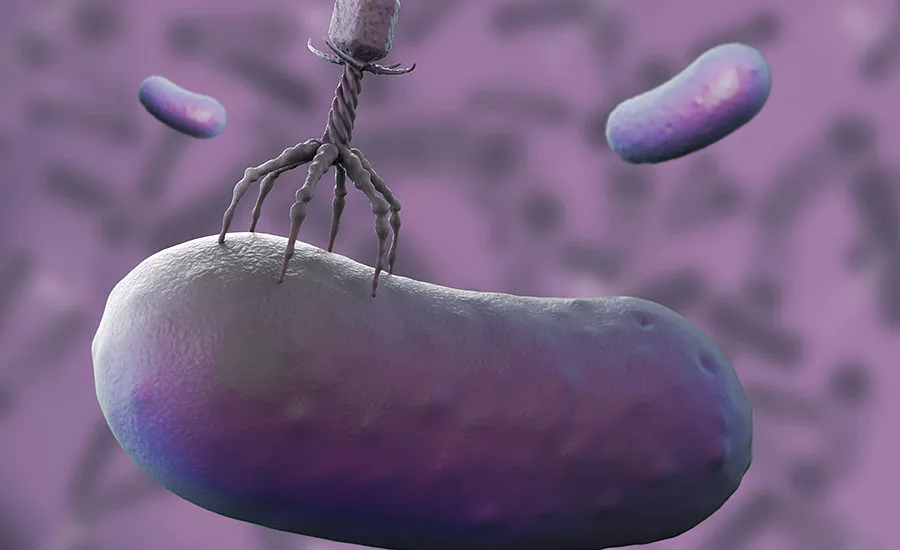
Bacteriophages targeting bacteria
Phages are becoming more popular as an alternative treatment and disinfection method.
September 15, 2017

As consumers increasingly demand antibiotic-free meat and poultry (and processors look to avoid antimicrobial resistance), alternative treatment and disinfection methods such as bacteriophages should become more popular in food and medicine.

Just this spring, a dying patient with multidrug-resistant bacterium was saved with emergency cocktails of bacteriophages.

Simply put, phages are viruses that target and attack bacteria. “Phages are everywhere so they are not inherently dangerous,” says Jason Gill, Ph.D., assistant professor of bacteriophage, biology and microbiology and program director of the Center for Phage Technology at College Station, Texas-based Texas A&M University. Gill’s team assisted with the sick patient. “But all companies working with them need to know what they’re doing, so there are no deleterious side effects.”

Generally phages are disseminated in a spray or nebulizer, he says.

“Processors prefer to use them on product surfaces,” notes Gill. “The phages won’t change the product or taste, but create a diluted buffer. Often, they are put on right before the item is vacuum packaged.”

While most phages are applied post-harvest, they can also be used pre-harvest to control the hot spots in beef facilities, such as drainage spots, or on hides before slaughter.

The drawback to using phages as sanitizers is that bacteria in processing facilities could develop resistance to them, says Laurence Goodridge, Ph.D., associate professor and Ian and Jayne Munro Chair in Food Safety at McGill University, based in Montreal, Quebec.

“If phages are sprayed on meat, even if the bacteria becomes resistant, the difference is that they [pathogens] can’t reinfect a surface in the plant,” Goodridge says.

Formulating better applications

Phages can also be used to detect pathogens faster. “During the enrichment step of the testing protocol, phages can speed up the detection process,” says Bruce Applegate, Ph.D., professor of food science and associate professor food science, at Purdue University, in Lafayette, Ind., whose team created NanoLuc phages.

The NanoLuc cells cause E. coli O157:H7 bacteria to glow if they connect, so processors can see whether the product is contaminated.

“Phages can be very effective for some applications, but there’s a huge range of conditions that phages might encounter in foods and food processing plants,” says Thomas Denes, Ph.D., assistant professor in molecular food microbiology at University of Tennessee, in Knoxville, Tenn. “We might be able to further improve the efficacy of phage-based biocontrol by formulating phage cocktails for use under specific conditions.”

Targeting more pathogens

Clustered regularly interspaced short palindromic repeats (CRISPR) technology aims to increase the functionality of phages so they can infect more than one pathogen, amongst other initiatives, he notes.

“There’s a lot of work being done with genetic modification of phages so they can target more pathogens,” he says. “Generally, they only target one type of bacteria, but we know any contaminant can be in animals at the same time.”

Treating the original source — animal health — with phages before pre-treatment intervention may be the next logical step.

“The challenge for animals is different because bacteria is hidden in their biofilm — a carpet of bacteria,” Goodridge says. “So it’s hard for bacteriophages to target this bacteria.”

Will consumers be on board with the increased use of phages?

“When phages were approved for use in the United States 11 years ago, there was huge backlash,” Goodridge says. “People saw the word ‘virus,’ and they got nervous. But now they realize phages are natural, naturally occurring, everywhere and where pathogens are, so they are more accepting.” NP

KEYWORDS: Bacteriophages Disinfectant

Share This Story

Looking for a reprint of this article?
From high-res PDFs to custom plaques, order your copy today!


Megan pellegrini
Megan Pellegrini is a contributing writer.

Recommended Content

JOIN TODAY
to unlock your recommendations.

Already have an account? Sign In

  • A cow eating grass and a chicken standing next to it in a field.

    The Top 100 Meat & Poultry Processors of 2026

    The 2026 Top 100 Meat & Poultry Processors highlights...
    Meat and Poultry Processing
    By: Fred Wilkinson
  • Breaded chicken nuggets on a white plate.

    Food safety programs prioritize prevention, verification, and traceability

    Across processing operations, food safety strategies are...
    Food Safety
    By: Sammy Bredar
  • An open double cheeseburger on a white plate, the top bun beside it, along with a side of seasoned fries.

    How convenience is driving summer grilling innovation in 2026

    Demand for high-quality, convenience-driven formats...
    Independent Processor
    By: Sammy Bredar
You must login or register in order to post a comment.

Report Abusive Comment

Manage My Account
  • eMagazine Subscriptions
  • Manage My Preferences
  • Newsletters
  • Online Registration
  • Subscription Customer Service
  • Connect with The National Provisioner

More Videos

Sponsored Content

Sponsored Content is a special paid section where industry companies provide high quality, objective, non-commercial content around topics of interest to the The National Provisioner audience. All Sponsored Content is supplied by the advertising company and any opinions expressed in this article are those of the author and not necessarily reflect the views of The National Provisioner or its parent company, BNP Media. Interested in participating in our Sponsored Content section? Contact your local rep!

close
  •  two individuals standing by a farm gate
    Sponsored byPIC

    When PRRS Hits Home: The Chinn Family’s Story and a Hopeful Future

  • A smiling man carrying a grocery basket is reaching down to pick up a package of meat in a grocery store.
    Sponsored byPIC

    The Green Light: New Data Shows 12-to-1 Support for Pork from PRRS-Resistant Pigs

  • Close up of a grocery cart full of groceries, a cropped image of a couple pushing the cart and a blurred background of the vegetable aisle.
    Sponsored byPIC

    New Market Research Finds Consumers in Eight Key Pork Markets Are Likely to Purchase Pork from Gene-Edited Pigs

Popular Stories

Butchers processing hanging beef carcasses in meat processing plant

Meat Institute says meatpacking industry restructuring won’t lower beef prices

Kroger logo

Kroger to acquire Giant Eagle for $1.65B

Corporate headquarters groundbreaking

PS Seasoning and Pro Smoker reveal new parent company at headquarters groundbreaking

2026 Top 100 Meat & Poultry Processors Report

Events

July 16, 2026

Strengthening Food Safety Plans for Modern Processing Operations

The live webinar will explore the latest technologies, emerging risks, and practical strategies shaping food safety programs across meat and poultry processing operations. Attendees will hear from industry experts on key challenges impacting processors today, along with approaches for strengthening and updating food safety plans across their facilities.

January 1, 2030

Webinar Sponsorship Information

For webinar sponsorship information, visit www.bnpevents.com/webinars or email webinars@bnpmedia.com.

View All Submit An Event

Products

Food Crime: An Introduction to Deviance in the Food Industry

Food Crime: An Introduction to Deviance in the Food Industry

See More Products
The National Provisioner 2026 Food Safety Report

Related Articles

  • Bacteriophages naturally exist in the environment and have long been studied for their ability to infect and kill pathogens

    Bacteriophages: Ready for battle

    See More
  • A Group of Phages

    Bacteriophages and application in the meat industry

    See More
  • Neogen logo

    Neogen sells global cleaners and disinfectants business for $130 million

    See More

Related Products

See More Products
  • meat inspection.jpg

    Meat Inspection and Control in the Slaughterhouse

  • seafood.jpg

    Seafood Safety and Quality

  • Handbook of Poultry Science and Technology, Volume 2, Secondary Processing

See More Products
×

Stay ahead of the curve. Unlock a dose of cutting-edge insights.

Receive our premium content directly to your inbox.

SIGN-UP TODAY
  • RESOURCES
    • Advertise
    • Contact Us
    • Directories
    • Store
    • Want More
  • SIGN UP TODAY
    • Create Account
    • eMagazine
    • Newsletter
    • Customer Service
    • Manage Preferences
  • SERVICES
    • Marketing Services
    • Reprints
    • Market Research
    • List Rental
    • Survey/Respondent Access
  • STAY CONNECTED
    • LinkedIn
    • Facebook
    • YouTube
    • X (Twitter)
  • PRIVACY
    • PRIVACY POLICY
    • TERMS & CONDITIONS
    • DO NOT SELL MY PERSONAL INFORMATION
    • PRIVACY REQUEST
    • ACCESSIBILITY

Copyright ©2026. All Rights Reserved BNP Media, Inc. and BNP Media II, LLC.

Design, CMS, Hosting & Web Development :: ePublishing