Simplifying moisture measurement to improve meat quality
In the meat processing industry, controlling the moisture content in dry good ingredients can impact product quality, formulation, processing, shelf life and even shipping costs. Therefore, accurate measurement of moisture content is essential throughout the process and even with the final product.
Until recently, however, conducting frequent moisture content tests in the field has been difficult. In many cases, the primary barrier has been the expertise and time required to conduct such tests. Often sophisticated moisture measurement devices must be operated by trained personnel that can properly calibrate the equipment. Many also require meticulous sample preparation.
Fortunately, handheld devices are now available that allow even less-skilled personnel to take lab-quality moisture measurements. These “point-and-measure” options allow readings to be quickly taken at any stage of the process including at the supplier, in receiving areas, in-process (prior and post-mixing) and on the finished product.
By doing so, meat processers can ensure a more consistent, high quality product ultimately reaches the consumer.
The Benefits of Frequent Moisture Readings
Although the reasons for measuring the moisture content of dry good meat ingredients can vary, the primary motivation is to improve product quality and the bottom line.
In terms of quality, incorrect moisture content in dry ingredients can lead to soggy products as well as alter its taste, texture, and appearance. Shelf life is also directly affected by moisture content. If there is too much moisture, mold can develop or the product can spoil in the package. Too little moisture and the product can become stale much faster.
Establishing the moisture level of dry ingredients that must be mixed together is also very important, as it can affect how the ingredients blend together, dissolve, or flow through the process.
Finally, since meat products are sold by weight, packaging and shipping the product at optimum moisture percentages can also help optimize the purchase price and freight cost.
Simplifying Moisture Measurement
Although traditional laboratory and online based moisture measurement techniques are useful in the right settings, they have lacked the simplicity and flexibility required for frequent spot checks.
One common test is Loss on Drying, which measures the total material weight change after drying. However, such tests typically require a sample to be prepared and brought back to the lab. The test takes at least 15 minutes to several hours to perform, which is too slow when more immediate measurements are required. It also requires the sample to be altered or destroyed.
As a result, secondary test methods have typically been used to deliver faster results. This type of test uses an indirect method and a single conversion to achieve accurate results. Secondary measurement techniques are routinely accepted as equal to the gold standard method. Examples are speedometers, common infrared and liquid thermometers and most pressure gauges. If there is a disadvantage, it is that the secondary instrument must first be calibrated to ensure accurate results. In some cases, calibration could only be performed by trained staff familiar with the equipment.
In response, industry innovators have developed a simplified approach that allows even less-trained personnel to take portable, instant moisture readings of dry good meat ingredients as needed.
The approach involves moisture meters that utilize Near-Infrared (NIR) light, a highly accurate, non-contact secondary measurement method that can deliver immediate laboratory quality moisture readings.
“NIR moisture meters allow very accurate instant measurement of solids, pastes, and liquids without contact or sample preparation, so there is no contamination in handheld and online models,” says John Bogart, Managing Director of Kett US, a manufacturer of a full range of moisture and organic composition analyzers. “Once the meter has been calibrated against the lab or production standard, the calibration is stored in the device so no calibration is required in the field. Measurements are fully traceable to the original measurement method.”
In addition, because the process is non-destructive, samples remain unaltered so they can be used for additional tests or put back into the product stream.
“NIR moisture meters follow the principle that water absorbs certain wavelengths of light,” says Bogart. “The meter reflects light off the sample, measures how much light has been absorbed, and the result is automatically converted into a moisture content reading.”
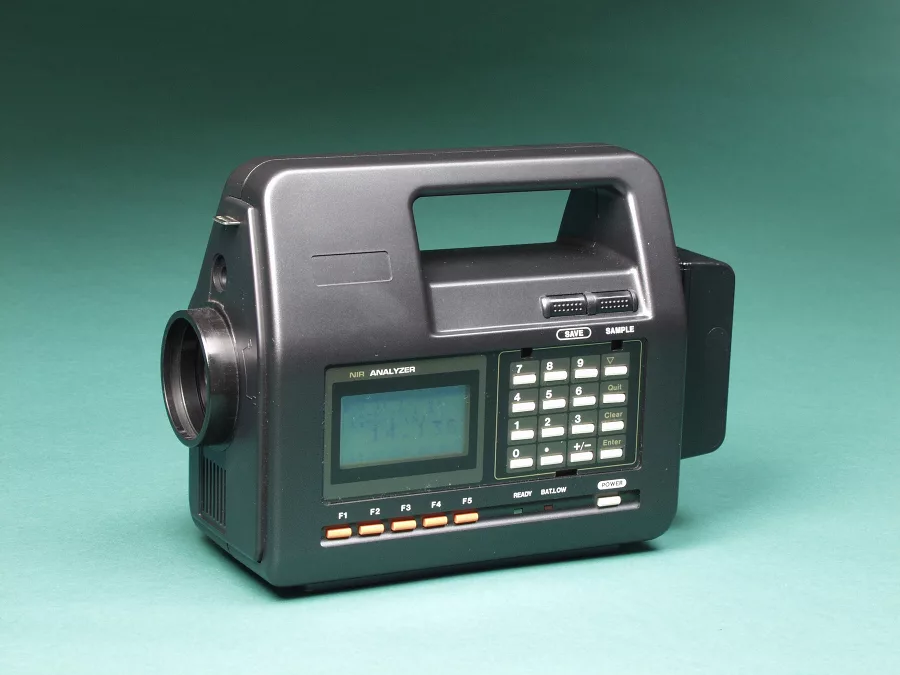
Unlike complex laboratory equipment, portable NIR equipment is designed for ease of use. For example, with Kett’s KJT130 Handheld Portable Instant Moisture Meter, the user simply points the instrument at the meat ingredient and the moisture content is instantly shown on a digital display, with results accurate to .01% in a 0-100% measurement range.
Because no direct contact or sample alteration is required, unusual textures and particle size variation are not an issue. This can be important when used with a range of meat ingredients in different settings.
For ease of use, the unit is operated via user friendly menu commands. The unit, which is the size of a camcorder, is designed for frequent spot checks wherever necessary, on both stationary and moving (process line) products. Moisture measurement data may be stored in the instrument, downloaded continuously, or manually recorded.
“The goal is for any staff member to be able to successfully use the moisture meter wherever it is needed, with minimal required training,” says Bogart. “This allows meat processors to have the certainty that what they are producing is of the highest quality.
“The key is to cost-effectively be able to conduct as much testing as required, with full confidence in the results, each and every time,” adds Bogart.
For more info, contact Kett: call 800-438-5388; email support@kett.com or visit www.kett.com.
Looking for a reprint of this article?
From high-res PDFs to custom plaques, order your copy today!