Provisioner logo
Provisioner logo
search
cart
facebook twitter linkedin youtube
  • Sign In
  • Create Account
  • Sign Out
  • My Account
Provisioner logo
Provisioner logo
  • NEWS
    • Industry News
    • Supplier News
    • Case Studies
    • Recalls
    • Regulations
    • New Consumer Products
  • EXCLUSIVES
    • Newsletters
    • Source Book
    • Sponsored Insights
    • Events
    • Webinars
    • Classifieds
    • White Papers
    • Provisioner Store
    • Market Research
  • MEAT PROCESSING
    • SUSTAINABILITY
    • Processing
    • Packaging
    • Ingredients
    • Formulation
    • Food Safety
    • Special Reports
    • Commentary
  • PROFILES
    • Processor Profiles
    • Processor of the Year
    • Top 100 Processors
  • MEDIA
    • Videos
    • Podcasts
  • DIRECTORY
  • MIHOF
  • INDEPENDENT PROCESSOR
  • EMAG
    • eMagazine
    • ARCHIVE ISSUES
    • Contact
    • Advertise
  • JOIN!
Meat and Poultry Industry NewsChicken

Independent Processor's Prime Cuts

Harrison Poultry breaks ground on new feed mill project
By Sam Gazdziak
Harrison Poultry Feed Mill
December 12, 2018

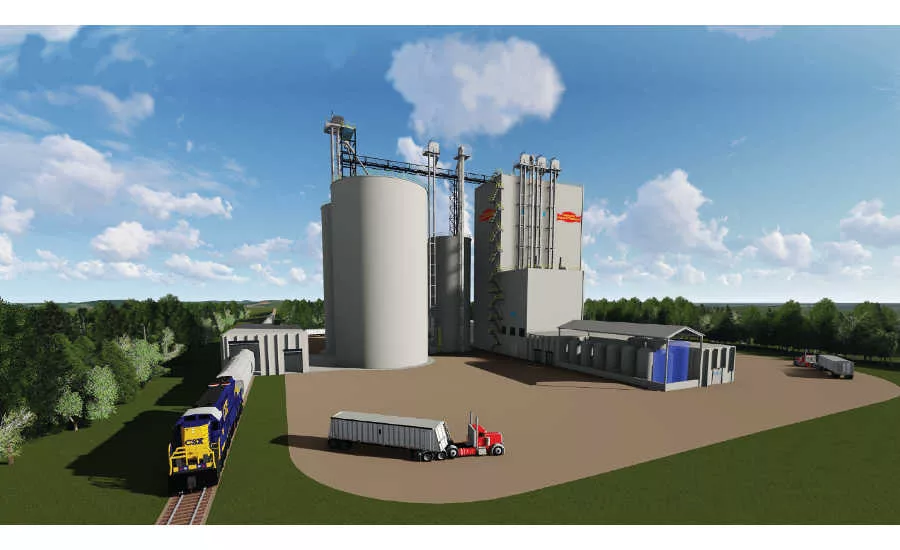
Harrison Poultry, a Bethlehem, Ga. chicken processor, held a groundbreaking ceremony for its new, state-of-the-art feed mill complex in early December 2018. That achievement was the first step in a multi-year, multi-million dollar plan to greatly increase its production capacity, processing capacity and operating efficiencies. For this 60-year-old Georgia processor, the key to its upcoming transformation had to start at the mill.

Harrison Poultry was founded by R. Harold Harrison in 1958. Seven years after the company was launched, it built a feed mill in Winder, Ga. That feed mill, now 53 years old, has the capacity to produce 5,000 tons of feed per week. The new mill will produce more than three times that amount — 18,000 tons per week.

“Most poultry processors have a proprietary feed formula. That’s a key component here. When you’re hitting your limitation on feed production, it’s not very easy to go out and buy supplemental feed,” explains Wayne Tanner, Chairman of the Board for Harrison Poultry.

The mill came with other inefficiencies as well, adds David Bleth, CEO.

“It was on a single track that could only allow us to have 11 railcars of corn at any given time. The railroad would have to stop on the main line, cut out 11 cars for us, and then continue on. They charged us additional freight called single-car freight rate, which was much more expensive and not as efficient,” he explains.

The new mill, which is expected to begin operation in the summer of 2020, will be able to take an entire train of 90 or more rail cars and offload them in 15 hours.

“That’s unheard-of efficiency,” Bleth says.

In addition, the mill will have multiple lines, so in addition to producing its own feed, Harrison Poultry can experiment with new formulations, utilize the bin capacity to store those new feeds, and run trials in the field to see how they perform.

The feed mill is located in Talliaferro County (pronounced “Toliver”), which is home to approximately 1,600 residents. The company has been told by county officials that the project will make Harrison Poultry the largest employer in the history of the county.

“We are pleased to welcome Harrison Poultry to our community,” said Jackie Butts, executive director of the Taliaferro County Development Authority. “This company will provide much-needed job opportunities for us and for the region, as well.”

This feed mill project will have a ripple effect on the entire region, as Harrison Poultry prepares for even further changes. Once the feed mill is built, the company will build a hatchery. To accommodate the new, larger facilities, it will need to add 300 to 400 chicken houses. With a larger supply of chickens, the company’s Bethlehem facility in Barrow County will need to add a second shift and, eventually, a new production facility in a to-be-determined location.

An economic impact study of the project concluded that the initial capital investment will be a minimum of $161.5 million and could easily approach $200 million, with the addition of land and infrastructure. There would be at least 236 full-time employees hired with a cumulative annual payroll of more than $8 million. Barrow County, the home of its current feed mill and hatchery, will see a slight decrease in employees as those jobs are transitioned to the new location. However, as the Bethlehem facility expands its processing capacity with a second shift, there will be a net job increase in the county.

Harrison Poultry’s desire to relocate its production base reflects the changes that have taken place in Georgia over the last few decades. Its present feed mill in Winder was at one point the center of its broiler house universe, Bleth explains. As that area has become less agricultural-oriented, the broiler houses have moved much further away from Harrison’s  existing feed mill.

“We have of all chicken companies some of the longest hauling distances to get to our farms. Now, some of them are well over 100 miles round-trip to get to them and deliver feed,” he adds. “We’re trying to centralize our feed mill again and get back to being near our core group of farms.”

Harrison Poultry has a nationwide distribution and also exports internationally. The company caters to the Hispanic market and produces a yellow-skin bird that is favored by that consumer base. The plan to modernize its operations has been in the works for close to a decade, but finding a location proved difficult until the option in Talliaferro County became available. Tanner credits Bleth and his team for putting in the effort over the last two years to bring the plan to closure.

“It all comes back to the feed mill,” Tanner relates. “Obviously, the feed mill is first, and then you need to hatch and grow the chickens, so you need an improved hatchery capacity. Then once you hatch those, you have to have somewhere to put them, so you need the grower houses, and from there you have to process them.

“You can see where this takes a lot of creative thinking and planning and logistics, and it’s a multi-year process to get it to where your goal is. We have that plan in place, and we just have to execute it,” he adds.

KEYWORDS: expansion feed mill georgia harrison poultry

Share This Story

Looking for a reprint of this article?
From high-res PDFs to custom plaques, order your copy today!
Former Editor In Chief, Independent Processor, and Former Editor, National Provisioner. 

Sam Gazdziak has been writing for trade publications since 1997 and joined The National Provisioner in 2004. He helped launch Independent Processor magazine in 2008 as its editor-in-chief.

Recommended Content

JOIN TODAY
to unlock your recommendations.

Already have an account? Sign In

  • Double Charburger

    Premiumization drives burger category

    Shoppers seek out premium meat offerings to fulfill...
    Meat and Poultry Industry News
    By: Sammy Bredar
  • JJS Adult Pekin duck

    Poultry Report 2025: Convenience propels poultry at retail

    Despite continued economic pressures, the poultry...
    Turkey
    By: Sammy Bredar
You must login or register in order to post a comment.

Report Abusive Comment

Manage My Account
  • eMagazine Subscriptions
  • Manage My Preferences
  • Newsletters
  • Online Registration
  • Subscription Customer Service
  • Connect with The National Provisioner

More Videos

Sponsored Content

Sponsored Content is a special paid section where industry companies provide high quality, objective, non-commercial content around topics of interest to the The National Provisioner audience. All Sponsored Content is supplied by the advertising company and any opinions expressed in this article are those of the author and not necessarily reflect the views of The National Provisioner or its parent company, BNP Media. Interested in participating in our Sponsored Content section? Contact your local rep!

close
  • A smiling man carrying a grocery basket is reaching down to pick up a package of meat in a grocery store.
    Sponsored byPIC

    The Green Light: New Data Shows 12-to-1 Support for Pork from PRRS-Resistant Pigs

  • Close up of a grocery cart full of groceries, a cropped image of a couple pushing the cart and a blurred background of the vegetable aisle.
    Sponsored byPIC

    New Market Research Finds Consumers in Eight Key Pork Markets Are Likely to Purchase Pork from Gene-Edited Pigs

  • Close up of a young pig with a blurred background.
    Sponsored byPIC

    New Research Forecasts Significant Economic and Market Impacts with PRRS-Resistant Pig Adoption

Popular Stories

Various new Primal snack sticks on a table amongst pencils, apples, a pair of glasses, lunch bags and a water bottle.

Protein demand drives snacking occasions

Several cuts of beef, pork and chicken on a wooden board, cast iron pan and salt.

Validated thermal lethality data and a new tool for ensuring safety of RTE meats

Cargill logo

Cargill initiates lockout at Fort Morgan beef plant after union rejects contract

2026 Top 100 Meat & Poultry Processors Report

Events

January 1, 2030

Webinar Sponsorship Information

For webinar sponsorship information, visit www.bnpevents.com/webinars or email webinars@bnpmedia.com.

View All Submit An Event

Products

Food Crime: An Introduction to Deviance in the Food Industry

Food Crime: An Introduction to Deviance in the Food Industry

See More Products
From Fresh to Frozen in 3 Minutes Flat: Unlocking the Secrets to Temperature Control Webinar Sponsored by Air Products

Related Articles

  • Wayne Farms breaks ground for new feed mill

    See More
  • Kemin logo 2021

    Kemin breaks ground on new facility for clean-label protein ingredients for meat and poultry industries

    See More
  • Williams Sausage breaks ground on new facility

    See More

Related Products

See More Products
  • Handbook of Meat, Poultry and Seafood Quality, second edition

  • fermented.jpg

    Handbook of Fermented Meat and Poultry, 2nd Edition

  • Handbook of Poultry Science and Technology, Two-Volume Set

See More Products

Events

View AllSubmit An Event
  • January 25, 2023

    AFIA Feed Education Program

    The American Feed Industry Association’s production compliance committee is hosting the annual free Feed Production Education program again in 2023. As regulatory requirements for the feed industry continue to evolve, this training session will update participants on any recent changes from several federal agencies including DOL, DOT, EPA, FDA and OSHA as well as a presentation on the importance of a written pandemic policy. In addition, the 2022 Commercial Dry Mill Feed Mill of the Year will be announced.    This agenda has been approved for 1 ARPAS CEU's.
View AllSubmit An Event

Related Directories

  • Midwest Poultry Federation

    The Midwest Poultry Federation (MPF), a 501(c)6 nonprofit organization, was founded in 1971 and held its first convention in Minneapolis in 1972. MPF’s primary purpose is to host an annual convention - called PEAK - emphasizing on-farm poultry production. The convention’s goal is to offer cutting-edge information to attendees through a balanced offering of exhibits and educational workshops.
×

Stay ahead of the curve. Unlock a dose of cutting-edge insights.

Receive our premium content directly to your inbox.

SIGN-UP TODAY
  • RESOURCES
    • Advertise
    • Contact Us
    • Directories
    • Store
    • Want More
  • SIGN UP TODAY
    • Create Account
    • eMagazine
    • Newsletter
    • Customer Service
    • Manage Preferences
  • SERVICES
    • Marketing Services
    • Reprints
    • Market Research
    • List Rental
    • Survey/Respondent Access
  • STAY CONNECTED
    • LinkedIn
    • Facebook
    • YouTube
    • X (Twitter)
  • PRIVACY
    • PRIVACY POLICY
    • TERMS & CONDITIONS
    • DO NOT SELL MY PERSONAL INFORMATION
    • PRIVACY REQUEST
    • ACCESSIBILITY

Copyright ©2026. All Rights Reserved BNP Media, Inc. and BNP Media II, LLC.

Design, CMS, Hosting & Web Development :: ePublishing