Provisioner logo
Provisioner logo
search
cart
facebook twitter linkedin youtube
  • Sign In
  • Create Account
  • Sign Out
  • My Account
Provisioner logo
Provisioner logo
  • NEWS
    • Industry News
    • Supplier News
    • Case Studies
    • Recalls
    • Regulations
    • New Consumer Products
  • EXCLUSIVES
    • Newsletters
    • Source Book
    • Sponsored Insights
    • Events
    • Webinars
    • Classifieds
    • White Papers
    • Provisioner Store
    • Market Research
  • MEAT PROCESSING
    • SUSTAINABILITY
    • Processing
    • Packaging
    • Ingredients
    • Formulation
    • Food Safety
    • Special Reports
    • Commentary
  • PROFILES
    • Processor Profiles
    • Processor of the Year
    • Top 100 Processors
  • MEDIA
    • Videos
    • Podcasts
  • DIRECTORY
  • MIHOF
  • INDEPENDENT PROCESSOR
  • EMAG
    • eMagazine
    • ARCHIVE ISSUES
    • Contact
    • Advertise
  • JOIN!
Supplier News

PU vs. epoxy - What’s the reason for different resins?
By Industry News
Florcrete Flooring
January 15, 2019

The two main types of resin floors are polyurethanes (PU) and epoxies – and understanding which is appropriate for different environments is very important for many construction industry professionals. 

Each flooring system has differing properties suited to particular uses and choosing the wrong solution can result in costly repairs or even complete floor failure down the line. 

While both are called resins, epoxy and PU floors should not be considered the same thing. Admittedly they do share similarities, such as being two-component systems (a resin and a hardener) that when brought together undergo a process of stoichiometric curing to form a solid layer. In both cases this results in a seamless, impervious coating that can be applied quickly in large quantities, but they are two very different types of materials with specific characteristics and uses.

The main difference between these two types of materials is in the molecular structure, which affects how it fuses together during the curing process. There are multiple types of components that can be used and that will vary the end result slightly, but essentially PUs have a higher cross-linked density than epoxies, making them the harder wearing of the two.

Thanks to this, PU systems have long been associated with offering strength, durability and resilience when faced with a variety of testing conditions, such as heavy footfall, physical impacts, extreme temperatures and corrosive chemicals. 

PU systems are therefore very well suited to industrial facilities, where the floor is likely to face a long list of challenges on a daily basis. For example, just a hand pallet truck when fully loaded could weigh in excess of one tonne, which puts a vast amount of pressure through its wheels and into the floor. The robust nature of PU systems means that they can survive the abuses of industrial operations for a very long period of time.

Epoxies on the other hand are much more rigid in terms of structure and cannot tolerate intense heat as well. To exemplify this, some epoxy coatings are heat resistant to temperatures up to 65°C, whereas PU systems are available that can tolerate 120°C. 

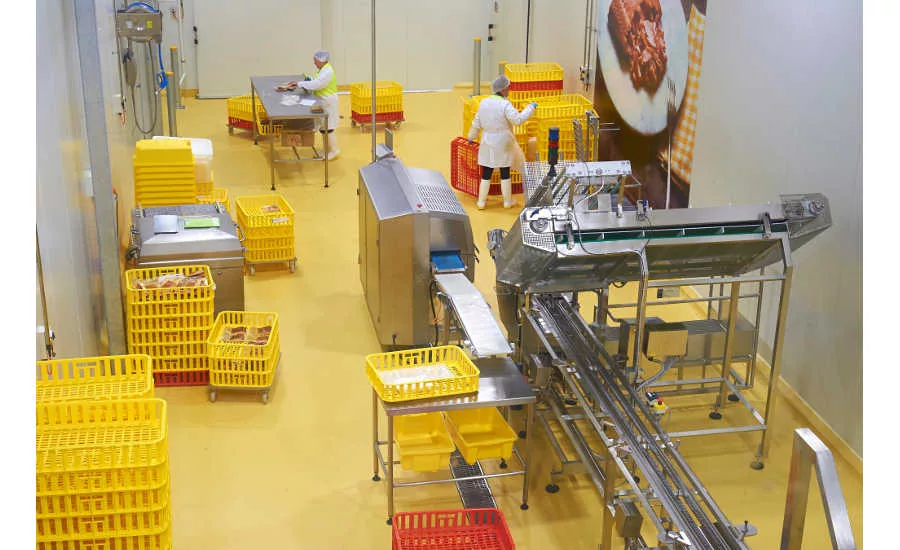
The superior chemical resistance of PU floors has made them popular in the food & beverage industry, where corrosive acids and by-products are found in large quantities. This means that floors are required that can stand up to chemical attack from organic acids as well as sugar, malt, caustic and powerful cleaning agents. 

At this point it might seem like PU is the superior option, however what they give in durability they take away in versatility and aesthetics. Epoxies can be very easily adapted for a wide variety of environments and are available in a much wider range of colours, styles, effects and decorative options. 

Unless there is a specific challenge or requirement for a PU, there will more than likely be an epoxy floor that is up to the task at hand, and which can do so in bright and glossy tones, glittering light reflective surfaces or multi-toned swirling shades.

This gives designers the creativity to install unique floors that convey the interior design scheme. This is a particularly good way to represent a brand identity, specific aesthetic or to infuse the environment with the desired vibe. This has made epoxies a go-to floor for large-scale commercial venues such as shopping centres and airports as well as in less heavy-duty industrial spaces or for customer-facing processing zones that need to look good as well as be functional.   

PU systems also tend to be thicker and heavier than epoxies, which is great for absorbing impacts and thermal shock, but if weight and space is an issue then epoxies offer a thinner and lighter option. 

Just to confuse issues further, when talking about PU it’s important to bear in mind that there are a few different types. There are full PU “liquid vinyl” type floors, which are great for creating soft surfaces underfoot due to the elastic nature of PU. However more common are PU deck coatings used for car parks and PU concrete systems, which are the most failure resistant type of resin flooring available.

PU concrete is often the one found in challenging industrial facilities as it is great at withstanding punishing impacts, extreme temperatures, heavy loads, harsh chemicals and the like. It can also be customised with anti-slip aggregates, anti-bacterial additives and is highly adept at dealing with rising moisture. As already mentioned it’s just not very pretty and unless it has an aliphatic coating it isn’t particularly colour stable. 

In summary, it’s not so much a case of which one is better, as it’s really about which one is better for the building in question. To find out more about what resin floors best suit a specific environment, get in touch with the resin flooring specialists Flowcrete today.  

KEYWORDS: flooring

Share This Story

Looking for a reprint of this article?
From high-res PDFs to custom plaques, order your copy today!


Recommended Content

JOIN TODAY
to unlock your recommendations.

Already have an account? Sign In

  • Double Charburger

    Premiumization drives burger category

    Shoppers seek out premium meat offerings to fulfill...
    Ingredients
    By: Sammy Bredar
  • JJS Adult Pekin duck

    Poultry Report 2025: Convenience propels poultry at retail

    Despite continued economic pressures, the poultry...
    Chicken
    By: Sammy Bredar
You must login or register in order to post a comment.

Report Abusive Comment

Manage My Account
  • eMagazine Subscriptions
  • Manage My Preferences
  • Newsletters
  • Online Registration
  • Subscription Customer Service
  • Connect with The National Provisioner

More Videos

Sponsored Content

Sponsored Content is a special paid section where industry companies provide high quality, objective, non-commercial content around topics of interest to the The National Provisioner audience. All Sponsored Content is supplied by the advertising company and any opinions expressed in this article are those of the author and not necessarily reflect the views of The National Provisioner or its parent company, BNP Media. Interested in participating in our Sponsored Content section? Contact your local rep!

close
  • A smiling man carrying a grocery basket is reaching down to pick up a package of meat in a grocery store.
    Sponsored byPIC

    The Green Light: New Data Shows 12-to-1 Support for Pork from PRRS-Resistant Pigs

  • Close up of a grocery cart full of groceries, a cropped image of a couple pushing the cart and a blurred background of the vegetable aisle.
    Sponsored byPIC

    New Market Research Finds Consumers in Eight Key Pork Markets Are Likely to Purchase Pork from Gene-Edited Pigs

  • Close up of a young pig with a blurred background.
    Sponsored byPIC

    New Research Forecasts Significant Economic and Market Impacts with PRRS-Resistant Pig Adoption

Popular Stories

Spam Dog

Hormel rolls out Spam hot dog for foodservice applications

Niman Ranch Uncured Grass-Fed Beef Bacon

Niman Ranch introduces beef bacon

Various new Primal snack sticks on a table amongst pencils, apples, a pair of glasses, lunch bags and a water bottle.

Protein demand drives snacking occasions

2026 Top 100 Meat & Poultry Processors Report

Events

June 11, 2026

From Fresh to Frozen in 3 Minutes Flat: Unlocking the Secrets to Temperature Control

Join Tony Vacaro, Foods Industry Manager, and Emile Klein, Foods Market Strategy Manager at Air Products and Chemicals, Inc. , as they tackle key questions surrounding heat removal in food processing. 

January 1, 2030

Webinar Sponsorship Information

For webinar sponsorship information, visit www.bnpevents.com/webinars or email webinars@bnpmedia.com.

View All Submit An Event

Products

Food Crime: An Introduction to Deviance in the Food Industry

Food Crime: An Introduction to Deviance in the Food Industry

See More Products
From Fresh to Frozen in 3 Minutes Flat: Unlocking the Secrets to Temperature Control Webinar Sponsored by Air Products

Related Articles

  • Critical Limit vs. Target Limit – What’s the difference?

    See More
  • Cheryl Hendricks of NCBA on what the AHA Heart Check Logo means for beef products

    See More
  • NCBA on what the GLP-1 Effect means for beef.png

    NCBA's Lillie Berman discusses what the GLP-1 Effect means for beef

    See More

Related Products

See More Products
  • meat.jpg

    Non-Thermal Processing Technologies for the Meat, Fish, and Poultry Industries

  • food safety.jpg

    Food Safety in the Seafood Industry: A Practical Guide for ISO 22000 and FSSC 22000 Implementation

See More Products

Related Directories

  • PMMI - The Assn. for Packaging and Processing Technologies

    PMMI is a global resource for the packaging and processing industry, uniting the industry across the manufacturing supply chain. Our members promote business growth in a variety of industries by developing innovative manufacturing solutions to meet evolving consumer demands, today and in the future. PMMI membership represents more than 1,000 manufacturers and suppliers of equipment, components and materials as well as providers of related equipment and services to the packaging and processing industry.
×

Stay ahead of the curve. Unlock a dose of cutting-edge insights.

Receive our premium content directly to your inbox.

SIGN-UP TODAY
  • RESOURCES
    • Advertise
    • Contact Us
    • Directories
    • Store
    • Want More
  • SIGN UP TODAY
    • Create Account
    • eMagazine
    • Newsletter
    • Customer Service
    • Manage Preferences
  • SERVICES
    • Marketing Services
    • Reprints
    • Market Research
    • List Rental
    • Survey/Respondent Access
  • STAY CONNECTED
    • LinkedIn
    • Facebook
    • YouTube
    • X (Twitter)
  • PRIVACY
    • PRIVACY POLICY
    • TERMS & CONDITIONS
    • DO NOT SELL MY PERSONAL INFORMATION
    • PRIVACY REQUEST
    • ACCESSIBILITY

Copyright ©2026. All Rights Reserved BNP Media, Inc. and BNP Media II, LLC.

Design, CMS, Hosting & Web Development :: ePublishing