Improving hydration, cooking and cooling, and de-flavoring of plant-based proteins in the manufacture of meat substitutes
By Jim McMahon
Dry beans, lentils and peas are a popular and growing choice in the diet of Americans. Factors driving the growth in consumption of pulses include widespread interest in ethnic foods and changes in Americans' dietary awareness. As a group they are one of the most nutritionally-complete foods, inexpensive and widely available. High in protein, fiber and carbohydrates, and low in fat, these black beans, pinto beans, garbanzo beans, soybeans, lentils and peas have become a healthy and popular substitute for meat.
Expanding Market for Meat Substitutes
The trend toward vegan, vegetarian and flexitarian diets is greatly influencing the use of plant-based proteins as meat and seafood substitutes. Market analysis prepared by The Good Food Institute (GFI) and the Plant Based Foods Association (PBFA), the trade association representing more than 160 plant-based food companies, reports that in 2019 the plant-based meat category alone was worth more than $939 million worldwide annually, with sales up18.4 percent compared to the prior year, and up 37.9 percent over the prior two years. More than 208 million units of plant-based meat were sold in 2019.
Leading this category are products such as Beyond Meat, which makes beef, sausage and beef crumbles under the brand Beyond, using primarily pea protein isolate. Impossible Foods produces the Impossible Burger, using soy protein concentrate, soy-protein isolate and potato protein. Soy and wheat-based proteins are also used in the Awesome Burger and Incredible Burger from Nestlé. Kraft Foods produces BOCA meatless patties using soy protein concentrate, isolated soy protein, and hydrolyzed soy protein as the main plant-based protein ingredients. And Good Catch Foods offers tuna substitutes using a blend of lentils, peas, chickpeas, soy and fava beans, like Naked in Water, that capture the taste and texture of real tuna.
Processing for Taste and Texture
To achieve the desired taste and texture for plant-based meat substitutes, manufacturers prepare pulses by subjecting them to processes such as hydration, cooking, de-flavoring, pasteurization and cooling. A wide range of product characteristics can be achieved by altering these process conditions. Supplemental ingredients and flavorings are added to arrive at proprietary blends. High-moisture extrusion and shear cell processes are used to define the texture and shape of the products, then molded into forms such as crumbles, strips, patties and sausages.
This article will focus on some of the latest processing technology related to hydration, cooking and cooling, de-flavoring and pouch cooling after pasteurization.
Continuous Processing
Over the past 40 years, continuous processing technology in the handling of pulses for cooking and cooling has evolved far beyond quality and throughput expectations of batch processes. Processing labor hours have reduced to a fraction of what batch systems require.
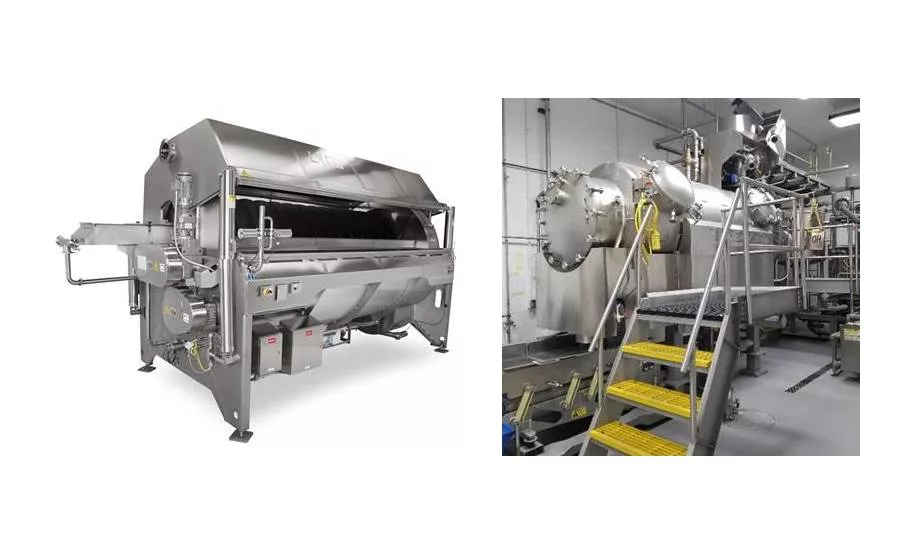
Continuous process systems slowly move pulses through an enclosed perforated drum resulting in the product being submerged in water, using an auger or screw to control dwell times. The pulses are hydrated, cooked and cooled to the same degree throughout their movement in the drum from entry to exit, ensuring uniform first-in/first-out (FI/FO) processing.
The conventional method of continuous process uses a rotary drum, where the enclosed auger/drum assembly rotates as one cylinder. A more recent continuous design has the auger rotating while residing within a stationary wedge-wire screen. Each system has its advantages with processing pulses, depending on the need for gentle product handling, and changeover and cleaning requirements.
Aided by the integration of pre-programmed PLCs that ensure a precisely controlled process and recipe management, continuous-processing systems deliver precise automated control of hydration, cook and cool functions, resulting in uniform heating and cooling that achieves a totally consistent end product.
The most advanced of these continuous-process systems have the added benefit of providing an exceptionally low product damage rate of less than 1 percent. Supporting this has been the development of two technologies that ensured more uniform processes, and allowed cookers and coolers to handle higher throughputs.
The first is a gentle mechanical stirring action on the pulses as they progress through the machine. The other is a system called Hydro-Flow, which applies water injection that puts the pulses in suspension, more evenly distributing the product loading across the width of the machine, and uniformly treating each particle.
Much of the technological developments integrated into continuous-process cookers and coolers, such as Hydro-Flow, were developed by Lyco Manufacturing, a leading manufacturer of commercial cooking and cooling systems for food processors. These improvements have helped push the acceptance of continuous processing, where now, more than 50 percent of the dry bean market has adapted to continuous over batch systems.
Hydration
Hydration in pulse processing is necessary to prepare the pulse for subsequent cooking or extrusion, by increasing water weight from a dry state of approximately 12 percent moisture to as much as 58 percent moisture.
"For hydration, continuous systems are much more effective than conveyor systems and static soak tanks of water," said Jeff Zittel, Vice President of Sales, Marketing, Applications Engineering and Service, with Lyco. "Hydration times are reduced from as much as from 4 to12 hours, to 1 hour or less, which is a huge improvement in productivity for processors of plant-based proteins."
Cooking and Cooling
Cooking and cooling plays a critical role in the processing of plant-based proteins for meat substitutes. They can be used to modify the outer texture of extruded soy products, as well as enabling the extruded pieces to be easily pulled into fibers resembling real meat. But for a growing number of processors of these meat substitutes the need for higher capacity lines with faster product change-overs has become a topline issue.
“Food processors have become increasingly concerned about food safety, quick change-overs, and faster clean-up time and turn-around time,” said Zittel. “This trend is taking place around the globe to accommodate the needs of more diverse consumers, and particularly so with the manufacture of ready-to-eat meals, and cooking and cooling plant-based proteins for meat substitutes.”
A recently-released continuous-processing system, called Clean-Flow, addresses this need, applicable to both cooking and cooling of pulses.
The Clean-Flow design begins with a very accurately made screw auger, similar to what is used in the systems mentioned prior. The auger resides in a stationary wedge-wire screen that encapsulates the screw from the 3:00 to 9:00 o’clock position. The tolerance between the screw and the screen is less than one-half a grain of rice. Water agitation via Hydro-Flow is injected through the screen which keeps the pulse product off from the floor of the screen, where it is maintained in total suspension. The pulse runs through the cooking Clean-Flow system, then is immediately put through another Clean-Flow cooling system to stop the cooking process. Damage to fragile pulses amounts to a fraction of one percent.
"A very unique aspect of this system is attributed to its namesake," added Zittel. "Clean-Flow is designed to reduce clean up from hours to minutes, because the screw is totally exposed for cleaning. During clean-up the wedge-wire screen is released from its fixed position, and is continually rotated 360 degrees around the screw alternately exposing the interior and exterior of the screen to clean-in-place (CIP) manifolds located in the cover of the machine. The screw can be rotated at the same time as the screen, again exposing all surfaces to the cleansing water sprays. The CIP can clean more than 98 percent of the machine without manual intervention."
De-flavoring
Despite the growing interest in using plant-based pulse proteins as meat substitutes, their flavor often can limit their use. Eliminating undesirable aroma and flavor properties provides a greater opportunity for the inclusion of pulse proteins in foods.
De-flavoring removes the bitter taste from garbanzo beans, yellow split peas, lentils and other pulses. The process is optimally accomplished by steaming. One advanced continuous system that is particularly well suited for de-flavoring is the Vapor-Flow steam cooker. The pulse is transported through the machine by an auger wrapped with a perforated screen. Steam is injected at the base of the cylinder at multiple points. The rotating auger ensures uniform heat penetration throughout the entire product load depth.
Another recently-released system, called Pressure-Flow, is a continuous cooker that is an ideal system for de-flavoring pulses. It reduces pulse cook times from 45 minutes down to 8 minutes or less. The system was specifically designed to hydrate, par-cook or fully-cook pulses, grains and other particulates. It provides plant-based protein processors with a unique continuous first-in/first-out pressure cooker, while offering the latest in fully-automated Clean-Flow technology in a pressure vessel.
Pouch Cooling after Pasteurization
"Flexible packaging/pouches are a convenient, portable and environmentally-friendly method to package processed plant-based proteins, and particularly fully-processed meat substitutes, for food service and retail markets," explained Zittel. "Once product is processed and put into a package or pouch it can be pasteurized."
After pasteurization, the pouched product needs to be cooled. Water is the most economical and efficient medium for transferring or removing the heat. Cooling time depends upon the product, density, weight and recipe, and can vary from 20 to 120 minutes. USDA Regulations dictate that final product temperature must be close to 40°F or lower within a given period of time. It is important that pouches pass through the danger zone (130°F to 80°F) rapidly where bacteria are most likely to proliferate. Pouches may vary from a few ounces to more than 10 pounds, and in every case gradual cooling is important so as not to freeze the exterior while the core remains warm.
Cooling pouched plant-based proteins in the form of strips, burgers, sausages and crumbles is effectively achieved with a continuous system called Chill-Flow, which represents a state-of-the-art system for pouch cooling.
This system functions as a rotating drum with an attached auger, and a perforated skin sheet wrapped around it that is fixed to the auger flights so to eliminate pinch points. These flights gently move the pouches through the system. The pouches are carefully agitated with Hydro-Flow, turned over and massaged, while totally submersed in water that is 33 degrees F as they advance through the cylinder. Much more energy efficient than air cooling, water deluge belts or belt freezer methods. Once through the system – in a FI/FO sequence – the pouches, now at 40° F, are then gently deposited out of the system for subsequent packaging and storage in a freezer. Product damage is near zero percent.
A Better Solution
"Food manufacturers are approaching the processing of plant-based meat substitutes from many different perspectives – from the selection and blending of pulses, to the systems employed to achieve final products," added Zittel.
But the preparation of these dry beans, lentils, soy beans and peas for processing into plant-based meat substitutes is increasingly becoming standardized with the use of continuous-processing systems. These highly-automated systems maintain precise control over time, temperature and moisture, enabling higher throughput, a better ROI, and most importantly a more standardized and better quality product.
For more information visit www.lycomfg.com.
Looking for a reprint of this article?
From high-res PDFs to custom plaques, order your copy today!