Butter and lard as coating materials in beef aging
Overall, lipid-coated aging did not show clear advantages over wet aging.
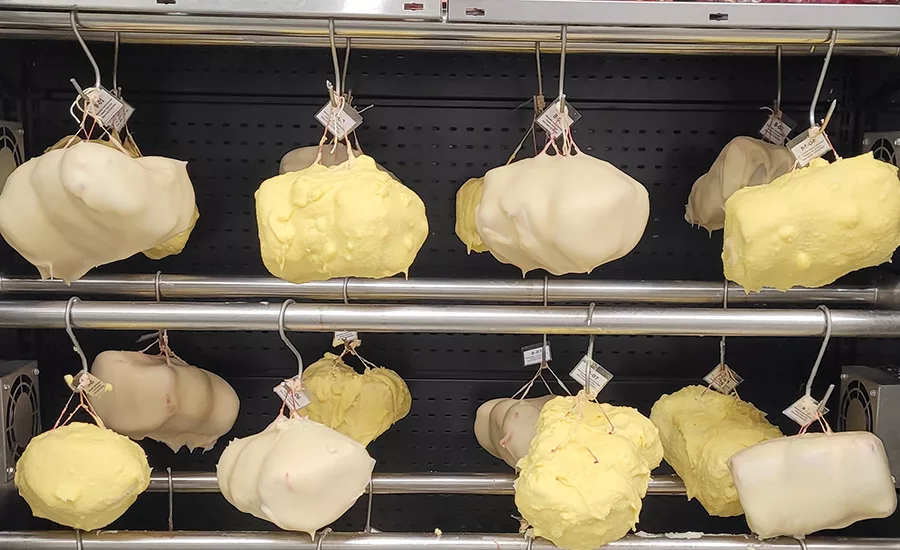
Figure 1. Samples in the aging process.
Photo credit: AMSA
Beef tenderness is a crucial attribute for consumers and can be enhanced by aging, which uses endogenous enzymes to alter the structure of meat fibers. The main aging techniques is wet aging, which involves vacuum packaging with low oxygen pressure; and the dry aging, which occurs without packaging and results in water evaporation and flavor concentration. However, a new type of meat aging is gaining traction in the sector, known as butter aging. In this process, the meat is coated with a layer of butter before aging. Its justification for use lies in enhancing flavor, thereby intensifying the consumer's sensory experience. Our objective was to investigate the effect of milk butter, compared to pork lard, as coating materials in the meat aging process.
The study utilized 36 portions of boneless loins without subcutaneous fat were used, divided into three treatments: vacuum aging, butter aging, and lard aging. Samples for wet aging were vacuum-sealed and placed in the aging chamber for a period of 28 days. Samples of lipid coating were hung for two days for surface drying to improve fat adhesion. After drying, the lipid layer was applied to the meats, which were hung for another two hours to dry, then weighed, and aged for 26 days. In total, all samples aging for 28 days. The entire aging process was conducted at 2°C, with 80% relative humidity and an airflow of 2.5 m/s.
Various meat quality attributes were analyzed after aging, including pH, water activity, moisture content, total lipid and total protein, protein oxidation, color stability, lipid oxidation, instrumental tenderness by the Warner-Bratzler method, and the determination of volatile compounds in cooked meat. The microbiological profile was also evaluated, with counts of psychrotrophic and mesophilic bacteria, lactic acid bacteria, molds, yeasts, and enterobacteria.
The results demonstrated an average lipid adhesion rate of 24.27%. After aging, the lard-aged samples losses 3.52% of their weight, while the butter-aged samples losses 1.53%. When dehydration losses from the initial two days were added, the total weight loss was 8.51% for butter-aged and 10.70% for lard-aged, higher than for wet-aged (3.21%) but lower than for dry-aged, which can result in up to 50% weight loss. The higher weight loss in lard-aged samples is attributed to the physicochemical composition of lard, which has a lower saturated fatty acid content (36.44%) compared to butter (69.91%) and a lower melting temperature (-22.68 °C), favoring greater dehydration in meat.
Samples with lipid coatings had higher pH (5.6) compared to wet-aged samples (5.42). The surface water activity was lower in lard-aged samples (0.9882) compared to wet-aged samples (0.9917), due to the lard composition. Aging did not significantly affect the moisture content, total lipids, protein oxidation, and instrumental tenderness. The luminosity of the samples was not affected by the type of aging, but storage time increased the lightness of the samples. Only the a* coordinate showed a significant interaction between aging type and storage time, with butter-aged and lard-aged samples showing higher color oxidation, with a 23.57% and 30.97% decrease in red color intensity for butter-aged and lard-aged, respectively, compared to vacuum aging.
Lipid oxidation, determined by the quantification of malonaldehyde content, also showed a significant interaction between aging type and storage time. In general, butter-aged samples were more oxidized than other treatments, possibly due to the higher water concentration between the meat and lipid layer and the presence of oxygen in the meat-fat system, caused by microcracks in the lipid layer.
Volatile compounds are essential for flavor and aroma and can be affected by meat processing and storage. This analysis was conducted on samples from the three aging treatments and fresh samples using gas chromatography coupled to a quadrupole mass spectrometer. Fresh meat had 14 unique compounds, while vacuum-aged meat had seven unique compounds, including esters and ketones. Butter-aged samples had five specific compounds, including alcohols and pyrazines, while lard-aged samples showed no distinct volatile compounds. Overall, 123 compounds were detected in fresh samples, 107 in wet-aged, 118 in butter-aged, and 99 in lard-aged samples. These differences in volatile composition highlight how aging methods and treatment characteristics influence the meat's volatile profile, resulting in distinct sensory characteristics for each aging type.
Microbiologically, butter-aged samples had higher psychrotrophic counts and visible signs of spoilage. Wet-aged samples had an average psychrotrophic count of 7.18 Log, with no visible signs of spoilage. Lard-aged samples had an average count of 7.42 Log, with signs of mucus and acidic aroma. Butter-aged samples showed higher psychrotrophic counts, accompanied by visible signs of spoilage and higher lactic acid bacteria counts. Enterobacteria, mold, and yeast counts showed no significant differences between treatments.
Using lipid coatings in meat aging resulted in products with similar physicochemical characteristics to wet aging, with butter aging showing higher final yield than pork lard. Color and microbiological quality were more satisfactory in lard-aged samples, while butter-aged samples had color issues and visible spoilage. Overall, lipid-coated aging did not show clear advantages over wet aging under the conditions of this study. Therefore, it is suggested that future studies consider shorter aging times to assess the commercial viability of these products.
How to cite:
Rezende-de-Souza, J. H., Nassu, R. T., Macedo, R. E., Francisco, V. C., Karwowski, M. S. & Pflanzer, S. B., (2024) “Yield and Quality Attributes of Aged Beef through Lipid Coatings: A Comparative Study of Milk Butter and Pork Lard”, Meat and Muscle Biology 8(1): 16909, 1-12. doi: https://doi.org/10.22175/mmb.16909
Looking for a reprint of this article?
From high-res PDFs to custom plaques, order your copy today!