Vision inspection solutions coupled with AI-based tools enhances food safety
The building blocks for AI-powered inspection technologies begin at-line.
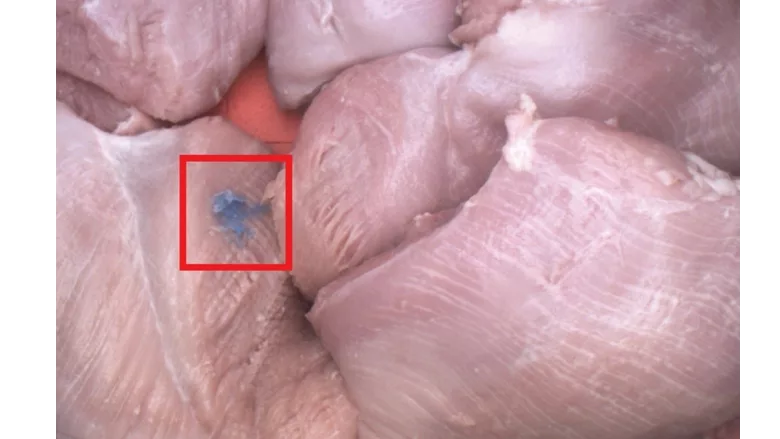
Photo credit: KPM Analytics
Had this tiny blue plastic not been detected by an AI inspection system this poultry processor could be facing a costly recall.
From raw meat cuts to finished foods, many meat and poultry processors rely on routine product sample quality checks to monitor and control the quality of their products. This key process becomes even more critical as processors scale their operations to handle higher throughputs, and automation reduces human presence on the processing lines.
During a typical sample quality check, the quality inspector removes the products from the line, measures product dimensions with calipers, assesses color, texture, marbling, and other visual features, weighs the product, and finally logs the data. With today’s high throughput production, this time-consuming process can result in high quantities of products being affected before the operator notices the process issue. This results in costly reprocessing steps that can cripple production facilities and put shipments on hold.
Also, what happens between sample checks when no one is observing the product? Foreign contaminants can occur in an instant and at any time. Many of these contaminants, such as wood, plastics, and low-density objects, may go unnoticed by current foreign material detection technologies like X-ray and metal detectors.
Maintaining and enhancing food quality is critical to upholding brand standards and protecting and satisfying consumers. However, as many food processing companies have found, traditional sampling techniques may fall short of meeting modern demands. Many processors are turning to automated inspection solutions to solve this problem, and these tools are often successfully implemented in a few simple steps.
Step 1: Improve the efficiency of manual product checks with objective technology
Human-based processes are inherently subjective, and routine product quality checks are no different. Every step in the quality sampling process is prone to human error, which can impact the recorded results. Factors such as the points an inspector decides to measure between, how tightly they press the calipers into the product, and even how they handle and place the product for measurement can have notable impacts on the results. Even the routine act of recording measurement results can be prone to typos and other errors that can contaminate collected data.
Many meat processing companies seeking to tighten manual quality checks have solved these issues using affordable at-line benchtop vision measurement systems. These products extract measurements from high-resolution 2D and 3D images to evaluate product size, shape, color, marbling, texture, and other attributes. Users can customize tolerances and measurement needs for each unique product. Some systems also include applications to predict a product's weight with high precision, removing the need for balance scales. All measurements are instantly captured during a single pass, eliminating subjective errors from the measurements and significantly speeding the process.
Benchtop vision measurement systems also allow quality teams to measure products faster, meaning operators can collect more data to represent the production process better. In fact, one major poultry producer in the US improved its average chicken breast inspection rate from about 450 to 1,700 per month — a nearly 380% increase. This increased sample size provides the data necessary to effectively monitor and react quickly to changes in the production process.
Step 2: Integrating at-line insights into in-line processes
Some companies' successes with benchtop vision systems have laid the framework for a fully integrated in-line system. This success happens because the measurement specifications created for the benchtop system can transfer to the production line, where in-line vision inspection systems provide full-speed inspection of all products on the production line. These systems often include the option to analyze the product's bottom surface. With in-line inspection, companies can inspect 100% of products with little human interaction needed.
If the system detects a defect, optional rejection systems such as air jets or paddles can automatically remove the out-of-spec product without stopping the process flow. The system collects all this quality data into trend reports to enable data-driven decision-making at an organization's line, plant, and corporate levels.
However, quality inspection is only part of an in-line vision system's overall value. Many customers — especially global quick-serve restaurant groups — have begun putting pressure on their suppliers to adopt new-generation food safety programs, especially those related to reducing foreign material incidents.
Step 3: Strengthening food safety with AI-powered inspection applications
Recent advancements in artificial intelligence have enhanced in-line vision inspection systems' detection capabilities, which often exceed those of human inspectors. AI-powered vision inspection technologies equipped with top and bottom surface high-resolution cameras, advanced lighting, and machine learning capabilities are well-suited to detecting objects like foils, films, paper, and more. The ability to detect many of these low-density contaminants makes these systems an excellent complement to existing X-ray and metal detector-based control systems.
Emerging hyperspectral imaging capabilities for in-line vision systems offer ways to analyze compositional properties like moisture and oil content on product surfaces. These new vision inspection capabilities enable further advanced foreign material and anomaly detection. AI-powered vision inspection applications continue to raise the bar for food safety and process control, especially when combined with X-ray and metal detectors to provide optimal protection. These investments can go a long way in satisfying customer demands and avoiding potentially costly recalls.
Pace and plan your approach
Vision inspection technologies may seem intimidating at first. Still, many of these systems are designed to be easily integrated into existing site processes and can be adopted with minimal effort or risk. The benefits offered by these systems are significant. They can streamline and improve the effectiveness of meat processors' quality and safety programs and provide a pathway for food processors to meet modern demands. Today's established range of vision inspection solutions and new AI-based tools that enhance capabilities and simplify setup make adopting these tools easier than ever and can bring immediate value to organizations.
Looking for a reprint of this article?
From high-res PDFs to custom plaques, order your copy today!