Provisioner logo
Provisioner logo
search
cart
facebook twitter linkedin youtube
  • Sign In
  • Create Account
  • Sign Out
  • My Account
Provisioner logo
Provisioner logo
  • NEWS
    • Industry News
    • Supplier News
    • Case Studies
    • Recalls
    • Regulations
    • New Consumer Products
  • EXCLUSIVES
    • Newsletters
    • Source Book
    • Sponsored Insights
    • Events
    • Webinars
    • Classifieds
    • White Papers
    • Provisioner Store
    • Market Research
  • MEAT PROCESSING
    • SUSTAINABILITY
    • Processing
    • Packaging
    • Ingredients
    • Formulation
    • Food Safety
    • Special Reports
    • Commentary
  • PROFILES
    • Processor Profiles
    • Processor of the Year
    • Top 100 Processors
  • MEDIA
    • Videos
    • Podcasts
  • DIRECTORY
  • MIHOF
  • INDEPENDENT PROCESSOR
  • EMAG
    • eMagazine
    • ARCHIVE ISSUES
    • Contact
    • Advertise
  • JOIN!
Meat and Poultry Industry NewsMeat and Poultry ProcessingBeef

University of Idaho study links cattle feed efficiency to heat stress, grazing behavior

Inefficient cattle spent more time grazing to meet their nutritional requirements.

By Industry News
University of Idaho.png

Photo credit: University of Idaho

March 24, 2026

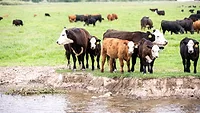
A new University of Idaho-led study explores the scientific reason why some cows spend hot summer days lazing along a shady streambank while others brave the heat and graze the hillsides. 

The study suggests cattle that inefficiently convert feed into body mass are more apt to struggle with heat stress while grazing rangeland in hot weather than their efficient counterparts. Consequently, efficient cattle tracked for the study took fuller advantage of the forage throughout their range, including on steep slopes, during hot days while their inefficient counterparts hunkered in lowlands and were more apt to trample riparian areas.  

“There are adaptations that cows take to adapt to their environment, and it’s different between the efficient and inefficient cattle,” said Jim Sprinkle, a UI Extension beef specialist and principal author of the study. “They adapted their grazing differently, and it’s influenced by their physiology.” 

The researchers conducted the experiment in 2016, closely tracking 12 efficient and 12 inefficient 2-year-old Hereford-Angus cross cows on rangeland at U of I’s Rinker Rock Creek Ranch in the Wood River Valley of central Idaho. They followed the cattle over four days in June and for four more days in August. 

Unlike in a feedlot, where ration sizes can be controlled, it’s extremely difficult to estimate how much forage cattle consume on rangeland. The team devised a creative method to quantify rangeland grazing — adding a small amount of a marker molecule to the rumen before starting the trial. The researchers followed each cow and collected its manure throughout the experiment to calculate forage consumption based on the dissipation of the marker in the manure over time. 

To validate estimates from their marker-based approach, they conducted the same analysis with cattle given the same marker and fed a known amount of forage in a feed intake monitoring system known as a GrowSafe unit. Those calculations enabled the researchers to create a table for adjusting forage-consumption estimates obtained from the rangeland trials. 

Cattle in the study were classified as efficient or inefficient as yearlings, based on the amount of feed they consumed in a GrowSafe unit. 

As expected, inefficient cattle spent more time grazing to meet their nutritional requirements. 

“The efficient cows are more purposeful about how they graze. They get in and get it done,” Sprinkle said. 

In June, when forage was lush and easily digestible, efficient and inefficient cows grazed rugged terrain and slopes. In August, however, efficient cattle continued grazing the hillsides, but inefficient cattle stuck to the lowlands, near shade and water. Sprinkle and his colleagues discovered inefficient cows had significantly more undigested forage in their rumen than their efficient counterparts during August grazing, when vegetation was dry and full of less digestible fiber. The inefficient cows were driven to keep eating to gain adequate nutrition and became overwhelmed by the combination of the summer heat and the heat generated inside of their rumen as forage accumulated. 

Based on the study results, Sprinkle advises ranchers who graze on rugged terrain in the summer to consider selecting their replacement heifers with efficiency in mind. 

“The majority of ranchers are not going to test their cows. However, you can buy bulls that have been tested for feed efficiency,” Sprinkle said. “You could do some selection over time to try to get some of those efficient cattle that presumably would use more of the rugged terrain.” 

The paper was published in the Dec. 13, 2025, edition of Journal of Animal Science. 

Source: University of Idaho

Share This Story

Looking for a reprint of this article?
From high-res PDFs to custom plaques, order your copy today!


Recommended Content

JOIN TODAY
to unlock your recommendations.

Already have an account? Sign In

  • Double Charburger

    Premiumization drives burger category

    Shoppers seek out premium meat offerings to fulfill...
    Special Reports
    By: Sammy Bredar
  • JJS Adult Pekin duck

    Poultry Report 2025: Convenience propels poultry at retail

    Despite continued economic pressures, the poultry...
    Meat and Poultry Industry News
    By: Sammy Bredar
You must login or register in order to post a comment.

Report Abusive Comment

Manage My Account
  • eMagazine Subscriptions
  • Manage My Preferences
  • Newsletters
  • Online Registration
  • Subscription Customer Service
  • Connect with The National Provisioner

More Videos

Sponsored Content

Sponsored Content is a special paid section where industry companies provide high quality, objective, non-commercial content around topics of interest to the The National Provisioner audience. All Sponsored Content is supplied by the advertising company and any opinions expressed in this article are those of the author and not necessarily reflect the views of The National Provisioner or its parent company, BNP Media. Interested in participating in our Sponsored Content section? Contact your local rep!

close
  • A smiling man carrying a grocery basket is reaching down to pick up a package of meat in a grocery store.
    Sponsored byPIC

    The Green Light: New Data Shows 12-to-1 Support for Pork from PRRS-Resistant Pigs

  • Close up of a grocery cart full of groceries, a cropped image of a couple pushing the cart and a blurred background of the vegetable aisle.
    Sponsored byPIC

    New Market Research Finds Consumers in Eight Key Pork Markets Are Likely to Purchase Pork from Gene-Edited Pigs

  • Close up of a young pig with a blurred background.
    Sponsored byPIC

    New Research Forecasts Significant Economic and Market Impacts with PRRS-Resistant Pig Adoption

Popular Stories

Spam Dog

Hormel rolls out Spam hot dog for foodservice applications

Colorado Premium logo

Colorado Premium acquires Old Hickory Smokehouse

Niman Ranch Uncured Grass-Fed Beef Bacon

Niman Ranch introduces beef bacon

2026 Top 100 Meat & Poultry Processors Report

Events

June 11, 2026

From Fresh to Frozen in 3 Minutes Flat: Unlocking the Secrets to Temperature Control

Join Tony Vacaro, Foods Industry Manager, and Emile Klein, Foods Market Strategy Manager at Air Products and Chemicals, Inc. , as they tackle key questions surrounding heat removal in food processing. 

January 1, 2030

Webinar Sponsorship Information

For webinar sponsorship information, visit www.bnpevents.com/webinars or email webinars@bnpmedia.com.

View All Submit An Event

Products

Food Crime: An Introduction to Deviance in the Food Industry

Food Crime: An Introduction to Deviance in the Food Industry

See More Products
From Fresh to Frozen in 3 Minutes Flat: Unlocking the Secrets to Temperature Control Webinar Sponsored by Air Products

Related Articles

  • University of Idaho grazing project.jpg

    University of Idaho project to highlight benefits of intensive, rotational cover crop grazing

    See More
  • Cattle

    Sweet molasses feed key to understanding grazing behavior in cattle

    See More
  • Participants in the April 10, 2026, dedication ceremony of University of Idaho’s new Meat Science and Innovation Center Honoring Ron Richard look through a window at hanging beef carcasses.

    University of Idaho dedicates meat science laboratory to longtime Vandal Brand Meats manager

    See More

Related Products

See More Products
  • GlobalData_logo_blue_header.png

    Frozen Meat (Meat) Market in the United States of America - Outlook to 2023...

  • GlobalData_logo_blue_header.png

    Cooked Meats - Packaged (Meat) Market in the United States of America - Outlook to 2023

  • GlobalData_logo_blue_header.png

    Chilled Raw Packaged Meat - Processed (Meat) Market in the United States of America - Outlook to 2023...

See More Products

Events

View AllSubmit An Event
  • January 25, 2023

    AFIA Feed Education Program

    The American Feed Industry Association’s production compliance committee is hosting the annual free Feed Production Education program again in 2023. As regulatory requirements for the feed industry continue to evolve, this training session will update participants on any recent changes from several federal agencies including DOL, DOT, EPA, FDA and OSHA as well as a presentation on the importance of a written pandemic policy. In addition, the 2022 Commercial Dry Mill Feed Mill of the Year will be announced.    This agenda has been approved for 1 ARPAS CEU's.
View AllSubmit An Event
×

Stay ahead of the curve. Unlock a dose of cutting-edge insights.

Receive our premium content directly to your inbox.

SIGN-UP TODAY
  • RESOURCES
    • Advertise
    • Contact Us
    • Directories
    • Store
    • Want More
  • SIGN UP TODAY
    • Create Account
    • eMagazine
    • Newsletter
    • Customer Service
    • Manage Preferences
  • SERVICES
    • Marketing Services
    • Reprints
    • Market Research
    • List Rental
    • Survey/Respondent Access
  • STAY CONNECTED
    • LinkedIn
    • Facebook
    • YouTube
    • X (Twitter)
  • PRIVACY
    • PRIVACY POLICY
    • TERMS & CONDITIONS
    • DO NOT SELL MY PERSONAL INFORMATION
    • PRIVACY REQUEST
    • ACCESSIBILITY

Copyright ©2026. All Rights Reserved BNP Media, Inc. and BNP Media II, LLC.

Design, CMS, Hosting & Web Development :: ePublishing