Staffing concerns on a meat packaging line? Think beyond a single machine
To truly reduce labor dependency and improve throughput, automation must work across the entire packaging line.
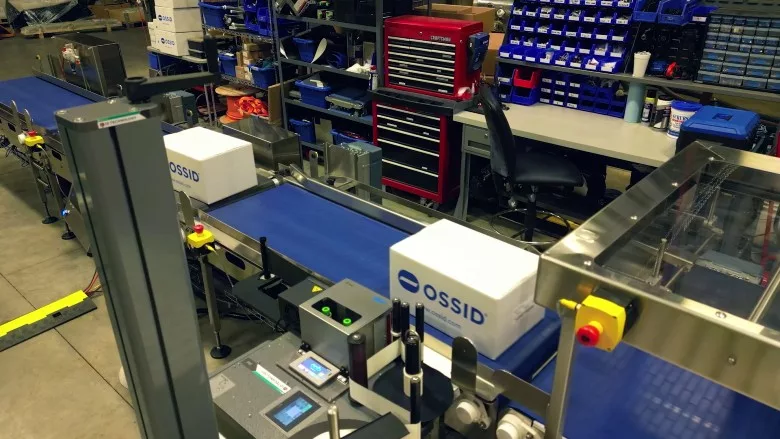
Ossid conveyor-based automation equipment
Labor shortages remain one of the main concerns for meat processors. For years, many facilities have struggled to recruit and retain workers, with the COVID-19 pandemic exacerbating the issue even further. A recent study by PMMI, the Association for Packaging and Processing Technologies, revealed that two-thirds of meat, poultry, and seafood manufacturers cited labor as their biggest operational challenge.
To address these staffing challenges, many processors look to automate their primary packaging operations, often starting with a high-speed tray sealer to extend shelf life and enhance product freshness through air-tight seals. Tray-sealed packages also improve presentation, creating premium packaging that can lead to higher profit margins for retailers, while contributing to sustainability goals by reducing film usage.
However, focusing on a single machine alone can limit the overall impact. When only one part of the line is automated, increased speed upstream can create inefficiencies downstream. To truly reduce labor dependency and improve throughput, automation must work across the entire packaging line.
Where automation begins: High-speed tray sealing
Meat processors need to be flexible to meet evolving retailer and consumer demands. Gone are the days of machines designed to run a single package size and style. Today’s lines must run multiple SKUs efficiently, requiring highly versatile packaging equipment.
That is why tray sealers built by reputable OEMs feature quick, tool-free changeovers to support a variety of packaging styles, including simple sealing, modified atmosphere packaging (MAP), and vacuum skin packaging (VSP). Operating at speeds of up to 20 cycles per minute in 24/7 production, these systems increase output while reducing manual labor.
In addition to speed and flexibility, today’s equipment is built for more consistent performance in demanding production environments. Improved motion control and product handling help maintain accuracy at higher speeds, while design features that support sanitation, maintenance, and changeovers can reduce downtime and improve overall uptime. User-friendly interfaces also simplify operation and allow for quicker adjustments on the line.
Many systems are also designed for easier integration with downstream equipment, helping them function as part of a broader automated line rather than as standalone machines.
The bottleneck challenge
While tray sealing can significantly increase throughput, it often reveals an imbalance across the line. When automation is solely added to upstream processes, downstream systems often struggle to keep up.
Production then becomes constrained by the slowest point, causing product to accumulate at the end of the line. Processors are forced to either slow production or add labor to manage the buildup – counterintuitive to the original goal of addressing staffing issues.
In these cases, the issue is not the tray sealer’s performance, but the lack of synchronization across the packaging system. Sustained efficiency depends on each part of the line keeping pace.
In these cases, the issue is not the tray sealer’s performance, but the lack of synchronization across the packaging system. Sustained efficiency depends on each part of the line keeping pace.
Maintaining end-of-line flow: Industrial case scale
In these situations, the industrial case scale becomes an important part of the solution. These machines support high-production operations requiring accurate weighing, labeling, and check-weighing capabilities. Positioned at the end of the line, they are designed to sustain upstream speeds through final packaging.
Advancements in weighing technology have improved overall accuracy and consistency. Higher-resolution load cells allow for extremely precise measurements, helping reduce product overfill and support regulatory compliance. Some systems handle multiple product types or SKUs at the same time, allowing for more dynamic production without stopping or reconfiguring the line.
Many are also designed with connectivity and data capabilities, allowing processors to track production, monitor performance, and integrate with broader plant systems.
Integrating these systems with downstream equipment is critical to maintaining that flow. A good example is labeling. As cases pass over the scale, product data is printed and applied seamlessly, with no interruption to flow. This continuous motion helps maintain line speed through end-of-line processes.
When paired with upstream equipment like high-speed tray sealers, industrial case scales help create a more balanced, efficient packaging line, ensuring that gains made earlier in the process are not lost at the end of the line.
A smarter approach to automation
Automation is an effective response to labor shortages on fresh protein packaging lines, but only when applied strategically. Isolated upgrades can create new constraints, while a balanced approach delivers sustained efficiency.
The tray sealer and case scale are typically two of the most impactful early upgrades, working together to align upstream speed with downstream performance. By addressing both ends of the packaging line, processors can increase throughput, reduce labor reliance and maintain consistent production flow.
Additional efficiencies can be gained through automating other end-of-line systems, like case packaging, palletizing, stretch wrapping, and more. But for processors looking to build a strong foundation, success starts with synchronizing the tray sealer and case scale as part of a fully integrated system.
Looking for a reprint of this article?
From high-res PDFs to custom plaques, order your copy today!