Provisioner logo
Provisioner logo
search
cart
facebook twitter linkedin youtube
  • Sign In
  • Create Account
  • Sign Out
  • My Account
Provisioner logo
Provisioner logo
  • NEWS
    • Industry News
    • Supplier News
    • Case Studies
    • Recalls
    • Regulations
    • New Consumer Products
  • EXCLUSIVES
    • Newsletters
    • Source Book
    • Sponsored Insights
    • Events
    • Webinars
    • Classifieds
    • White Papers
    • Provisioner Store
    • Market Research
  • MEAT PROCESSING
    • SUSTAINABILITY
    • Processing
    • Packaging
    • Ingredients
    • Formulation
    • Food Safety
    • Special Reports
    • Commentary
  • PROFILES
    • Processor Profiles
    • Processor of the Year
    • Top 100 Processors
  • MEDIA
    • Videos
    • Podcasts
  • DIRECTORY
  • MIHOF
  • INDEPENDENT PROCESSOR
  • EMAG
    • eMagazine
    • ARCHIVE ISSUES
    • Contact
    • Advertise
  • JOIN!

Packaging Tech: Putting a lid on it
January 1, 2011


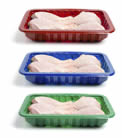
As a result of Wal-Mart’s adoption of case-ready meat packaging, and the more prevalent use of modified-atmosphere packaging over the past 10 years, many different lids and plastic trays are being used in meat packaging today as alternatives to the traditional foam trays. New tray materials are providing improved clarity, product support and protection, and ease of handling at lower costs.

“In dollar terms, foam trays are by far the leading tray type in meat, poultry and seafood packaging, although non-foam trays are expected to grow faster in coming years than foam trays,” due to a mature market, increased use of non-foam trays in case-ready packaging and growing interest in environmentally friendly packaging, say Esther Palevsky and Joe Iorillo, analysts for The Freedonia Group, an international business research group, based in Cleveland.

Trays and lids are also more prevalent in the meat aisle today because of their use in modified-atmosphere packaging (MAP), in which gases like nitrogen and carbon dioxide are injected into the package, and processed deli meats.

“This [use of MAP] will prompt heightened demand for barrier trays, which often employ barrier films, such as ethylene vinyl alcohol, laminated to the inner tray,” say Palevsky and Iorillo. “Higher performing films will see increased use as such films offer extended freshness and are important in enhancing product display.”

Plastics such as polypropylene, amorphous polyethylene terephthalate (APET) and crystallized polyethylene terephthalate (CPET) are also being increasingly used in trays.

Palevsky and Iorillo note that some tray packaging systems enable a reduction in tray height over standard lidding films, thereby reducing overall packaging, saving retail and storage space and reducing shipping costs.

Other recent innovations include self-absorbent foam trays, which are designed to soak up blood and other liquids, eliminating the need for a separate soaker pad.

In addition, sustainability and environmental concerns are prompting more use of trays designed to be biodegradable in industrial composting facilities, according to Palevsky and Iorillo.

Rigid trays are facing growing competition from flexible packaging, such as pouches and bags, because the flexible packages use less overall materials, are less likely to leak, have a longer shelf life and are less expensive to produce. Nonetheless, consumers aren’t sold on their benefits yet because their meat color isn’t as appealing as the meat from foam trays and high-oxygen MAP, says Huston Keith, principal and founder, Keymark Associates, a market research firm, based in Marietta, Ga.

“Consumers are starting to gradually accept vacuum pouches for some situations though,” he says.

Shelf life and appearance of the product contents are key concerns that will continue to be a focus of packaging improvements.  For example, in case-ready packaging, high-oxygen packages can maintain the desirable red color of meat for seven to 10 days and have a shelf life of up to 12 days. 

With low-oxygen packaging — in which the oxygen is virtually eliminated and gases such as nitrogen and carbon dioxide are flushed into the container — processors can boost their shelf life up to 28 days.

“However, because of the lack of oxygen, the meat has a dark purple color, which is generally considered unappealing to consumers accustomed to the ‘fresh’ red color of raw meat,” say Palevsky and Iorillo.

Another challenge packaging manufacturers will continue working on will be the ease of opening and resealability of their trays and lids, says Keith.

“Some processed-meat suppliers do an end run around these challenges by using resealable tubs, he says. “They work well, but how cost-effective they are is another question.”

In the coming years, analysts say to expect a greater use of biodegradable plastics, recyclable non-foam trays — including clear Polyethylene Terephthalate (PET) trays — and reclosable trays.

New trays and lids are providing improved clarity, support and ease of handling — at lower costs.

Share This Story

Looking for a reprint of this article?
From high-res PDFs to custom plaques, order your copy today!

Recommended Content

JOIN TODAY
to unlock your recommendations.

Already have an account? Sign In

  • A cow eating grass and a chicken standing next to it in a field.

    The Top 100 Meat & Poultry Processors of 2026

    The 2026 Top 100 Meat & Poultry Processors highlights...
    Processor Profiles
    By: Fred Wilkinson
  • Breaded chicken nuggets on a white plate.

    Food safety programs prioritize prevention, verification, and traceability

    Across processing operations, food safety strategies are...
    Meat and Poultry Processing
    By: Sammy Bredar
  • An open double cheeseburger on a white plate, the top bun beside it, along with a side of seasoned fries.

    How convenience is driving summer grilling innovation in 2026

    Demand for high-quality, convenience-driven formats...
    Meat and Poultry Industry News
    By: Sammy Bredar
You must login or register in order to post a comment.

Report Abusive Comment

Manage My Account
  • eMagazine Subscriptions
  • Manage My Preferences
  • Newsletters
  • Online Registration
  • Subscription Customer Service
  • Connect with The National Provisioner

More Videos

Sponsored Content

Sponsored Content is a special paid section where industry companies provide high quality, objective, non-commercial content around topics of interest to the The National Provisioner audience. All Sponsored Content is supplied by the advertising company and any opinions expressed in this article are those of the author and not necessarily reflect the views of The National Provisioner or its parent company, BNP Media. Interested in participating in our Sponsored Content section? Contact your local rep!

close
  •  two individuals standing by a farm gate
    Sponsored byPIC

    When PRRS Hits Home: The Chinn Family’s Story and a Hopeful Future

  • A smiling man carrying a grocery basket is reaching down to pick up a package of meat in a grocery store.
    Sponsored byPIC

    The Green Light: New Data Shows 12-to-1 Support for Pork from PRRS-Resistant Pigs

  • Close up of a grocery cart full of groceries, a cropped image of a couple pushing the cart and a blurred background of the vegetable aisle.
    Sponsored byPIC

    New Market Research Finds Consumers in Eight Key Pork Markets Are Likely to Purchase Pork from Gene-Edited Pigs

Popular Stories

Butchers processing hanging beef carcasses in meat processing plant

Meat Institute says meatpacking industry restructuring won’t lower beef prices

Kroger logo

Kroger to acquire Giant Eagle for $1.65B

Corporate headquarters groundbreaking

PS Seasoning and Pro Smoker reveal new parent company at headquarters groundbreaking

2026 Top 100 Meat & Poultry Processors Report

Events

January 1, 2030

Webinar Sponsorship Information

For webinar sponsorship information, visit www.bnpevents.com/webinars or email webinars@bnpmedia.com.

View All Submit An Event

Products

Food Crime: An Introduction to Deviance in the Food Industry

Food Crime: An Introduction to Deviance in the Food Industry

See More Products
The National Provisioner 2026 Food Safety Report

Related Articles

  • Packaging Tech: Bagging it

    See More
  • Packaging Tech: A Measured Approach

    See More
  • Re-sealable Zipper Packaging

    Incorporating resealable packaging tech takes time

    See More

Related Products

See More Products
  • food safety.jpg

    Food Safety in the Seafood Industry: A Practical Guide for ISO 22000 and FSSC 22000 Implementation

  • Optimizing Social Media from a B2B Perspective

  • Poultry Meat Processing, Second Edition

See More Products

Events

View AllSubmit An Event
  • August 28, 2025

    The Future of Smoke: Trends, Tech & Safety in Smoked Meats

    On-Demand Join us for an inside look at the latest innovations and emerging trends transforming smoked meat production. Gain expert insight from Dr. Jonathan Campbell, who brings a wealth of experience from his dynamic career focused on enhancing the quality, safety, and efficiency of processed meats.
View AllSubmit An Event
×

Stay ahead of the curve. Unlock a dose of cutting-edge insights.

Receive our premium content directly to your inbox.

SIGN-UP TODAY
  • RESOURCES
    • Advertise
    • Contact Us
    • Directories
    • Store
    • Want More
  • SIGN UP TODAY
    • Create Account
    • eMagazine
    • Newsletter
    • Customer Service
    • Manage Preferences
  • SERVICES
    • Marketing Services
    • Reprints
    • Market Research
    • List Rental
    • Survey/Respondent Access
  • STAY CONNECTED
    • LinkedIn
    • Facebook
    • YouTube
    • X (Twitter)
  • PRIVACY
    • PRIVACY POLICY
    • TERMS & CONDITIONS
    • DO NOT SELL MY PERSONAL INFORMATION
    • PRIVACY REQUEST
    • ACCESSIBILITY

Copyright ©2026. All Rights Reserved BNP Media, Inc. and BNP Media II, LLC.

Design, CMS, Hosting & Web Development :: ePublishing