Processing Tech
Fine-tuning slaughter
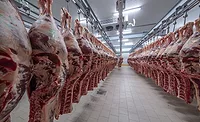
 Across the industry, many of the basic slaughter processes and techniques have remained the same. What has changed in the past 20 years is the great focus on microorganisms, and as such, more attention is being paid to the harvest floor and each process.
Over time, companies have been able to fine-tune good manufacturing practices and make sure each position and individual is doing best practices, says Trevor Caviness, president of Caviness Beef Packers, Hereford, Texas.
Michael Oliver, an engineer at Harris Ranch Beef Co., Selma, Calif., agrees that one of the greatest challenges is managing bacteria in the slaughtering process and not allowing that bacteria to be pulled into a facility. Last year, Harris Ranch renovated and expanded its harvest facility in Selma, Calif., with bacteria management in mind.
“What we worked on was sanitary and design principles on the facility and equipment to make the equipment and facility easy to clean, maintain and operate,” Oliver says. “We feel with a smoother production process, you are going to minimize issues with the product and improve employee safety.”
Harris Ranch also tries to minimize the human factors that can contribute to contamination.
“We’re doing that by providing a work environment that’s clean and ergonomically correct,” Oliver says. “We installed equipment that can remove the hide with more automation and fewer human factors. We built a new harvest floor that came online in February, and one of the big reasons was managing the hide-removal process in order to maximize yield and minimize contamination.”
The expectations of the slaughter process is quickly approaching the same expectations of a ready-to-eat process, even though the slaughter process produces a raw product that has not been subjected to the complete cooking process, adds Brandon Carlson, assistant vice president of operations at Harris Ranch.
“Having the correct equipment and [having that equipment] in the proper operating condition is a necessity,” Carlson says. “Even more paramount is a skilled, competent labor force that can handle the enormous variability in terms of animal size and shape, organic load and pathogenic load, such as Shiga toxin-producing E. coli and Salmonella. There has been a renewed focus on employee training and auditing. The industry has implemented ‘unbiased’ third-party video auditing of job performance at key positions.”
Another challenge for many processors is space, says Caviness.
“The more space you give … an employee for a particular job, then the better job the employee is going to do, because the employee won’t be rushed and won’t be cramped,” he explains. “You should have a better presentation of the carcass to the employee to do the proper job.”
Additionally, Carlson says, the focus on humane handling and animal welfare has increased in recent times.
“The industry must assure that animals are handled humanely and harvested in a quick, painless fashion,” he says. Nevertheless, the biggest current trend in slaughter equipment in the beef industry is sanitary design and elimination of microbial harborage and product contact points, Carlson adds.
“As with all other equipment, it is essential to keep equipment operating per the manufacturer’s design criteria,” he says. “Preventative maintenance is essential to reduce downtime and production costs. Sanitary design has been improved via construction with materials resistant to corrosion by cleaning chemicals, elimination of hollow spaces, incorporation of stand-offs and simplistic equipment design to make it easier to clean and sanitize.”
Processing faster
In the poultry industry, microorganisms also are receiving close attention during processing.
“There is much emphasis today on food safety and maintaining low bacteria counts on raw chicken,” says Brain Williams, director of processing at Sanderson Farms Inc., Laurel, Miss. “The emphasis on food safety has led to more complex HACCP programs. Advancements in technology and equipment have enabled the industry to continue to lower the incident rates for the presence of microorganisms on raw chicken.”
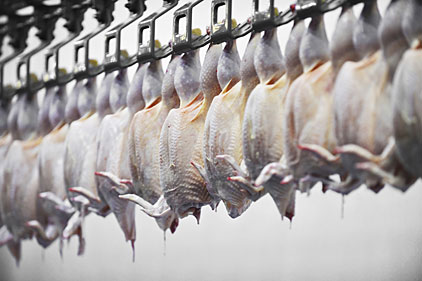
In the poultry industry, basic processing remains the same with some faster line speeds and more large birds. More automation also is present prior to chilling, so processing is less labor-intensive today than years ago.
“Many companies are running faster line speeds than ever before — sometimes up to 140 birds per minute,” Williams says. “Processing equipment has evolved and improved with each generation to allow for improved performance. New equipment has been modified to allow for the faster line speeds and also heavier bird weights.”
Maintenance and upkeep of processing equipment is also critical.
“It can be very expensive if proper preventative maintenance is not performed daily,” Williams says. “A good maintenance program is required to maintain a regular slaughter schedule, provide good product quality and maintain HACCP compliance. A medium-size poultry processing plant will spend $350,000 to $400,000 per month for maintenance and repair. A poor maintenance program will cost more than that in lost yield, poor quality and loss efficiencies.”
Cleaning of equipment also improves with each generation. Across the industry, equipment manufacturers are designing equipment with cleaning and sanitation in mind. In the poultry industry, clean-in-place procedures are used whenever possible, Williams says. Cleaning chemicals also continue to improve.
Many of the advancements in poultry processing relate to processing larger birds and running at higher line speeds.
“We have also seen new technology related to X-ray and bone detection in boneless breast meat, metal detection, robots, stunning, automated portioning equipment and sizing/sorting equipment,” Williams says. “Our industry is rapidly moving toward more technology- and computer-based systems. The two areas where automation is needed but has not been developed are to replace hand-deboning and the catching of live birds.”
Robotics technology has not taken off in beef packing yet, but Caviness sees it as the next large improvement to come. Oliver, at Harris Ranch, agrees: When equipment shopping for its recent harvest-floor renovations, his company saw robotics that simply weren’t conducive or designed for its chain speeds, but the robotic potential is there for the future. Carlson believes Harris Ranch implemented as much as it possibly could to improve the slaughter process at its Selma facility.
“We just need to assure that each step of the process is completed as designed,” he says. “Probably the only remaining frontier in beef slaughter is further mechanization of the harvest process with robotics and development of more effective antimicrobial interventions.”
Looking for a reprint of this article?
From high-res PDFs to custom plaques, order your copy today!