Food Safety
Antimicrobial interventions offer multi-hurdle protection
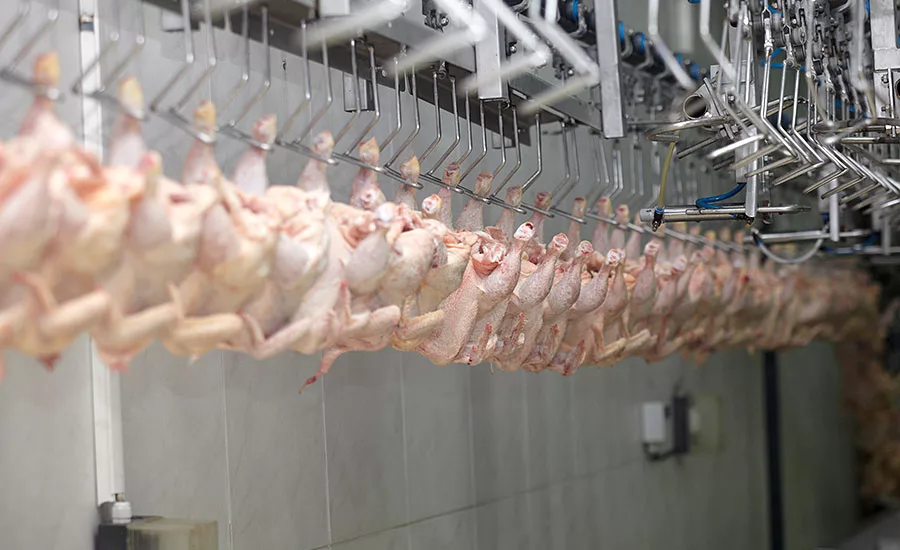
Early on, antimicrobial interventions were primarily used for whole-carcass treatment, but over the years the use has expanded to other forms of the products and equipment.
Antimicrobial interventions have been instrumental in improving food safety in the meat and poultry industry. Early uses were primarily whole-carcass treatment working to reduce microbial contamination, and many antimicrobial interventions have been documented as efficacious against E. coli O157:H7 and Salmonella.
Over the years, antimicrobial interventions have been further developed, and the use has expanded to other forms of the products and equipment.
“Antimicrobial interventions are processing aids,” says Lynn Delmore, an instructor for the Center for Meat Safety and Quality at Colorado State University in Fort Collins. “The meat industry has found the use of multiple microbial interventions to be most effective, thus setting up numerous barriers to the microbial population resulting in greater reductions and ultimately safer food. We term this ‘hurdle technology.’”
Numerous solutions are being developed and evaluated, including blends, very high and low pH solutions and increased concentrations with shorter application times, Delmore says. In addition, application methods and techniques and measuring and monitoring automation are advancing.
Ashley Peterson, the National Chicken Council’s (NCC) senior vice president of scientific and regulatory affairs, agrees that significant funding and research are being devoted to advancing the technology of antimicrobial dips and sprays for food processing, including chicken processing. Currently, the most efficient way to apply antimicrobial treatments to chicken products is through immersion dips; however, use of targeted in-line sprays is increasing, and dips in debone and second processing areas to prevent potential cross-contamination of all chicken parts.
“Processors are additionally seeking to optimize existing technologies by adding agitation in dip tanks and angling spray nozzles in order to achieve better contact with carcasses and parts,” she says.
“Obtaining the best benefits from antimicrobial interventions involves a partnership between chemical suppliers, the broiler chicken industry, and research institutions to regularly adjust methods for maximum coverage, exposure time, concentration, pH and other treatment parameters,” Peterson adds. “These partnerships are important to meeting new and evolving food safety standards, and to continue to reduce the potential for foodborne illness associated with poultry products.”
As an example in the turkey industry, Butterball, in Garner, N.C., implements a multi-hurdle approach to food safety, which includes various steps within its process where antimicrobial agents are used.
“One of the most obvious points of antimicrobial use is in our immersion chill system where turkey carcasses go through a stage of chill tanks, dirty to clean, with antimicrobials applied in the tanks,” says Alice Johnson, Butterball’s senior vice president of food safety, animal care and government relations. “The immersion is beneficial in the reduction of pathogenic microorganism, as well as the enhancement of product shelf-life. We found that antimicrobial sprays, combined with inside outside washers and surface brushes, help with bacteria reduction.”
Over the past several years, Butterball has worked through enhancements in its food safety protocols in the grinding areas of its facility. “We have instituted various sprays and dips on parts as they are removed from the carcass, the meat from the bone, and prior to the grinding step,” Johnson says.
Sanderson Farms, in Laurel, Miss., sees the most advancement occurring with antimicrobial dips and sprays in the development of better and more efficient ways of application. In addition, new applications sites are always being evaluated on whole carcasses as well as poultry parts, says Marty Ewing, Sanderson Farms’ quality assurance manager.
While antimicrobial dips and sprays are typically used on carcasses, primals, subprimals, cuts, trimmings and offal, new areas for use include more use on processing floors in addition to belts, tables and equipment, Delmore says. In addition, processors are using antimicrobial dips and sprays more on sub-primal, trimmings and offal.
Problems persist
One of the biggest challenges associated with antimicrobial dips and sprays today is the ability to use these interventions in-line in debone and second processing areas in an effort to safely and effectively meet increasing food safety requirements.
“Use of an antimicrobial intervention must consider factors such as limited operating space, food product quality, and proximity to workers and worker safety,” NCC’s Peterson says. “A number of advances are being developed to address these challenges from multi-step interventions and sensor controls, which aid in food safety systems management, to improved microbiological tests and informatics software. Emerging software, specifically, allows processors to monitor individual interventions in real time, analyze their performance data and respond to potential issues immediately. Utilizing a range of available technologies and adjusting equipment can greatly improve food safety as well as maintain a safe work environment for both inspectors and company personnel.”
Both dips and sprays are useful only if applied appropriately, Butterball’s Johnson adds. “Some of the struggles we have faced include maintaining current concentrations, keeping dwell time effective, clogged spray systems and spray direction,” she says.
Unfortunately, antimicrobial dips and sprays cannot sterilize raw product. “Raw product will always have some level of bacterial contamination, so safe handling to prevent cross contamination and thorough cooking to 165oF for poultry is imperative,” Sanderson Farms’ Ewing says.
Antimicrobial dips and spray also face the challenges of drip times, particularly in smaller cuts along with application methodologies for trimmings, Delmore says. Efficacy on cold carcasses, primals, sub-primals, cuts and trimmings are challenging as well. Consumer perception also remains a challenge in addition to perception by export customers leading to unfavorable policies and trade barriers, Delmore adds.
Regarding the use of antimicrobial dips or sprays to reduce pathogen contamination of beef, a spoiler has surfaced regarding Salmonella reduction. For many years, the industry has known that this pathogen can reside in the lymph nodes of cattle, explains Michael Doyle, regents professor of food microbiology at the Center for Food Safety at the University of Georgia in Griffin.
“More recently it has been revealed that depending on many factors, this source of salmonellae contamination of beef appears to be a greater contributor to the Salmonella contamination issue than previously recognized,” he says. “In those situations when lymph node contamination is significant, Salmonella would be within the animal’s fat hence antimicrobial dips and sprays would not be effective. Such treatments are largely effective on beef carcass surfaces, not within tissues.”
Further development
NCC’s Peterson sees that future developments will focus on integrating intelligent systems and multiple platforms for monitoring antimicrobial intervention operational parameters, data management and documentation. “With this in mind, all future products and technologies must be rigorously tested for safety and must be cost-effective,” she says. “Processing equipment will also continue to evolve in order to allow for more thorough contact with poultry products.”
Delmore also projects that antimicrobial dips and sprays will see increased use further down the processing line, in offal and in trimmings.
As the global demand for poultry meat continues to grow, Peterson also expects currently used antimicrobial dips, sprays and equipment to be adopted by other countries for food safety management. “Innovation in antimicrobial interventions will be driven by global recognition and research of food safety, technological advancement, and water and resource conservation,” she says. NP
Food fraud, vulnerability assessment
By John Spink, Michigan State University
Food fraud is one of the hottest lesser-known food-industry topics out there today. While you might not be aware of the threat and compliance requirements of food fraud, you will be. As the concept has become better defined — illegal dishonesty for economic gain using food — a seemingly endless number of incidents have cropped up. Addressing food fraud is a regulatory compliance requirement in the Food Safety Modernization Act Preventive Controls Final Rule (2016), and for financial reporting under Sarbanes-Oxley (2002) and Frank-Dodd (2007), and it dates all the way back to the “Adulterated Foods” and “Misbranded Foods” sections of the Food, Drug & Cosmetics Act (1938).
Although you might not be aware of current requirements, thanks to the efforts of the Global Food Safety Initiative (GFSI), U.K. Elliott Review and the U.K. National Food Crime Unit, the new Chinese Food Safety Laws, as well as the new pressure from the U.S. Department of Justice on financial reporting crimes, there is no doubt you will become aware of them. Although addressing food fraud may seem daunting and completely outside your normal area of expertise, do not despair. There are many efforts underway to educate those in the industry.Michigan State University’s Food Fraud Initiative (www.FoodFraud.msu.edu) has offered a free Food Fraud Overview MOOC (massive open online course) since 2013. Also, GFSI endorsed the SSAFE guidance on food fraud that includes Food Fraud Vulnerability Assessment Tool. The tool is available online at www.PWC.com/FoodFraud.
Michigan State University’s Food Fraud Initiative (www.FoodFraud.msu.edu) has offered a free Food Fraud Overview MOOC (massive open online course) since 2013. Also, GFSI endorsed the SSAFE guidance on food fraud that includes Food Fraud Vulnerability Assessment Tool. The tool is available online at www.PWC.com/FoodFraud.
The best way to start addressing food fraud is to become educated on the regulatory compliance requirements as well your internal enterprise-wide reporting needs. Each company has a unique “fraud opportunity” and corporate “risk-appetite.” The methods and tools can help you define and implement the most efficient system.
To learn more about food fraud and other hot topics in food safety, plan to attend the Food Safety Summit Conference & Expo, May 8-11, 2017, in Rosemont, Ill. The Food Safety Summit provides food-safety information, intelligence and guid-ance to processors of all foods, including meat, poultry and seafood, and it is an official partner of The National Provisioner. For more information or to register, visit www.foodsafetysummit.com.
Looking for a reprint of this article?
From high-res PDFs to custom plaques, order your copy today!