Provisioner logo
Provisioner logo
search
cart
facebook twitter linkedin youtube
  • Sign In
  • Create Account
  • Sign Out
  • My Account
Provisioner logo
Provisioner logo
  • NEWS
    • Industry News
    • Supplier News
    • Case Studies
    • Recalls
    • Regulations
    • New Consumer Products
  • EXCLUSIVES
    • Newsletters
    • Source Book
    • Sponsored Insights
    • Events
    • Webinars
    • Classifieds
    • White Papers
    • Provisioner Store
    • Market Research
  • MEAT PROCESSING
    • SUSTAINABILITY
    • Processing
    • Packaging
    • Ingredients
    • Formulation
    • Food Safety
    • Special Reports
    • Commentary
  • PROFILES
    • Processor Profiles
    • Processor of the Year
    • Top 100 Processors
  • MEDIA
    • Videos
    • Podcasts
  • DIRECTORY
  • MIHOF
  • INDEPENDENT PROCESSOR
  • EMAG
    • eMagazine
    • ARCHIVE ISSUES
    • Contact
    • Advertise
  • JOIN!
Food SafetyBeef

Meat Science Review

Mulitple-hurdle antimicrobial interventions and ground beef quality

By L. Clay Eastwood, Ashley Arnold, Rhonda K. Miller, Kerri B. Gehring, Jeffrey W. Savell
August 9, 2018

With the U.S. Department of Agriculture’s Food Safety and Inspection Service (FSIS) declaration of Escherichia coli O157:H7 and Shiga toxin-producing E. coli (STEC) as adulterants in non-intact raw beef products and intact raw beef products intended for non-intact use (FSIS, 2012), adding antimicrobial interventions has become standard procedure during beef harvest and further processing.

Despite best practices, however, microbial contamination of beef carcasses can be a direct result of harvesting cattle (Kang, Koohmaraie, & Siragusa, 2001). Implementing multiple applications of antimicrobial interventions can mitigate possible contamination from the slaughter process and improve the microbiological quality of beef carcasses (Bacon et al., 2000). The concept of using consecutive decontamination processes in beef packing plants to improve the microbiological quality of beef carcasses is beneficial to reduce microbiological contamination of beef carcass surfaces that can occur during the beef harvest process (Bacon et al., 2000). The application of organic acids and hot water as a means of whole-carcass spraying has evolved from ambient to warm water washes, to use of antimicrobials, hot water and steam (Koohmaraie et al., 2005). But because most carcass decontamination treatments do not sterilize the carcass, microorganisms remaining on carcass surfaces can easily be transferred onto freshly cut surfaces during carcass fabrication, and subsequently carried through grinding operations (Pohlman, Stivarius, McElyea, Johnson, & Johnson, 2002).

In the past, ground beef processors have expressed concern related to the effect of antimicrobial interventions on quality of beef raw materials, especially characteristics such as discoloration, off odors and off flavors. The impact of these treatments must be addressed, because consumers often associate meat quality with color and base their buying decisions on such attributes (Mancini & Hunt, 2005). A study was conducted to evaluate possible quality defects caused by multiple applications of antimicrobial interventions (hot water, lactic acid, acidified sodium chlorite, Beefxide) applied at various steps along the ground beef production chain.

Combinations of antimicrobial treatments — hot water (82 degrees C or higher), lactic acid (4-5 percent), acidified sodium chlorite (pH of 2.7-2.8) and Beefxide (lactic/citric acid mixture; up to 2.5 percent) — were applied to hot or chilled carcasses and trimmings before manufacturing ground beef patties, which were designated for color evaluation, consumer panel or trained panel evaluation (Table 1).
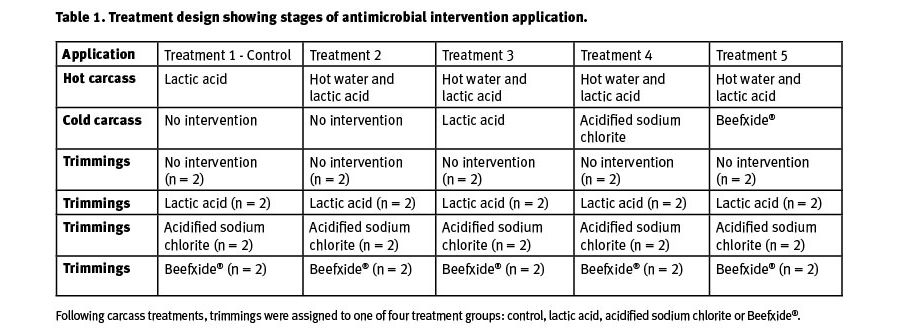
Stages of Antimicrobial Intervention Application

While some visual darkening and loss of redness of patty color occurred by the completion of the shelf-life period, overall few significant changes were seen in color for each treatment combination. Consumer scores were affected by combined antimicrobial treatment effects for overall liking (P = 0.0190), flavor liking (P = 0.0246), and beefy flavor liking (P = 0.0313). Trained panelists detected 18 out of 33 attributes with only scores for fat-like (P = 0.0391) and cardboardy (P < 0.0001) being affected by treatments.

No clear trends were related to any single or combined antimicrobial treatment, and findings support that these food safety interventions have minimal negative effects on beef patty quality. In general, findings from this study show that food safety interventions, while effective in reducing microbiological counts on product surfaces, have minimal negative effects on beef patty quality.  NP


KEYWORDS: American Meat Science Association (AMSA) antimicrobial meat science review

Share This Story

Looking for a reprint of this article?
From high-res PDFs to custom plaques, order your copy today!


L. Clay Eastwood, Texas A&M University

Ashley N. Arnold is an assistant research professor, Meat Science, at Texas A&M. Contact her at a.arnold@tamu.edu or (979) 862-3643.

Rhonda K. Miller, Ph.D., is a professor in the Meat Science Section, Department of Animal Science, Texas A&M University, in College Station, Texas.
Kerri B. Gehring, Texas A&M University
Jeffrey W. Savell, Texas A&M University

Recommended Content

JOIN TODAY
to unlock your recommendations.

Already have an account? Sign In

  • Double Charburger

    Premiumization drives burger category

    Shoppers seek out premium meat offerings to fulfill...
    Burgers
    By: Sammy Bredar
  • JJS Adult Pekin duck

    Poultry Report 2025: Convenience propels poultry at retail

    Despite continued economic pressures, the poultry...
    Chicken
    By: Sammy Bredar
You must login or register in order to post a comment.

Report Abusive Comment

Manage My Account
  • eMagazine Subscriptions
  • Manage My Preferences
  • Newsletters
  • Online Registration
  • Subscription Customer Service
  • Connect with The National Provisioner

More Videos

Sponsored Content

Sponsored Content is a special paid section where industry companies provide high quality, objective, non-commercial content around topics of interest to the The National Provisioner audience. All Sponsored Content is supplied by the advertising company and any opinions expressed in this article are those of the author and not necessarily reflect the views of The National Provisioner or its parent company, BNP Media. Interested in participating in our Sponsored Content section? Contact your local rep!

close
  • A smiling man carrying a grocery basket is reaching down to pick up a package of meat in a grocery store.
    Sponsored byPIC

    The Green Light: New Data Shows 12-to-1 Support for Pork from PRRS-Resistant Pigs

  • Close up of a grocery cart full of groceries, a cropped image of a couple pushing the cart and a blurred background of the vegetable aisle.
    Sponsored byPIC

    New Market Research Finds Consumers in Eight Key Pork Markets Are Likely to Purchase Pork from Gene-Edited Pigs

  • Close up of a young pig with a blurred background.
    Sponsored byPIC

    New Research Forecasts Significant Economic and Market Impacts with PRRS-Resistant Pig Adoption

Popular Stories

JBS USA logo

JBS USA closing pair of processing facilities

Various new Primal snack sticks on a table amongst pencils, apples, a pair of glasses, lunch bags and a water bottle.

Protein demand drives snacking occasions

Several cuts of beef, pork and chicken on a wooden board, cast iron pan and salt.

Validated thermal lethality data and a new tool for ensuring safety of RTE meats

2026 Top 100 Meat & Poultry Processors Report

Events

January 1, 2030

Webinar Sponsorship Information

For webinar sponsorship information, visit www.bnpevents.com/webinars or email webinars@bnpmedia.com.

View All Submit An Event

Products

Food Crime: An Introduction to Deviance in the Food Industry

Food Crime: An Introduction to Deviance in the Food Industry

See More Products
From Fresh to Frozen in 3 Minutes Flat: Unlocking the Secrets to Temperature Control Webinar Sponsored by Air Products

Related Articles

  • Poultry carcasses

    Antimicrobial interventions offer multi-hurdle protection

    See More
  • Exploring alternative primals for ground-beef patties

    See More
  • Cattle Eating

    Does feeding RFMDGS decrease beef quality?

    See More

Related Products

See More Products
  • Handbook of Meat, Poultry and Seafood Quality, second edition

  • seafood.jpg

    Seafood Safety and Quality

  • meat quality.jpg

    Meat Quality: Genetic and Environmental Factors

See More Products
×

Stay ahead of the curve. Unlock a dose of cutting-edge insights.

Receive our premium content directly to your inbox.

SIGN-UP TODAY
  • RESOURCES
    • Advertise
    • Contact Us
    • Directories
    • Store
    • Want More
  • SIGN UP TODAY
    • Create Account
    • eMagazine
    • Newsletter
    • Customer Service
    • Manage Preferences
  • SERVICES
    • Marketing Services
    • Reprints
    • Market Research
    • List Rental
    • Survey/Respondent Access
  • STAY CONNECTED
    • LinkedIn
    • Facebook
    • YouTube
    • X (Twitter)
  • PRIVACY
    • PRIVACY POLICY
    • TERMS & CONDITIONS
    • DO NOT SELL MY PERSONAL INFORMATION
    • PRIVACY REQUEST
    • ACCESSIBILITY

Copyright ©2026. All Rights Reserved BNP Media, Inc. and BNP Media II, LLC.

Design, CMS, Hosting & Web Development :: ePublishing