Provisioner logo
Provisioner logo
search
cart
facebook twitter linkedin youtube
  • Sign In
  • Create Account
  • Sign Out
  • My Account
Provisioner logo
Provisioner logo
  • NEWS
    • Industry News
    • Supplier News
    • Case Studies
    • Recalls
    • Regulations
    • New Consumer Products
  • EXCLUSIVES
    • Newsletters
    • Source Book
    • Sponsored Insights
    • Events
    • Webinars
    • Classifieds
    • White Papers
    • Provisioner Store
    • Market Research
  • MEAT PROCESSING
    • SUSTAINABILITY
    • Processing
    • Packaging
    • Ingredients
    • Formulation
    • Food Safety
    • Special Reports
    • Commentary
  • PROFILES
    • Processor Profiles
    • Processor of the Year
    • Top 100 Processors
  • MEDIA
    • Videos
    • Podcasts
  • DIRECTORY
  • MIHOF
  • INDEPENDENT PROCESSOR
  • EMAG
    • eMagazine
    • ARCHIVE ISSUES
    • Contact
    • Advertise
  • JOIN!
Meat and Poultry ProcessingBeef

Meat Science Review

Does feeding RFMDGS decrease beef quality?

The effects of reduced-fat modified distillers grains with solubles (RFMDGS) in finishing diets of feedlot steers on fresh and processed beef quality.
By M.A. Nelson, C. E. Fehrman, A. A. Hohertz, A. Dicostanzo, R.B. Cox
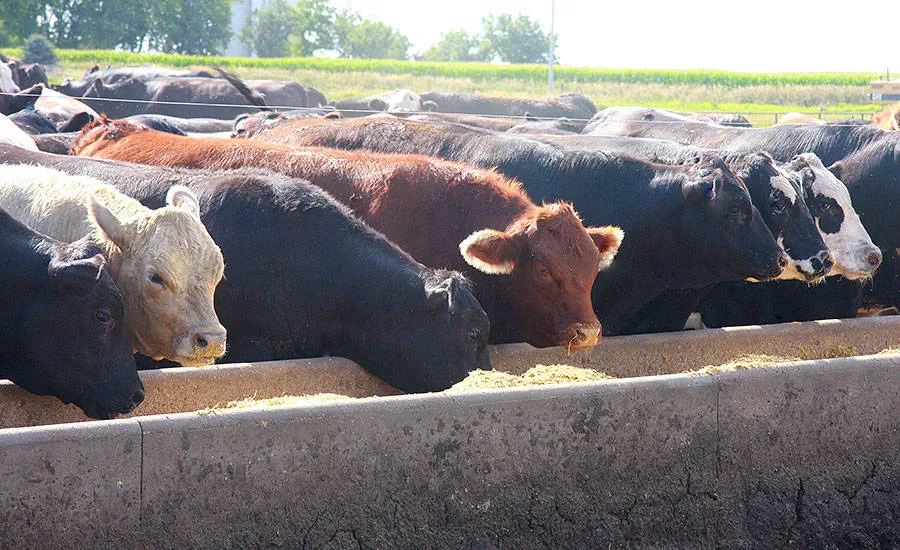
Cattle Eating
March 28, 2017

The 2013 corn ethanol industry expansion introduced a new livestock feed: reduced-fat distillers grains which contains 3 percent less ether extract, 6 to 9 percent less corn oil, and similar energy values compared to full-fat distillers grains1,2,4. Of the fat within distillers grains, 49 percent is linoleic fatty acid which has been shown to decrease retail shelf life stability through oxidation resulting in faster onset of rancidity and decreasing consumer appeal3,5,6.

An objective of the present study was to quantify the effects of varying levels of reduced-fat modified distillers grains with solubles (RFMDGS) on carcass characteristics and fresh and processed meat quality.

Our study utilized fifty crossbred (Angus x Gelbvieh X Holstein x Jersey) steers (initial body weight: 379 ± 32 kg) that were randomly assigned to one of four dietary treatments that consisted of: 14.93 percent RFMDGS of diet dry matter (DMD) with 0.74 percent corn oil DMD (FF15); 15.60 percent RFMDGS DMD (RF15); 30.84 percent RFMDGS DMD (RF30); and 46.27 percent RFMDGS DMD (RF45). Diet FF15 mimicked a full-fat distillers grains diet and served as the control. Steers were fed dietary treatments for 181 days and then fed a common diet for four days before harvesting.

Hot carcass weight (HCW), 12th rib backfat (BF); ribeye area (REA); percent kidney, pelvic, and heart fat (KPH); and marbling score data were collected 24 hours postmortem. Strip loins (IMPS #180) were collected for vacuum purge loss evaluation and fabricated into 2.54 cm steaks for drip loss, cook loss and sensory evaluation (n = 122; untrained panelists; 120-point labeled affective magnitude scales). Shoulder clods (IMPS #114) were used to create ground beef and bologna. Blended meat blocks were utilized to make an emulsified bologna product using a commercial seasoning blend. Thiobarbituric acid reactive substances (TBARS) analysis occurred utilizing d0 and d14 retail shelf life ground beef samples that were vacuum sealed and frozen until analysis. Bologna samples were evaluated for sensory attributes (n = 108; untrained panelists; 120- point labeled affective magnitude scales). Twelfth rib backfat was analyzed for fatty acid composition and calculated iodine value. All data was analyzed using PROC MIXED procedure in SAS.

There was no treatment effect for HCW (P = 0.96), BF (P = 0.63), REA (P = 0.62), KPH (P = 0.27) or marbling score (P = 0.67). All moisture loss attributes did not differ among treatments (P = 0.09). There was no treatment effect for overall liking (P = 0.15), flavor liking (P = 0.75), texture liking (P = 0.07) or off-flavor (P = 0.72) in steak sensory analysis. Subjective toughness values of steaks from FF15 were greater than RF15 (10.78 and 8.77, respectively; P = 0.01). Subjective juiciness values of steaks from FF15 were greater than RF45 (8.50 and 6.94, respectively;
P = 0.03). There was no treatment effect for flavor liking or off-flavor in bologna sensory analysis. Subjective overall liking was greater in RF45 compared to FF15 bologna samples (78.14 and 71.63, respectively; P = 0.03). Subjective texture liking of bologna from RF45 were greater than FF15 (78.25 and 67.51, respectively; P <0.01). Subjective toughness liking of bologna from RF30 and RF45 were greater compared to FF15 (77.21, 78.25, and 67.51, respectively; P <0.01). There was no treatment effect for d0 or d14 TBARS (P = 0.94 and P = 0.27, respectively). Treatment did not affect percentage of linoleic acid (C18:n-6, P = 0.34) or calculated iodine value (P = 0.59).

Although results indicate feeding 45 percent RFMDGS had no effect on carcass characteristics, it altered subjective fresh beef quality, increased subjective processed beef quality, and had minimal effects on fatty acid composition when compared to the mimicked full-fat diet. NP

References:

  1. Anderson, Vern and Chanda Engel. 2014. Effects of Fat Level in Distillers Grain on Feedlot Finishing Performance and Carcass Traits. Available at: https://www.ag.ndsu.edu/carringtonrec/documents/livestockrd/docs2014/2014-effects-of-fat-level-in-distillers-grain-on-feedlot-finishing-performance-and-carcass-traits. Accessed on March 20, 2016.
  2. Buckner, C. D., G. E. Erickson, T. L. Mader, S. L. Colgan, K. K. Karges, and M. L. Gibson. 2007. Optimum Levels of Dry Distillers Grains with Solubles for Finishing Beef Steers. Nebraska Beef Cattle Report. MP90:36-38.
  3. Diaz-Royon, Fernando; Garcia, Alvaro; and Kurt A. Rosentrater. 2012. Composition of Fat in Distillers Grains. iGrow.
  4. Lundy, E. L. and D. Loy. 2014. Ethanol Coproducts for Beef Cattle: The Changing Distillers Grains for Feedlot Cattle. Iowa Beef Center. Iowa State University Extension and Outreach Factsheet.
  5. McClements, D. J. and E. A. Decker. 2008. Lipids. In S. Damodaran, K. L. Parkin, and O. R. Fennema (eds), Fennema’s food chemistry. 4th ed. CRC Press, Boca Raton, Fla.
  6. Wood, J.D.; Richardson, R.I.; Nute, G.R.; Fisher, A.V.; Campo, M.M.; Kasapidou, E.; Sheard, P.R.; and M. Enser. 2003. Effects of fatty acids on meat quality: a review. Meat Sci. 66:21-32. 
KEYWORDS: American Meat Science Association (AMSA) beef quality meat science review

Share This Story

Looking for a reprint of this article?
From high-res PDFs to custom plaques, order your copy today!


M. A. Nelson is with University of Minnesota, Department of Animal Science.
C. E. Fehrman is with University of Minnesota, Department of Animal Science.
A. A. Hohertz is with University of Minnesota, Department of Animal Science.
A. Dicostanzo is with University of Minnesota, Department of Animal Science.
R. B. Cox is with University of Minnesota, Department of Animal Science.

Recommended Content

JOIN TODAY
to unlock your recommendations.

Already have an account? Sign In

  • Double Charburger

    Premiumization drives burger category

    Shoppers seek out premium meat offerings to fulfill...
    Meat and Poultry Industry News
    By: Sammy Bredar
  • JJS Adult Pekin duck

    Poultry Report 2025: Convenience propels poultry at retail

    Despite continued economic pressures, the poultry...
    Meat and Poultry Industry News
    By: Sammy Bredar
You must login or register in order to post a comment.

Report Abusive Comment

Manage My Account
  • eMagazine Subscriptions
  • Manage My Preferences
  • Newsletters
  • Online Registration
  • Subscription Customer Service
  • Connect with The National Provisioner

More Videos

Sponsored Content

Sponsored Content is a special paid section where industry companies provide high quality, objective, non-commercial content around topics of interest to the The National Provisioner audience. All Sponsored Content is supplied by the advertising company and any opinions expressed in this article are those of the author and not necessarily reflect the views of The National Provisioner or its parent company, BNP Media. Interested in participating in our Sponsored Content section? Contact your local rep!

close
  • A smiling man carrying a grocery basket is reaching down to pick up a package of meat in a grocery store.
    Sponsored byPIC

    The Green Light: New Data Shows 12-to-1 Support for Pork from PRRS-Resistant Pigs

  • Close up of a grocery cart full of groceries, a cropped image of a couple pushing the cart and a blurred background of the vegetable aisle.
    Sponsored byPIC

    New Market Research Finds Consumers in Eight Key Pork Markets Are Likely to Purchase Pork from Gene-Edited Pigs

  • Close up of a young pig with a blurred background.
    Sponsored byPIC

    New Research Forecasts Significant Economic and Market Impacts with PRRS-Resistant Pig Adoption

Popular Stories

Various new Primal snack sticks on a table amongst pencils, apples, a pair of glasses, lunch bags and a water bottle.

Protein demand drives snacking occasions

Several cuts of beef, pork and chicken on a wooden board, cast iron pan and salt.

Validated thermal lethality data and a new tool for ensuring safety of RTE meats

Cargill logo

Cargill initiates lockout at Fort Morgan beef plant after union rejects contract

2026 Top 100 Meat & Poultry Processors Report

Events

January 1, 2030

Webinar Sponsorship Information

For webinar sponsorship information, visit www.bnpevents.com/webinars or email webinars@bnpmedia.com.

View All Submit An Event

Products

Food Crime: An Introduction to Deviance in the Food Industry

Food Crime: An Introduction to Deviance in the Food Industry

See More Products
From Fresh to Frozen in 3 Minutes Flat: Unlocking the Secrets to Temperature Control Webinar Sponsored by Air Products

Related Articles

  • A Mississippi State University study indicates that native warm season grasses can be incorporated in the stocker phase of cattle

    Does native-grass grazing affect beef quality?

    See More
  • Meat Science Review: Beef quality and mid-gestational energy restriction

    See More
  • Dry-aging has been widely practiced in many local meat processors, high-end restaurants and gourmet markets

    Identifying optimal dry-aging regimes for improving beef quality

    See More

Related Products

See More Products
  • Handbook of Meat, Poultry and Seafood Quality, second edition

  • meat quality.jpg

    Meat Quality: Genetic and Environmental Factors

  • seafood.jpg

    Seafood Safety and Quality

See More Products

Events

View AllSubmit An Event
  • August 23, 2016

    Feeding Quality Forums

    Don’t miss your chance to hear industry experts share current insight on market conditions, a discussion on yield grading, finish dates on cattle, antibiotic stewardship in the feed yard and external influences affecting the industry.
View AllSubmit An Event
×

Stay ahead of the curve. Unlock a dose of cutting-edge insights.

Receive our premium content directly to your inbox.

SIGN-UP TODAY
  • RESOURCES
    • Advertise
    • Contact Us
    • Directories
    • Store
    • Want More
  • SIGN UP TODAY
    • Create Account
    • eMagazine
    • Newsletter
    • Customer Service
    • Manage Preferences
  • SERVICES
    • Marketing Services
    • Reprints
    • Market Research
    • List Rental
    • Survey/Respondent Access
  • STAY CONNECTED
    • LinkedIn
    • Facebook
    • YouTube
    • X (Twitter)
  • PRIVACY
    • PRIVACY POLICY
    • TERMS & CONDITIONS
    • DO NOT SELL MY PERSONAL INFORMATION
    • PRIVACY REQUEST
    • ACCESSIBILITY

Copyright ©2026. All Rights Reserved BNP Media, Inc. and BNP Media II, LLC.

Design, CMS, Hosting & Web Development :: ePublishing