Provisioner logo
Provisioner logo
search
cart
facebook twitter linkedin youtube
  • Sign In
  • Create Account
  • Sign Out
  • My Account
Provisioner logo
Provisioner logo
  • NEWS
    • Industry News
    • Supplier News
    • Case Studies
    • Recalls
    • Regulations
    • New Consumer Products
  • EXCLUSIVES
    • Newsletters
    • Source Book
    • Sponsored Insights
    • Events
    • Webinars
    • Classifieds
    • White Papers
    • Provisioner Store
    • Market Research
  • MEAT PROCESSING
    • SUSTAINABILITY
    • Processing
    • Packaging
    • Ingredients
    • Formulation
    • Food Safety
    • Special Reports
    • Commentary
  • PROFILES
    • Processor Profiles
    • Processor of the Year
    • Top 100 Processors
  • MEDIA
    • Videos
    • Podcasts
  • DIRECTORY
  • MIHOF
  • INDEPENDENT PROCESSOR
  • EMAG
    • eMagazine
    • ARCHIVE ISSUES
    • Contact
    • Advertise
  • JOIN!
Meat and Poultry ProcessingBeef

Meat Science Review

Identifying optimal dry-aging regimes for improving beef quality
By Yuan H. Brad Kim PhD
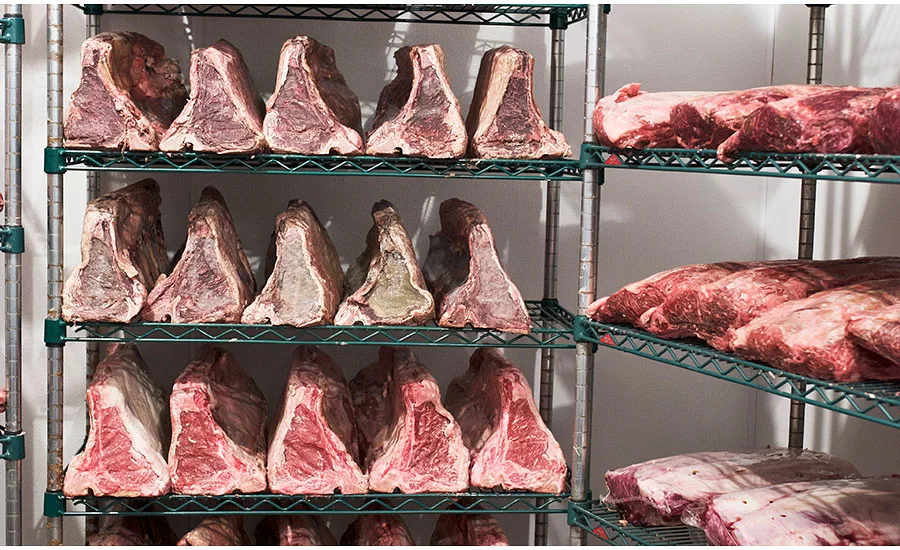
Dry-aging has been widely practiced in many local meat processors, high-end restaurants and gourmet markets

Despite being a costly process, dry-aging has been widely practiced in many local meat processors, high-end restaurants and gourmet markets.

June 10, 2016

Dry-aging is a traditional butchery process to store whole carcasses or unpackaged primals or sub-primals under a controlled environment for a certain period of time. Despite the fact dry-aging is a costly process because of decreased yields and greater weight losses during aging and trimming, it has been widely practiced in many local meat processors, high-end restaurants and gourmet markets. This is mainly due to its known positive effects on enhancing beef palatability attributes, particularly generating unique flavor characteristics, such as brown-roasted beefy/brothy, buttery, nutty/roasted nut, and/or sweet flavor.

But several published studies actually found no significant impact of dry-aging on eating quality attributes of beef. The primary reason for this inconsistent result could be because of the improper/uncontrolled processing condition applied for dry-aging. In fact, the optimal dry-aging regimes compiling the essential processing environment components have not been clearly established. Therefore, in our study we compared various essential dry-aging factors (temperature, humidity and air-flow) and their subsequent effects on meat quality attributes of beef loins. Further, using a novel metabolomics approach, we investigated the metabolites differences of dry-aged and wet-aged beef, with particular emphasis on flavour precursors.

A total of 30 beef short loins (bone-in) from 15 beef carcasses were obtained at two days postmortem. Each loin was cut in half, yielding 60 sub-sections. A total of six treatments, including four dry-aging regimes (2 aging temperature (1 or 3°C) x 2 air-flow rates (0.2 m/s or 0.5 m/s), and two wet-aging control groups (1 or 3°C) were randomly assigned to the six sections and aging was carried out for three weeks in controlled dry-aging testing cabinets. The given 2 x 2 (temperature x air-flow) combinations resulted in various RH regimes, such as 76 percent (at 1°C and 0.2 m/s), 73 percent (at 1°C and 0.5 m/s), 49 percent (at 3°C and 0.2 m/s), and 55 percent (at 3°C and 0.5 m/s). 

The sensory panel determined the dry-aged loins had better flavor and overall likability compared with the wet-aged loins, but no differences in tenderness or juiciness. While there was no significant interaction between aging type and aging regime, loins aged at 3°C with 0.2 m/s (air-flow) and 49 percent RH yielded the highest numerical values in overall likability, flavor, juiciness and tenderness compared with other treatments. We found that eight of the 32 predominant metabolites detected were statistically different between aging treatments. Among those, tryptophan, phenylalanine, valine, tyrosine, glutamate, isoleucine and leucine were significantly more abundant in the dry-aged beef samples than in the wet-aged samples, whereas inosine monophosphate was more abundant in the wet-aged group.

This result suggests that dry-aging could be further optimized through identifying the best dry-aging regimes to provide premium quality beef products to consumers in a consistent manner. NP

KEYWORDS: American Meat Science Association (AMSA) beef quality dry-aged beef dry-aging meat science review

Share This Story

Looking for a reprint of this article?
From high-res PDFs to custom plaques, order your copy today!
Yuan H. Brad Kim is an Assistant Professor of Animal Sciences in the Meat Science and Muscle Biology Lab, Department of Animal Sciences, Purdue University. Contact him via email at bradkim@purdue.edu.

Recommended Content

JOIN TODAY
to unlock your recommendations.

Already have an account? Sign In

  • Double Charburger

    Premiumization drives burger category

    Shoppers seek out premium meat offerings to fulfill...
    Burgers
    By: Sammy Bredar
  • JJS Adult Pekin duck

    Poultry Report 2025: Convenience propels poultry at retail

    Despite continued economic pressures, the poultry...
    Meat and Poultry Industry News
    By: Sammy Bredar
You must login or register in order to post a comment.

Report Abusive Comment

Manage My Account
  • eMagazine Subscriptions
  • Manage My Preferences
  • Newsletters
  • Online Registration
  • Subscription Customer Service
  • Connect with The National Provisioner

More Videos

Sponsored Content

Sponsored Content is a special paid section where industry companies provide high quality, objective, non-commercial content around topics of interest to the The National Provisioner audience. All Sponsored Content is supplied by the advertising company and any opinions expressed in this article are those of the author and not necessarily reflect the views of The National Provisioner or its parent company, BNP Media. Interested in participating in our Sponsored Content section? Contact your local rep!

close
  • A smiling man carrying a grocery basket is reaching down to pick up a package of meat in a grocery store.
    Sponsored byPIC

    The Green Light: New Data Shows 12-to-1 Support for Pork from PRRS-Resistant Pigs

  • Close up of a grocery cart full of groceries, a cropped image of a couple pushing the cart and a blurred background of the vegetable aisle.
    Sponsored byPIC

    New Market Research Finds Consumers in Eight Key Pork Markets Are Likely to Purchase Pork from Gene-Edited Pigs

  • Close up of a young pig with a blurred background.
    Sponsored byPIC

    New Research Forecasts Significant Economic and Market Impacts with PRRS-Resistant Pig Adoption

Popular Stories

JBS USA logo

JBS USA closing pair of processing facilities

Various new Primal snack sticks on a table amongst pencils, apples, a pair of glasses, lunch bags and a water bottle.

Protein demand drives snacking occasions

Several cuts of beef, pork and chicken on a wooden board, cast iron pan and salt.

Validated thermal lethality data and a new tool for ensuring safety of RTE meats

2026 Top 100 Meat & Poultry Processors Report

Events

January 1, 2030

Webinar Sponsorship Information

For webinar sponsorship information, visit www.bnpevents.com/webinars or email webinars@bnpmedia.com.

View All Submit An Event

Products

Food Crime: An Introduction to Deviance in the Food Industry

Food Crime: An Introduction to Deviance in the Food Industry

See More Products
From Fresh to Frozen in 3 Minutes Flat: Unlocking the Secrets to Temperature Control Webinar Sponsored by Air Products

Related Articles

  • Discoloration scores of steaks from beef loins assigned to different aging types

    Effects of dry aging on color and oxidation stabilities of beef loins

    See More
  • Beef steak in dry aged meat aging cabinet

    Dry-aging to improve palatibility in cull cow beef

    See More
  • PCA Analysis of Identified Metabolites

    Hunting compounds crucial to dry aging flavor

    See More

Related Products

See More Products
  • Handbook of Meat, Poultry and Seafood Quality, second edition

  • meat quality.jpg

    Meat Quality: Genetic and Environmental Factors

  • seafood.jpg

    Seafood Safety and Quality

See More Products

Related Directories

  • International Assn. for Food Protection

    The International Association for Food Protection (IAFP) represents a broad range of members with a singular focus — protecting the global food supply. Within the association, you will find educators, government officials, microbiologists, food industry executives and quality control professionals who are involved in all aspects of growing, storing, transporting, processing and preparing all types of foods.
×

Stay ahead of the curve. Unlock a dose of cutting-edge insights.

Receive our premium content directly to your inbox.

SIGN-UP TODAY
  • RESOURCES
    • Advertise
    • Contact Us
    • Directories
    • Store
    • Want More
  • SIGN UP TODAY
    • Create Account
    • eMagazine
    • Newsletter
    • Customer Service
    • Manage Preferences
  • SERVICES
    • Marketing Services
    • Reprints
    • Market Research
    • List Rental
    • Survey/Respondent Access
  • STAY CONNECTED
    • LinkedIn
    • Facebook
    • YouTube
    • X (Twitter)
  • PRIVACY
    • PRIVACY POLICY
    • TERMS & CONDITIONS
    • DO NOT SELL MY PERSONAL INFORMATION
    • PRIVACY REQUEST
    • ACCESSIBILITY

Copyright ©2026. All Rights Reserved BNP Media, Inc. and BNP Media II, LLC.

Design, CMS, Hosting & Web Development :: ePublishing