Provisioner logo
Provisioner logo
search
cart
facebook twitter linkedin youtube
  • Sign In
  • Create Account
  • Sign Out
  • My Account
Provisioner logo
Provisioner logo
  • NEWS
    • Industry News
    • Supplier News
    • Case Studies
    • Recalls
    • Regulations
    • New Consumer Products
  • EXCLUSIVES
    • Newsletters
    • Source Book
    • Sponsored Insights
    • Events
    • Webinars
    • Classifieds
    • White Papers
    • Provisioner Store
    • Market Research
  • MEAT PROCESSING
    • SUSTAINABILITY
    • Processing
    • Packaging
    • Ingredients
    • Formulation
    • Food Safety
    • Special Reports
    • Commentary
  • PROFILES
    • Processor Profiles
    • Processor of the Year
    • Top 100 Processors
  • MEDIA
    • Videos
    • Podcasts
  • DIRECTORY
  • MIHOF
  • INDEPENDENT PROCESSOR
  • EMAG
    • eMagazine
    • ARCHIVE ISSUES
    • Contact
    • Advertise
  • JOIN!
Meat and Poultry ProcessingBeef

Meat Science Review

Hunting compounds crucial to dry aging flavor

Further investigation of dry-aging effects on palatability attributes and metabolomics profiles of beef loins.
By Derico Setyabrata, Jiwon Lee, Silvana Martini, Jerrad F. Legako, Tiago J.P. Sobreira, Yuan H. Brad Kim PhD
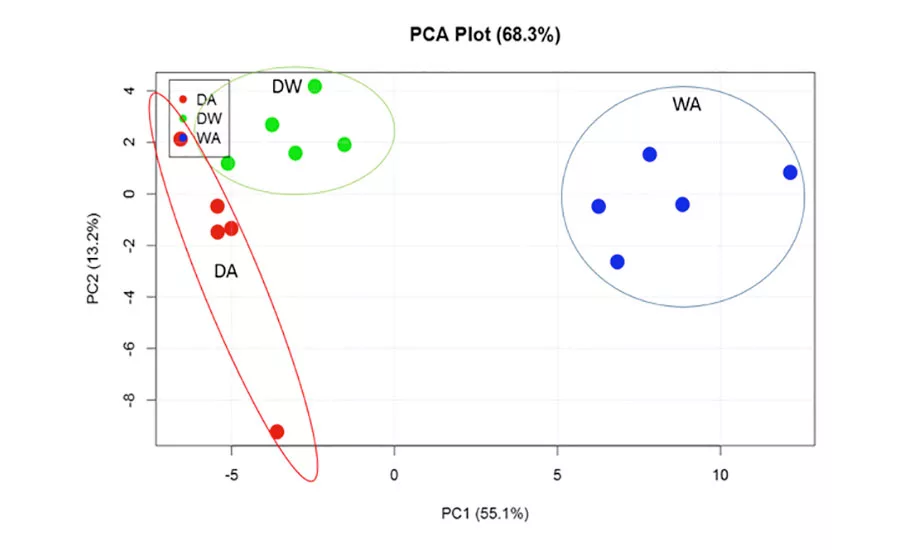
PCA Analysis of Identified Metabolites
Figure 1: PCA analysis of identified metabolites (P<0.05) in samples from different treatments (DA: Dry aging, DW: Dry aging in water permeable bag, WA: Wet aging).
January 16, 2019

Dry aging is a traditional aging method in which primal or sub-primal sections of the carcass are stored in a controlled environment for several weeks without any type of packaging material. Dry aging is well known for enhancing meat palatability attributes. In particular, unique flavor development through dry aging such as beefy, nutty, brown-roasted or buttery is a major driver of dry-aging practice. In a recent study conducted in the Meat Science and Muscle Biology laboratory at Purdue University, dry aging resulted in improvement of meat palatability of low-marbled, grass-fed beef loins. This study suggested that dry aging can be an effective post-harvest value-adding strategy to provide consistent, desirable palatability characteristics of grass-fed beef with low marbling. While positive effects of dry aging on meat quality attributes have been reported in several scientific studies, specific chemical compounds associated with this unique dry-aging flavor have not been fully established. 

Metabolomics is an emerging analytical technique that enables the detection and measurement of small molecular compounds, such as amino acids and sugars. Previous studies have shown that different muscle types have different metabolomics profiles, indicating the feasibility of identifying specific compounds related to meat quality. We hypothesized that chemical compounds associated with dry-aged flavor, or other palatability attributes, could be identified by using the metabolomics approach.  Therefore, the objective of this study was to identify key compounds associated with eating quality attributes of dry-aged beef via metabolomics analysis. This study was a further investigation of our previous study, in which significant improvements in eating quality attributes were found in low-marbled, grass-fed beef loins through dry aging.

For this study, beef loins from nine beef carcasses were obtained at seven days postmortem. Loins were then cut into two sections, randomly assigned to three aging methods (wet aging, dry aging and dry aging in a water-permeable bag) and aged for 28 days at 35 degrees Fahrenheit and 78 percent relative humidity. After aging, samples were trimmed, and multiple steaks from each section were collected for both consumer sensory analysis and chemical analyses including metabolomics, volatile compounds and fatty acid profiling. The consumer panel was asked to provide both liking scores and additional descriptive comments on eating quality attributes. The frequency of positive comments from all provided responses were then quantified for further frequency analysis of each attribute. Metabolomics analysis was conducted using Ultra Performance Liquid Chromatography — Mass Spectrometry system, and relative abundance of metabolites was quantified for the statistical analyses. All data were analyzed using SAS, and further analysis using principle component analysis (PCA) was conducted using R software. 

A total of 1,666 metabolites were detected, of which 125 metabolites were found to be significantly associated to aging-type treatments. The PCA analysis was conducted to observe the clustering and separation of the metabolites. A distinct separation between the wet-aging and dry-aging metabolomics profile was found (Figure 1). Further separation of clusters between the different dry-aging treatments (dry aging and dry aging in the water permeable bag) was also observed (Figure 1). Higher abundance of glutamate and glutamine compounds were detected in both dry-aging treatments, which could be potentially related to the flavor development of dry-aged products. Further, abundance of specific flavor-related compounds such as thiamine, thiazole and bisjuglone were detected in dry-aged beef. More antioxidant related compounds such as carnitine and glucosides were observed in wet aging, indicating possibly less oxidation in the treatment. 

For volatile compound analysis, volatiles related to dry-aged flavor, such as methanethiol, pentanedione and heptanone, were identified and found to be more abundant in dry-aged product. No significant difference in fatty acid profile was observed among the different treatments. Based on the frequency analysis of the consumer sensory comments, higher frequency of positive comments (e.g. good, strong and/or beefy) was given to both dry aging and dry aging in the water-permeable bag for all traits except aroma when compared with wet aging. 

The results of the current study indicate higher flavor-related metabolites and compounds were released through the dry-aging process, and those can be attributed to the unique dry-aged beef flavor. Through further understanding of these compounds, potential indicators of dry-aging process could be identified in order to optimize the process and to provide consistently high-quality dry-aged products to the consumers. NP


Author Notes:

Derico Setyabrata1, Jiwon Lee2, Silvana Martini2, Jerrad Legako3, Tiago J.P. Sobreira4, Yuan H. Brad Kim1*

  1. Meat Science and Muscle Biology Lab, Department of Animal Sciences, Purdue University, West Lafayette, IN, USA;
  2. Department of Nutrition, Dietetics, and Food Science, Utah State University, Logan, UT, USA
  3. Department of Animal and Food Science, Texas Tech University, Lubbock, TX, USA; 
  4. Bindley Bioscience Center, Purdue University, West Lafayette, IN, USA

* Corresponding author: Brad Kim, Assistant Professor (bradkim@purdue.edu)

KEYWORDS: American Meat Science Association (AMSA) dry-aged beef dry-aging meat science review

Share This Story

Looking for a reprint of this article?
From high-res PDFs to custom plaques, order your copy today!


Derico Setyabrata is affiliated with the Meat Science and Muscle Biology Lab, Department of Animal Sciences, at Purdue University in West Lafayette, Ind.
Jiwon Lee is with Department of Nutrition, Dietetics, and Food Science, Utah State University, Logan, UT, USA.
Silvana Martini is with Department of Nutrition, Dietetics, and Food Science, Utah State University, Logan, UT, USA.
Jerrad Legako is with the Department of Animal and Food Science at Texas Tech University, Lubbock, TX, USA.
Tiago J.P. Sobreira is with Bindley Bioscience Center, Purdue University, West Lafayette, IN, USA.

Yuan H. Brad Kim is an Assistant Professor of Animal Sciences in the Meat Science and Muscle Biology Lab, Department of Animal Sciences, Purdue University. Contact him via email at bradkim@purdue.edu.

Recommended Content

JOIN TODAY
to unlock your recommendations.

Already have an account? Sign In

  • Double Charburger

    Premiumization drives burger category

    Shoppers seek out premium meat offerings to fulfill...
    Ingredients
    By: Sammy Bredar
  • JJS Adult Pekin duck

    Poultry Report 2025: Convenience propels poultry at retail

    Despite continued economic pressures, the poultry...
    Turkey
    By: Sammy Bredar
You must login or register in order to post a comment.

Report Abusive Comment

Manage My Account
  • eMagazine Subscriptions
  • Manage My Preferences
  • Newsletters
  • Online Registration
  • Subscription Customer Service
  • Connect with The National Provisioner

More Videos

Sponsored Content

Sponsored Content is a special paid section where industry companies provide high quality, objective, non-commercial content around topics of interest to the The National Provisioner audience. All Sponsored Content is supplied by the advertising company and any opinions expressed in this article are those of the author and not necessarily reflect the views of The National Provisioner or its parent company, BNP Media. Interested in participating in our Sponsored Content section? Contact your local rep!

close
  • A smiling man carrying a grocery basket is reaching down to pick up a package of meat in a grocery store.
    Sponsored byPIC

    The Green Light: New Data Shows 12-to-1 Support for Pork from PRRS-Resistant Pigs

  • Close up of a grocery cart full of groceries, a cropped image of a couple pushing the cart and a blurred background of the vegetable aisle.
    Sponsored byPIC

    New Market Research Finds Consumers in Eight Key Pork Markets Are Likely to Purchase Pork from Gene-Edited Pigs

  • Close up of a young pig with a blurred background.
    Sponsored byPIC

    New Research Forecasts Significant Economic and Market Impacts with PRRS-Resistant Pig Adoption

Popular Stories

Spam Dog

Hormel rolls out Spam hot dog for foodservice applications

Colorado Premium logo

Colorado Premium acquires Old Hickory Smokehouse

Niman Ranch Uncured Grass-Fed Beef Bacon

Niman Ranch introduces beef bacon

2026 Top 100 Meat & Poultry Processors Report

Events

June 11, 2026

From Fresh to Frozen in 3 Minutes Flat: Unlocking the Secrets to Temperature Control

Join Tony Vacaro, Foods Industry Manager, and Emile Klein, Foods Market Strategy Manager at Air Products and Chemicals, Inc. , as they tackle key questions surrounding heat removal in food processing. 

January 1, 2030

Webinar Sponsorship Information

For webinar sponsorship information, visit www.bnpevents.com/webinars or email webinars@bnpmedia.com.

View All Submit An Event

Products

Food Crime: An Introduction to Deviance in the Food Industry

Food Crime: An Introduction to Deviance in the Food Industry

See More Products
From Fresh to Frozen in 3 Minutes Flat: Unlocking the Secrets to Temperature Control Webinar Sponsored by Air Products

Related Articles

  • Beef steak in dry aged meat aging cabinet

    Dry-aging to improve palatibility in cull cow beef

    See More
  • Discoloration scores of steaks from beef loins assigned to different aging types

    Effects of dry aging on color and oxidation stabilities of beef loins

    See More
  • Dry-aging has been widely practiced in many local meat processors, high-end restaurants and gourmet markets

    Identifying optimal dry-aging regimes for improving beef quality

    See More

Related Products

See More Products
  • food-crime.jpg

    Food Crime: An Introduction to Deviance in the Food Industry

  • GlobalData_logo_blue_header.png

    Frozen Meat (Meat) Market in the United States of America - Outlook to 2023...

  • GlobalData_logo_blue_header.png

    Cooked Meats - Packaged (Meat) Market in the United States of America - Outlook to 2023

See More Products

Events

View AllSubmit An Event
  • June 11, 2026

    From Fresh to Frozen in 3 Minutes Flat: Unlocking the Secrets to Temperature Control

    Join Tony Vacaro, Foods Industry Manager, and Emile Klein, Foods Market Strategy Manager at Air Products and Chemicals, Inc. , as they tackle key questions surrounding heat removal in food processing. 
View AllSubmit An Event

Related Directories

  • Flavor Dynamics Inc.

    Flavor Dynamics, Inc. is guided by a commitment to creating innovative products of consistent, superior quality. Our commitment to food safety and quality assurance is reflected by our “AA” BRC Audit grade. Choose from clean label, gluten free, vegan, NON-GMO and organic options. Contact us at customercare@flavordynamics.com
×

Stay ahead of the curve. Unlock a dose of cutting-edge insights.

Receive our premium content directly to your inbox.

SIGN-UP TODAY
  • RESOURCES
    • Advertise
    • Contact Us
    • Directories
    • Store
    • Want More
  • SIGN UP TODAY
    • Create Account
    • eMagazine
    • Newsletter
    • Customer Service
    • Manage Preferences
  • SERVICES
    • Marketing Services
    • Reprints
    • Market Research
    • List Rental
    • Survey/Respondent Access
  • STAY CONNECTED
    • LinkedIn
    • Facebook
    • YouTube
    • X (Twitter)
  • PRIVACY
    • PRIVACY POLICY
    • TERMS & CONDITIONS
    • DO NOT SELL MY PERSONAL INFORMATION
    • PRIVACY REQUEST
    • ACCESSIBILITY

Copyright ©2026. All Rights Reserved BNP Media, Inc. and BNP Media II, LLC.

Design, CMS, Hosting & Web Development :: ePublishing