2017 Food Safety Report
Foodborne illness estimates: Fascinating and misleading
Comparing CDC’s estimated numbers to reality when it comes to annual foodborne illness predictions.

Statistics are fascinating. We use them to make decisions every day, and while everyone knows they can be skewed toward whatever answer you want, we just don’t often think of exactly how vulnerable they are.
With modern computers and the plethora of data that is available, we have come to rely on statistics to give us a quick snapshot of where we are and where we are going. But statistics — especially predictive or probability statistics — are vulnerable to manipulation, errors and just plain bad math. Because of how they are used, many of us have learned to take them with a grain of salt.
Sir Charles Dilke [1843-1911] was quoted in 1891 as saying that false statements might be arranged according to their degree under three heads: fibs, lies and statistics. Here in America, Mark Twain once quoted British Prime Minister Benjamin Disraeli, saying, “There are three kinds of lies: lies, damned lies, and statistics.”
Even when the numbers used in statistics are correct, they can still be used to mislead. For example, if we did a survey on this article, and 51 out of 100 people liked it, I could say: “More than half the people who read my article liked it!” — which sounds a whole lot better than having to say that 49 percent of readers didn’t like it.
Isn’t it profound to consider, then, if statistics can be so easily manipulated to mislead, how can anyone trust the government’s annual estimated predictions of the number of illnesses and deaths caused by Salmonella? Especially since the math behind those statistics isn’t obvious or explained.
The Centers for Disease Control and Prevention (CDC), U.S. Food and Drug Administration (FDA), and USDA Food Safety and Inspection Service (FSIS) — among others — are budgeted billions of dollars based on these estimates. FDA and FSIS focus regulatory resources specifically based on estimated illnesses. The food industry then spends billions of dollars to address the issues raised by the estimated number of illnesses and deaths attributed to a pathogen or allergen. The predictions and statistics these agencies provide and use are truly critical.
Given their importance, these estimates must be accurate, right? And they must remain accurate, because the CDC must grade itself based on its estimates, then check to see how many people report the illness or are reported as having died from the disease, right?
Well, hold on to your graphing calculator, but I’m sorry to say, the answer to both those questions is “no.” In fact, the CDC just keeps cranking out estimates and refuses to look at actual numbers or make modifications based on actual numbers. I guess it just knows better.
So how can we get a real, honest, actual picture of what is going on? I tried.
I started by digging up what we know: the number of deaths. After all, every person who dies has a death certificate issued by a competent medical examiner that includes the cause of that person’s death, right? Turns out, that was a waste of my time.
Apparently, the CDC automatically assumes that the medical examiner is incorrect on cases of death, so it doesn’t use this as a baseline. Instead the agency starts with an estimate (it doesn’t share the process for creating that original estimate), then runs it through a series of calculations and adjustments to come up with the final numbers. Additionally, for the base numbers on food allergies in children, the CDC relies on parent-provided information and then extrapolates numbers under an assumption that some parents didn’t report food allergies.
To be honest, this clearly calls into question the validity of CDC’s “estimates.” The agency uses similar processes to “estimate” the number of illnesses attributed to Salmonella, E. coli, etc. It comes up with some fantastic numbers; but, again, are these numbers even remotely representative of what is going on? Unfortunately, we just don’t know.
Two things we do know: First, we know CDC, FDA and FSIS budgets have been increased to deal with the estimated illness rates, and second, we know the trends of people who have died and have actual death certificates.
Salmonella deaths from both enteritis and septicemia are trending higher (43 deaths in 2015). E. coli deaths are trending down as are deaths from Staphylococcus (both aureus septicemia and foodborne intoxication deaths). Of note, there haven’t been any deaths related to foodborne staphylococcal intoxication since the year 2000. Unspecified foodborne intoxications deaths and deaths attributed to Listeria are on the rise.
Deaths from allergic and dietetic gastroenteritis and colitis (food allergies included) remain at less than one a year, with none reported in 2015. While trending higher, deaths from Campylobacter enteritis have dropped from a high of nine deaths in 2013 to two deaths each in 2014 and 2015. The real shocker in the data is the dramatic climb in deaths from Creutzfeldt-Jakob disease. In 2002, there were 200 deaths reported. In 2015, 450 deaths were reported.
To put all of this in context, from 1999 through 2015, approximately 20,605 people died from something potentially related to something they ate. By comparison, during the same period, 90,242 people died from Clostridium difficile, typically picked up at the hospital or doctor’s office.
Because the CDC doesn’t report on its estimates versus reality, I thought I would do it for them. In 2014, the CDC estimated that annually, there would be 378 deaths from Salmonella, 76 deaths from Campylobacter, 20 deaths from E. coli O157, and 255 deaths from Listeria monocytogenes — information presented as part of the healthy people 2020 progress review. When we look at the actual deaths in 2015 compared with the estimates, this is what we see:
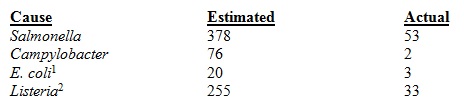
*1) Actual deaths don’t specify O157
*2) Actual deaths don’t specify Listeria monocytogenes and may include all forms of Listeria.
Based on how wrong these numbers were, how can industry trust any of the estimates CDC gives, whether illnesses, deaths or otherwise? Don’t get me wrong: Even though the estimates from the CDC are clearly over-inflated, 91 people still died, and that’s not acceptable. While we don’t know the method or product (if any) that contributed to those people becoming infected, we must strive as an industry to drive these numbers down as low as possible.
For processors, the ultimate question becomes: Where do I focus my food safety efforts and resources? My recommendation is very simple. Put it toward prevention. Go back to the basics, look at your systems, your food safety and quality teams, and make sure that, in the mad dash to appease the latest statistic, regulation or auditor pet peeve, you aren’t missing fundamental food safety controls.
First, make sure there are no cross-contamination issues, and then control the temperatures of your products. Although there are a lot of other issues out there, if you can control those two things, you not only increase product shelf life, but you also go a long way toward ensuring safe products.
A top-notch focus on food safety efforts that matter will help keep the probabilities of a foodborne illness being pinned on your company low and predictable. Meanwhile, always remember, based on the real statistics, we as an industry are doing a pretty good job and can get even better. NP
Looking for a reprint of this article?
From high-res PDFs to custom plaques, order your copy today!