Provisioner logo
Provisioner logo
search
cart
facebook twitter linkedin youtube
  • Sign In
  • Create Account
  • Sign Out
  • My Account
Provisioner logo
Provisioner logo
  • NEWS
    • Industry News
    • Supplier News
    • Case Studies
    • Recalls
    • Regulations
    • New Consumer Products
  • EXCLUSIVES
    • Newsletters
    • Source Book
    • Sponsored Insights
    • Events
    • Webinars
    • Classifieds
    • White Papers
    • Provisioner Store
    • Market Research
  • MEAT PROCESSING
    • SUSTAINABILITY
    • Processing
    • Packaging
    • Ingredients
    • Formulation
    • Food Safety
    • Special Reports
    • Commentary
  • PROFILES
    • Processor Profiles
    • Processor of the Year
    • Top 100 Processors
  • MEDIA
    • Videos
    • Podcasts
  • DIRECTORY
  • MIHOF
  • INDEPENDENT PROCESSOR
  • EMAG
    • eMagazine
    • ARCHIVE ISSUES
    • Contact
    • Advertise
  • JOIN!
Meat and Poultry ProcessingFood Safety

Standardize sample chicken bones used for x-ray testing
By Joergen Rheinlaender
x-ray
January 15, 2020

Testing an X-ray system is typically based on selecting small bones and cutting small pieces of these bones. These pieces are subsequently placed into a chicken fillet or a deboned leg. The product is subsequently scanned by the X-ray system, and its ability to detect the bone in question is assessed.

But a bone is not just a bone. The detectability of a bone depends on its calcification level, and the detection depends on the X-ray technology being used. Most important is the X-ray energy selection. At lower levels of X-ray energy and with longer wavelengths (below 30 kV), the contrast between bone and meat increases exponentially.

X-ray systems for poultry bone detection typically work around 60-80 kV. The high energy is needed because of the sensitivity limitation of standard X-ray imaging detectors. This is unfortunate, since the contrast between bone and meat reduces exponentially with increasing energy. For some years, research in the medical and dental sector has brought new detectors with very good imaging characteristics down to 10 kV. These are very interesting for chicken-bone detection, because the excellent contrast is matched with an excellent resolution.

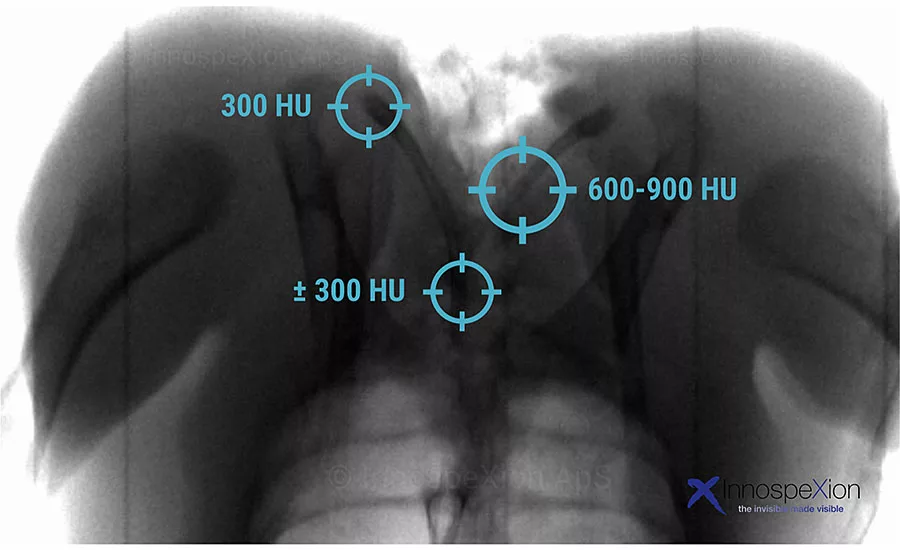
The quantitative distinction is based on differences in X-ray attenuation using the Hounsfield Unit (HU). This scale is based on water having the value of 0 HU, whereas air has the value -1,000 HU. A calcified bone from pork, for example, is typically in the range 600-1,000 HU (or beyond), whereas soft-bone (cartilage) is much lower (e.g. 100-250 HU), because of the lower abundance of calcium minerals.

For chicken, the bone HU value depends on the age of the chicken, its feeding, its breed and many other factors. For chicken in general food production, an average HU is about 400-450 HU for calcified bone, but varying from the level of cartilage (soft bone) (100-250 HU) up to 1,000 HU for the larger and most calcified bone.

Because the detection of a bone depends on the HU value of the bone, it makes no sense to consider only the dimension when evaluating the bone detectability. A comparison of different X-ray systems must therefore be made with the exact same bone pieces. This is difficult, since practical conditions may cause loss of the (very small) bone pieces used. The optimal solution therefore is to apply a test sample with artificial bone pieces (made of a polymer with hydroxyapatite) with a HU value (i.e. around 400-450) similar to that of the average chicken bone.

The above analysis unveils that the comparison of different X-ray systems should be based on standardized test samples. It is also clear that quality control verifications of X-ray system detection capability (as performed e.g. on an hourly regular) must be based on well-known, certified and calibrated test samples. It makes sense to use test samples with HU values in the range 400 to 450 HU, as these conform to the average range of calcified bones in general chicken production. NP

KEYWORDS: product inspection x-ray systems

Share This Story

Looking for a reprint of this article?
From high-res PDFs to custom plaques, order your copy today!


Joergen Rheinlaender, Ph.D., is CEO of InnospeXion ApS Denmark. For more information, visit www.innospexion.dk.

Recommended Content

JOIN TODAY
to unlock your recommendations.

Already have an account? Sign In

  • Double Charburger

    Premiumization drives burger category

    Shoppers seek out premium meat offerings to fulfill...
    Ingredients
    By: Sammy Bredar
  • JJS Adult Pekin duck

    Poultry Report 2025: Convenience propels poultry at retail

    Despite continued economic pressures, the poultry...
    Turkey
    By: Sammy Bredar
You must login or register in order to post a comment.

Report Abusive Comment

Manage My Account
  • eMagazine Subscriptions
  • Manage My Preferences
  • Newsletters
  • Online Registration
  • Subscription Customer Service
  • Connect with The National Provisioner

More Videos

Sponsored Content

Sponsored Content is a special paid section where industry companies provide high quality, objective, non-commercial content around topics of interest to the The National Provisioner audience. All Sponsored Content is supplied by the advertising company and any opinions expressed in this article are those of the author and not necessarily reflect the views of The National Provisioner or its parent company, BNP Media. Interested in participating in our Sponsored Content section? Contact your local rep!

close
  • A smiling man carrying a grocery basket is reaching down to pick up a package of meat in a grocery store.
    Sponsored byPIC

    The Green Light: New Data Shows 12-to-1 Support for Pork from PRRS-Resistant Pigs

  • Close up of a grocery cart full of groceries, a cropped image of a couple pushing the cart and a blurred background of the vegetable aisle.
    Sponsored byPIC

    New Market Research Finds Consumers in Eight Key Pork Markets Are Likely to Purchase Pork from Gene-Edited Pigs

  • Close up of a young pig with a blurred background.
    Sponsored byPIC

    New Research Forecasts Significant Economic and Market Impacts with PRRS-Resistant Pig Adoption

Popular Stories

JBS USA logo

JBS USA closing pair of processing facilities

Various new Primal snack sticks on a table amongst pencils, apples, a pair of glasses, lunch bags and a water bottle.

Protein demand drives snacking occasions

Several cuts of beef, pork and chicken on a wooden board, cast iron pan and salt.

Validated thermal lethality data and a new tool for ensuring safety of RTE meats

2026 Top 100 Meat & Poultry Processors Report

Events

January 1, 2030

Webinar Sponsorship Information

For webinar sponsorship information, visit www.bnpevents.com/webinars or email webinars@bnpmedia.com.

View All Submit An Event

Products

Food Crime: An Introduction to Deviance in the Food Industry

Food Crime: An Introduction to Deviance in the Food Industry

See More Products
From Fresh to Frozen in 3 Minutes Flat: Unlocking the Secrets to Temperature Control Webinar Sponsored by Air Products

Related Articles

  • InnoSpexion X-ray inspection

    Chicken bone detection: Facts on detection capabilities for X-ray systems based on chicken bone composition variations

    See More
  • Eagle PI Logo

    Compliance checklist for X-ray inspection in the food industry

    See More
  • The National Provisioner Supplier News

    Recent developments’ implications for the x-ray industry

    See More

Related Products

See More Products
  • meat.jpg

    Non-Thermal Processing Technologies for the Meat, Fish, and Poultry Industries

  • advanced tech.jpg

    Advanced Technologies for Meat Processing

  • food safety.jpg

    Food Safety in the Seafood Industry: A Practical Guide for ISO 22000 and FSSC 22000 Implementation

See More Products

Related Directories

  • ProSpection Solutions

    Prospection Solutions delivers AI-powered X-ray inspection systems for meat processors, including Dual Energy X-Ray (“Bone Hunter”) and the Eliminator Grinder. Our technology detects bone and foreign material while ensuring product integrity and compliance. From grind to packaging, we help maximize yield, reduce risk, and protect food safety - finding what others miss.
×

Stay ahead of the curve. Unlock a dose of cutting-edge insights.

Receive our premium content directly to your inbox.

SIGN-UP TODAY
  • RESOURCES
    • Advertise
    • Contact Us
    • Directories
    • Store
    • Want More
  • SIGN UP TODAY
    • Create Account
    • eMagazine
    • Newsletter
    • Customer Service
    • Manage Preferences
  • SERVICES
    • Marketing Services
    • Reprints
    • Market Research
    • List Rental
    • Survey/Respondent Access
  • STAY CONNECTED
    • LinkedIn
    • Facebook
    • YouTube
    • X (Twitter)
  • PRIVACY
    • PRIVACY POLICY
    • TERMS & CONDITIONS
    • DO NOT SELL MY PERSONAL INFORMATION
    • PRIVACY REQUEST
    • ACCESSIBILITY

Copyright ©2026. All Rights Reserved BNP Media, Inc. and BNP Media II, LLC.

Design, CMS, Hosting & Web Development :: ePublishing