Provisioner logo
Provisioner logo
search
cart
facebook twitter linkedin youtube
  • Sign In
  • Create Account
  • Sign Out
  • My Account
Provisioner logo
Provisioner logo
  • NEWS
    • Industry News
    • Supplier News
    • Case Studies
    • Recalls
    • Regulations
    • New Consumer Products
  • EXCLUSIVES
    • Newsletters
    • Source Book
    • Sponsored Insights
    • Events
    • Webinars
    • Classifieds
    • White Papers
    • Provisioner Store
    • Market Research
  • MEAT PROCESSING
    • SUSTAINABILITY
    • Processing
    • Packaging
    • Ingredients
    • Formulation
    • Food Safety
    • Special Reports
    • Commentary
  • PROFILES
    • Processor Profiles
    • Processor of the Year
    • Top 100 Processors
  • MEDIA
    • Videos
    • Podcasts
  • DIRECTORY
  • MIHOF
  • INDEPENDENT PROCESSOR
  • EMAG
    • eMagazine
    • ARCHIVE ISSUES
    • Contact
    • Advertise
  • JOIN!
Meat and Poultry Industry News

How much feed does US livestock, poultry and aquaculture consume?

Circular ingredients make up 37% of total feed consumption.
By Industry News
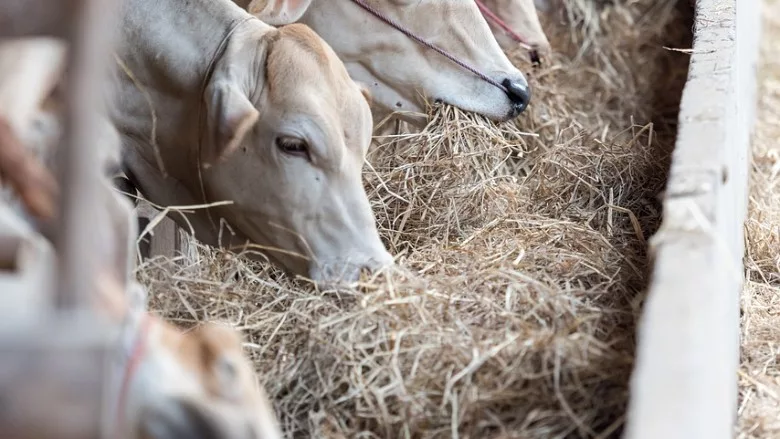
Cattle feeding
Image by Sasin Tipchai from Pixabay

Cattle feeding

Photo courtesy of Sasin Tipchai/Pixabay

February 28, 2025

The Institute for Feed Education and Research, in collaboration with the American Feed Industry Association and North American Renderers Association’s research arm the Fats and Proteins Research Foundation, are announcing a new report that quantifies the amount of feed consumed by America’s major livestock, poultry and aquaculture species. In 2023, US livestock, poultry and farmed aquaculture consumed approximately 283.6 million tons of feed, according to the IFEEDER report.

“The new IFEEDER feed consumption data demonstrates the vital role that feed mills, ingredient suppliers, liquid feed manufacturers, renderers and row crop farmers play in keeping animals fed throughout their lives, which, in turn, provides Americans with nutritious meat, milk and eggs,” said Lara Moody, IFEEDER's executive director. “On behalf of our project partners AFIA and FPRF, IFEEDER is pleased to make this data readily available as part of its ongoing mission to advance understanding and trust in a sustainable animal feed supply chain.”

The project, conducted by researchers at Decision Innovation Solutions, which has conducted similar studies in the past for IFEEDER, used a ration cost-optimization model to quantify the consumption of feed ingredients for the major animal species. Excluding harvested forages and roughages, the study found that in 2023, beef cattle consumed the most feed at 76.7 million tons, followed by broilers at 61.5 million tons, hogs at 60.9 million tons, dairy cattle at 48.7 million tons, egg-laying hens at 17.7 million tons, turkeys at 10.9 million tons, horses at 5.3 million tons, sheep and goats at 1.2 million tons and aquaculture at 615,800 tons.

The report primarily examined nearly 70 unique feed ingredients used among the studied species, finding that by weight, corn tops the list at 159.4 million tons, followed by soybean meal at 35.4 million tons, corn distillers’ dried grains at 32.6 million tons, wheat middlings at 5.6 million tons and canola meal at 5.2 million tons. Recognizing that feed often complements harvested forages and roughages (e.g., corn silage, alfalfa hay, other hay, legume silage, corn stalks, sorghum silage and wheat straw) in ruminant diets, DIS calculated that dairy and beef cattle, sheep, goats and horses consumed 267.4 million tons of those ingredients. The report also found that 37% of total feed consumption (excluding harvested forages and roughages) came from “circular” ingredients, which are coproducts or byproducts from the human food industry or other industrial processes that might otherwise go to landfill.

“Many Americans may be surprised to learn that US feed mills and rendering facilities work closely with their local bakeries, food processors and ethanol facilities to capture nutritious ingredients, some of which might otherwise go to waste, and through a highly regulated process, safely feed them to animals,” said Moody. “With more than one-third of production animal diets’ consisting of circular ingredients, our industry is doing its part to reduce waste.”

Five states topped the list in the tonnage of feed ingredients fed to animals in 2023, including Iowa at 29.1 million tons (primarily to hogs, beef cattle and egg-layers), Texas at 24.4 million tons (primarily to beef cattle, dairy cattle and broilers), Nebraska at 17.3 million tons (primarily to beef cattle and hogs), North Carolina at 15.5 million tons (primarily to hogs, broilers and turkeys), and Kansas at 15.3 million tons (primarily to beef cattle, hogs and dairy cattle).

IFEEDER thanks ED&F Man Commodities, the National Corn Growers Association and Westway Feed Products for providing financial contributions to support this research project. One hundred percent of IFEEDER donations support funding for research, education and sustainability initiatives on behalf of the US animal food industry.

Source: Institute for Feed Education and Research

KEYWORDS: animal feed consumption report

Share This Story

Looking for a reprint of this article?
From high-res PDFs to custom plaques, order your copy today!


Recommended Content

JOIN TODAY
to unlock your recommendations.

Already have an account? Sign In

  • A cow eating grass and a chicken standing next to it in a field.

    The Top 100 Meat & Poultry Processors of 2026

    The 2026 Top 100 Meat & Poultry Processors highlights...
    Meat and Poultry Industry News
    By: Fred Wilkinson
  • Breaded chicken nuggets on a white plate.

    Food safety programs prioritize prevention, verification, and traceability

    Across processing operations, food safety strategies are...
    Food Safety
    By: Sammy Bredar
  • An open double cheeseburger on a white plate, the top bun beside it, along with a side of seasoned fries.

    How convenience is driving summer grilling innovation in 2026

    Demand for high-quality, convenience-driven formats...
    Special Reports
    By: Sammy Bredar
You must login or register in order to post a comment.

Report Abusive Comment

Manage My Account
  • eMagazine Subscriptions
  • Manage My Preferences
  • Newsletters
  • Online Registration
  • Subscription Customer Service
  • Connect with The National Provisioner

More Videos

Sponsored Content

Sponsored Content is a special paid section where industry companies provide high quality, objective, non-commercial content around topics of interest to the The National Provisioner audience. All Sponsored Content is supplied by the advertising company and any opinions expressed in this article are those of the author and not necessarily reflect the views of The National Provisioner or its parent company, BNP Media. Interested in participating in our Sponsored Content section? Contact your local rep!

close
  •  two individuals standing by a farm gate
    Sponsored byPIC

    When PRRS Hits Home: The Chinn Family’s Story and a Hopeful Future

  • A smiling man carrying a grocery basket is reaching down to pick up a package of meat in a grocery store.
    Sponsored byPIC

    The Green Light: New Data Shows 12-to-1 Support for Pork from PRRS-Resistant Pigs

  • Close up of a grocery cart full of groceries, a cropped image of a couple pushing the cart and a blurred background of the vegetable aisle.
    Sponsored byPIC

    New Market Research Finds Consumers in Eight Key Pork Markets Are Likely to Purchase Pork from Gene-Edited Pigs

Popular Stories

JBS USA logo

JBS USA closing pair of processing facilities

Kroger logo

Kroger to acquire Giant Eagle for $1.65B

Justin Ransom interview

USDA's Justin Ransom discusses the Small Processors Action Plan

2026 Top 100 Meat & Poultry Processors Report

Events

July 16, 2026

Strengthening Food Safety Plans for Modern Processing Operations

The live webinar will explore the latest technologies, emerging risks, and practical strategies shaping food safety programs across meat and poultry processing operations. Attendees will hear from industry experts on key challenges impacting processors today, along with approaches for strengthening and updating food safety plans across their facilities.

January 1, 2030

Webinar Sponsorship Information

For webinar sponsorship information, visit www.bnpevents.com/webinars or email webinars@bnpmedia.com.

View All Submit An Event

Products

Food Crime: An Introduction to Deviance in the Food Industry

Food Crime: An Introduction to Deviance in the Food Industry

See More Products
The National Provisioner 2026 Food Safety Report

Related Articles

  • Insurance Policy Papers

    How much product insurance does a processor need?

    See More
  • little chick drinking water

    Water acidification: how much and when for broilers?

    See More
  • How Much Do Wisconsinites Love Their Sausage?

    See More

Related Directories

  • U.S. Poultry & Egg Assn.

    U.S. Poultry & Egg Association is the world’s largest poultry association, representing the entire industry as an “All Feather” Association. Membership includes producers and processors of broilers, turkeys, ducks, eggs, breeding stock, and allied companies. USPOULTRY is also the managing partner for the International Production & Processing Expo (IPPE).
×

Stay ahead of the curve. Unlock a dose of cutting-edge insights.

Receive our premium content directly to your inbox.

SIGN-UP TODAY
  • RESOURCES
    • Advertise
    • Contact Us
    • Directories
    • Store
    • Want More
  • SIGN UP TODAY
    • Create Account
    • eMagazine
    • Newsletter
    • Customer Service
    • Manage Preferences
  • SERVICES
    • Marketing Services
    • Reprints
    • Market Research
    • List Rental
    • Survey/Respondent Access
  • STAY CONNECTED
    • LinkedIn
    • Facebook
    • YouTube
    • X (Twitter)
  • PRIVACY
    • PRIVACY POLICY
    • TERMS & CONDITIONS
    • DO NOT SELL MY PERSONAL INFORMATION
    • PRIVACY REQUEST
    • ACCESSIBILITY

Copyright ©2026. All Rights Reserved BNP Media, Inc. and BNP Media II, LLC.

Design, CMS, Hosting & Web Development :: ePublishing