The dual advantage of belting: Operational efficiency and food safety
Utilizing conveyor and power transmission belts to further business goals.
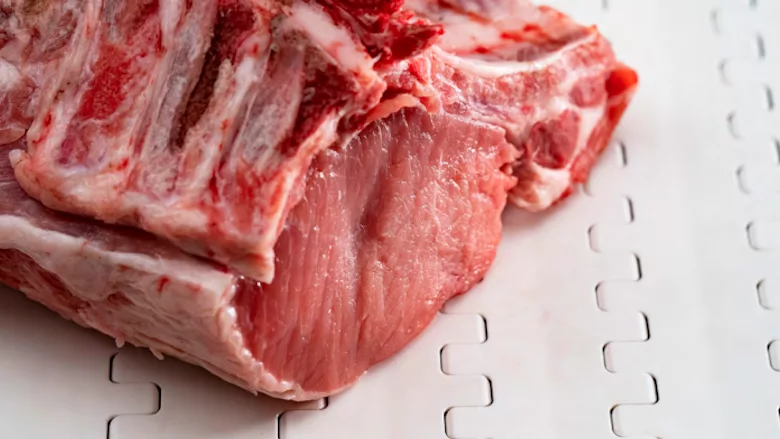
While the meat and poultry industry is embracing future-focused solutions, like artificial intelligence (AI) to achieve smarter operations, innovative conveying and power transmission belts are already making the industry more efficient, productive and safe. These belts ensure a continuous flow of product, from raw material to packaged goods, while mitigating contamination risks and standing up to the harsh environmental conditions required to ensure food safety.
Maximizing operational efficiency
In this industry, conveyor and power transmission belts must withstand heavy loads, constant use, and the demanding conditions, including presence of blood, fat, and bones, as well as high-pressure washdowns. However, conditions vary across different stages of production, necessitating different durability needs.
For example, friction drive belts mitigate slippage through exposure to mud and fluids while the belts carrying carcasses through the cutting and splitting stages must stand up to the constant slicing and chopping of knife blades sharp enough to cut bone. In both instances, belts must remain reliable, damage-resistant and easy to clean to maintain necessary levels of speed, efficiency, and sanitation.
In processes like deboning and trimming, cut-resistant materials and reinforced belt edges also minimize damage and prevent foreign body contamination. Whether the material is modular or synthetic, conveyor belts can be modified or customized to prevent unscheduled downtime and excess water consumption during washdowns. For example, modular conveyor belts designed to minimize crevices can reduce opportunities for bacterial growth and fragmentation from knife blades catching on the material, threats to both consumer and employee safety. Meanwhile, synthetic conveyor belts can be equipped with antimicrobial covers and KleenEdge non-fray edges to minimize contamination.
Behind the scenes, power transmission belting is equally crucial. These belts drive the motors, gears, pulleys, and other mechanical components that power the entire processing line. They typically include timing belts, flat belts, and V-belts, all of which power meat and poultry processing and packaging. These applications require exceptional chemical and corrosion resistance to maintain high performance and reliability.
To ensure consistent and reliable operations across multiple stages of production, V-belts play a significant role in meat and poultry processing machinery, including compressors, fans and water pumps. Similarly, flat belts also serve in various processing machinery, including those used in cutting and deboning processes. Their role is to minimize downtime and maximize efficiency in this demanding environment. Timing belts support overall efficiency by offering precise power transmission and consistent performance, to maintain food safety standards and reduce contamination risks.
No compromise on food safety
Blood and bone fragments are ever-present in humid meat and poultry processing environments, necessitating materials that are FDA-approved and food-safety compliant, resistant to chemicals or abrasion induced wear and tear, and unhindered by fluctuating temperatures. A good belting partner can help businesses exceed industry standards for higher performance and ensure easier, less disruptive maintenance.
Merging exceptionally designed belts and automation can minimize opportunities for human error and, by extension, threats to worker wellbeing and food safety. For example, belts with metal and X-ray detectable properties can make it easy to identify and remove belt fragments that could otherwise contaminate product, preventing costly recalls. In manual operations, blue belts make irregularities on the production line easy to spot with the naked eye. While these considerations are important, so is a rigid cleaning schedule, and belt properties designed to sustain frequent exposure to water and chemicals. A trusted belting partner brings this all into focus, navigating material selection, hygiene demands, and automation integration to ensure operation stays safe, efficient, and compliant.
Looking for a reprint of this article?
From high-res PDFs to custom plaques, order your copy today!