Harpak-Ulma unveils TFX thermoformers for meat-brick and high-volume producers
Harpak-Ulma announces the North American release of the Ulma TFX thermoformer.
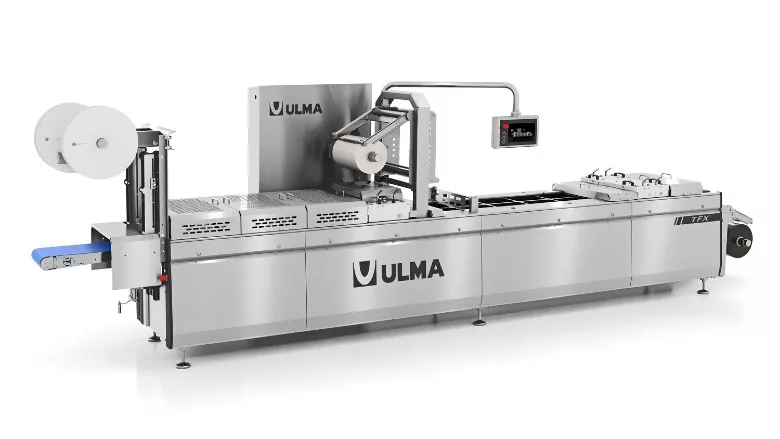
TFX thermoformer
Packaging solutions provider Harpak-Ulma is announcing the North American release of the Ulma TFX thermoformer, a next‑generation smart platform engineered to help food, medical and consumer-packaged goods producers achieve higher throughput, enhanced package quality and stronger sustainability performance. The TFX features multiple performance-enhancing innovations designed to reduce cycle time, stabilize process variation and support the use of recyclable packaging materials.
Ulma designed its new range of TFX thermoformers to tackle some of today’s most demanding food packaging challenges — including production efficiency, sustainability, digitalization and process repeatability. The TFX delivers synchronized high-speed performance, rapid error-proofed changeovers, intuitive operation, sustainable film, optimized materials usage and smart, data-driven production management. It was engineered from the ground up to maximize efficiency, uptime and environmental responsibility across modern packaging lines.
The TFX line leverages optimized motion coordination and a redesigned vacuum system that shortens evacuation time, enabling faster, more predictable cycles for high-volume applications that can accelerate vacuum performance by up to 20%. These improvements are especially significant for producers packaging standardized “Brick-Packs,” a format rapidly expanding across major retailers. Packaged meat bricks require precise forming, rapid evacuation and repeatable sealing to maintain their rigid geometry and minimize purge — making cycle-time stability and vacuum efficiency critical drivers of throughput and package integrity.
The TFX also integrates ULMA’s advanced forming (Better Form X) and sealing (Better Seal X) technologies, making it capable of running thinner base films without sacrificing package strength or integrity. This is particularly valuable for meat-brick applications, which rely on deep, dimensionally consistent forming and robust seals to maintain shape. Running thinner, recyclable materials without compromising rigidity allows processors to reduce plastic consumption while maintaining the visual appeal and durability expected by retailers and club store shoppers. This capability supports processors seeking reductions in plastic consumption and improved sustainability metrics.
Other advanced capabilities include automated film alignment, zone-specific heating and constant-atmosphere sealing controls — features designed to improve first-pass yield and reduce rework. In meat-brick production, even minor film wander, uneven heating or seal variation can result in notable deformation or purge leakage. Automated alignment and precision heating help ensure every brick maintains its crisp, consistent profile — essential for stacking, case packing and warehouse-club merchandising. On-board tools such as RFID format verification and recipe-driven digital control accelerate changeovers while reducing operator error.
Centralized recipe control allows operators to auto-adjust settings based on production orders, while built-in monitoring tools track usage of film, electricity, air and gas by shift or batch. At the end of each run, the system generates a PDF report, giving manufacturers a comprehensive view of production performance. This enables producers to pinpoint waste, validate sustainability improvements and support continuous improvement initiatives.
For meat-brick processors running extremely high volumes with tight retail cost-to-produce pressures, such insights help quantify the financial benefits of precision forming, reduced vacuum times and lower material use — giving operations teams clear visibility into the true cost of each packaged unit.
Source: Harpak-Ulma
Looking for a reprint of this article?
From high-res PDFs to custom plaques, order your copy today!