AI takes center stage at Annual Meat Conference
Meat industry explores AI applications to drive efficiency gains and add value.
Smart Meat: Leveraging AI for Retail and Wholesale Excellence
OXON HILL, Md. — At the 2026 Annual Meat Conference, artificial intelligence (AI) was really all anyone could talk about. From farm to fork, AI's influence is taking over the meat industry, helping to improve forecast accuracy, inventory visibility and waste reduction.
The third annual NVIDIA State of AI in Retail and CPG report found that more than 90% of retailers are either using or piloting AI, with 95% seeing cost reductions linked to AI initiatives, reinforcing the influence AI is having across the industry. Largely, the industry is shifting away from pilot programs toward systemwide integration.
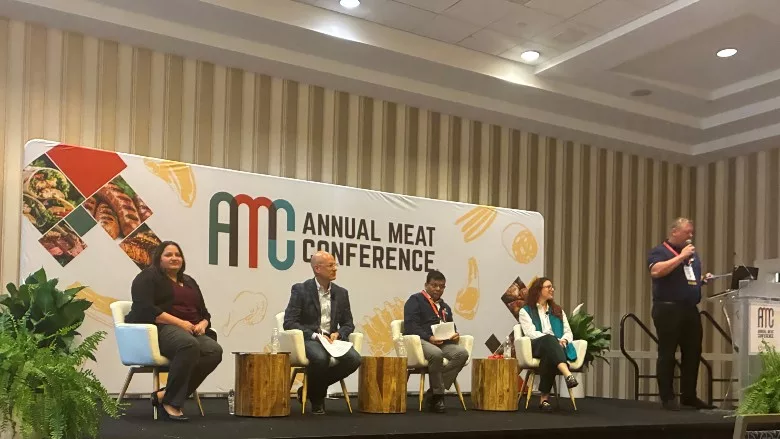
One standout educational session from the 2026 AMC explored AI at both retail and foodservice, explaining how integrating AI into retail stores can enhance operational efficiency and overall strategy. The session featured speakers Alex Considine Tong, chief product officer for Retail Insight, and Rohit Tripathi, vice president, industry strategy, CPAG and manufacturing for Relex Solutions.
During his presentation, Tripathi said that Relex AI capabilities have helped Rastelli Foods Group save $3.5 million dollars in year one of utilizing its AI, with a 95% reduction in planning time. Group of Butchers saw a 10% improvement in forecast accuracy and a 5-10% reduction in stock levels. Tripathi noted that AI "comes in many flavors," and it is important to select the right tool for the right job.
Considine Tong emphasized that AI should not feel like extra work. Though users may experience a learning curve with AI, it should help make workers' and consumers' lives easier, not add hurdles. Tripathi and Considine Tong both remarked that the technology and AI are the easy part; the hard part is integrating the technology into the established workforce, and ensuring data is properly shared across teams.
Considine Tong noted that for retailers, AI can help simplify store-levels actions and align waste and availability KPIs. She said that AI can help processors transparently share performance drivers, agree on mutual KPIs and perform active root cause analysis.
Both speakers emphasized that AI does not work in a silo; it is essential to treat AI as a connected system designed for users and built on continuous feedback loops.
AI's influence on the entire meat industry supply chain is only beginning. NVIDIA's 2026 state of the industry report found that 90% surveyed said AI investment would grow in 2026, driving efficiencies in AI performance, new use cases and employee training. By following Tripathi and Considine Tong's recommendations for implementation, industry can move beyond pilot programs and begin scaling AI across procurement, processing and retail, positioning companies for stronger operational control and long-term competitive advantage.
Looking for a reprint of this article?
From high-res PDFs to custom plaques, order your copy today!