Automation & Robotics Special Report
Automation strategies expand beyond labor replacement
Meat and poultry processors continue investing in automation, but flexibility, scalability and operational fit drive purchasing decisions.
Labor shortages continue pushing meat and poultry companies toward automation investments, particularly in repetitive or difficult-to-staff areas of production. Automation discussions are no longer centered solely on replacing labor with robotics; now, production flexibility, throughput, uptime and long-term operational fit are carrying more weight in these investment conversations. Growing SKU complexity and shifting production demands are also changing how facilities evaluate automation investments.
“The primary driver behind automation and modernization in meat and poultry processing, and frankly across industries, is the need to increase output efficiency while reducing dependency on manual operations,” said Alfredo Valadez, project manager and automation consultant for Burns & McDonnell.
Valadez noted that fully automated systems do not necessarily fit every application. Detailed trimming, irregular product variation, and certain packaging applications require a high degree of human dexterity. Fully automating those areas often requires highly customized engineering solutions that increase cost, implementation risk and time-to-ROI.
Since some applications are not a good fit for automation, processors are shifting their attention toward applications that offer the clearest return.
“There isn’t enough labor to fill all the roles that are needed to keep up with demand,” said Ryan Park, vice president of sales and marketing for SPI Automation, part of the Grote Co. Family of Brands. “Adopting the right level of automation can maximize uptime, consistency and flexibility.”
Park noted that processors continue investing heavily in systems relating to inspection, checkweighing, foreign material detection and quality control. Portioning, cooking and secondary processing applications remain strong automation opportunities, as those environments often involve repetitive tasks with measurable efficiency gains.
Production flexibility is becoming crucial to many processors navigating broader SKU portfolios, shorter production runs and more customized product requirements. Systems designed around a limited number of high-volume products can create challenges when production schedules and product mixes shift frequently. That pressure is increasing interest in retrofit projects, modular equipment and scalable systems that operators can adjust as production needs evolve.
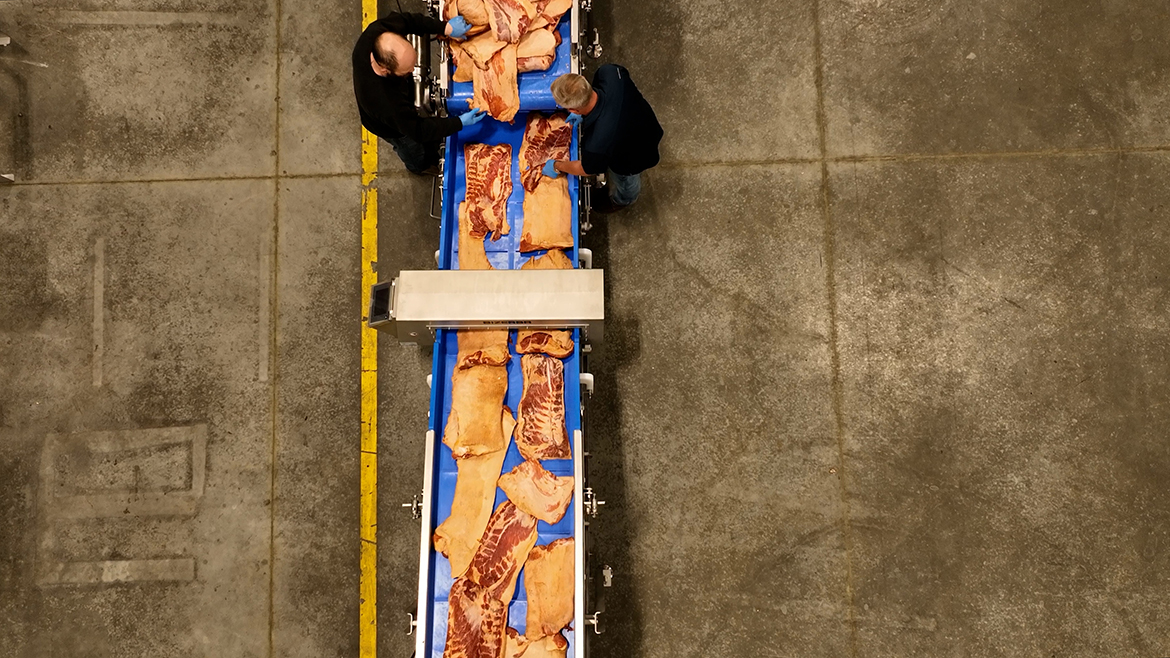
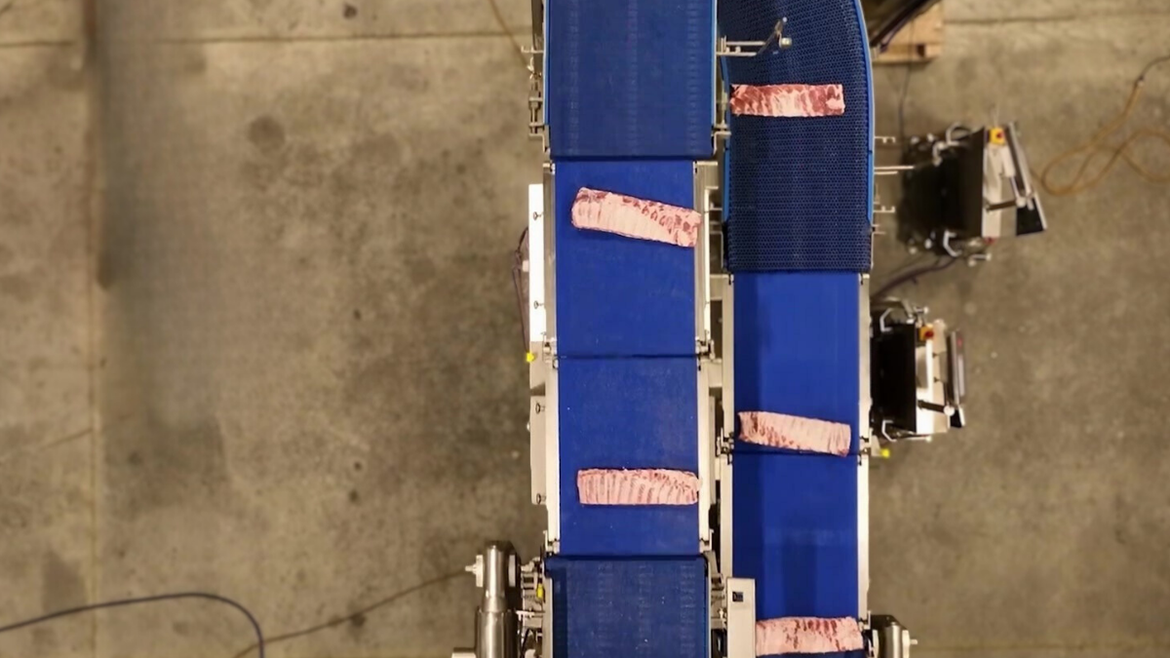
A pork metal detection and slicer conveyor system shown in action, featuring a PFI sanitary stainless steel two-stage dumper and inclined belt conveyor, along with a Grote Company high-speed slicer.
Courtesy of the Grote Co. Family of Brands
“When we talk about modernization, we’re also talking about a rigorous evaluation of production lines,” Valadez said. “Identifying bottlenecks, eliminating them and asking whether consolidating lines or even facilities makes operational and financial sense.”
Rather than replacing entire lines, many facilities now prioritize targeted upgrades to improve flexibility while limiting disruption.
“It’s important to consider the overall longer-term goals and vision,” Park said.
Semi-automated systems can also offer advantages in facilities where product variability or production flexibility creates challenges for highly customized automation solutions. “In those cases, a semi-automated or ergonomically optimized solution often delivers a better overall outcome,” Valadez said.
Automation discussions are also expanding beyond physical equipment into forecasting, pricing, product development and operational decision-making.
Steven Hershberger, president and CEO of the newly named Legacy Maker Farms, said the company integrated artificial intelligence tools across multiple business areas following the acquisition of Honey Creek Legacy.
“AI tools play five key roles in our business and in each instance, they are critical to our ability to perform as a company at the highest level possible,” he said.
Legacy Maker Farms uses predictive intelligence systems to analyze customer and market data in near-real time, helping identify purchasing patterns across both B2B and B2C markets. The company also uses AI within ERP systems to connect sales patterns with SKU management and pricing decisions.
Changing customer expectations and shifting production demands are increasing the need for faster operational decision-making. “Change is the only constant, and it is important for us never to get stuck in the ‘this is how it has always been done’ rut,” Hershberger said. “Customers and consumers demand much more today, and they have plenty of options for their dollar.”
Additional AI applications support customer communication, marketing and product development initiatives. Hershberger said AI-assisted systems help identify product opportunities, refine launch strategies, and improve responsiveness across departments, noting that AI tools should remain operational support systems rather than autonomous decision-makers.
Rather than pursuing automation for the sake of modernization, many processors are taking a more measured approach based on facility needs, production goals and long-term flexibility.
Looking for a reprint of this article?
From high-res PDFs to custom plaques, order your copy today!