What meat and poultry processors should know about hygienic fluid transfer
Hoses, pumps and piping can harbor contamination out of sight.
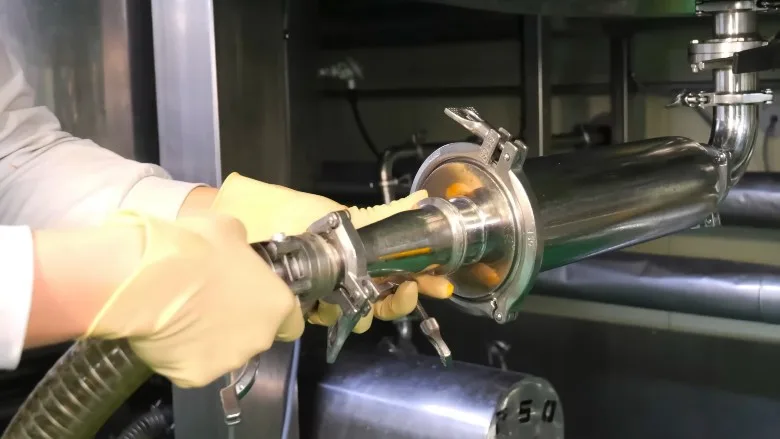
Meat and poultry slaughter and processing facilities know where contamination risks tend to concentrate. It's not the open product zones that get scrubbed hourly. It's the closed paths fluids travel through between steps, the pumps and hoses and clamp connections that move brine, blood, marinade and edible fats, and wash water shift after shift. Those internal surfaces stay moist, warm, and out of sight, which is exactly the combination microbes favor.
The equipment is part of the food safety plan
Transfer hardware contacts product directly, so its condition feeds into the same safety outcomes as any cutting surface or chiller. A pump head with a scored interior or a hose with a collapsed liner becomes a harborage point, and harborage points have a way of seeding contamination that only surfaces later in finished-product testing. Plants that treat fluid handling as plumbing tend to pay for that framing eventually. Plants that fold it into the hazard analysis catch problems while they're still cheap.
Sanitary design and geometry
A design that incorporates sloped surfaces that drain on their own and includes bends with wide enough radii, welds ground flush with no crevices and interior finishes at a stated roughness number leaves little room where soil can hide.
Another factor is material selection. The rubber compounds and steel grades in the line face a rough chemical diet. Sour marinades one hour, caustic or chlorinated wash the next, then a blast of hot water, repeated across thousands of cycles, and none of it should leave the surface pitted, swollen or sloughing particles into the product stream. Pick the wrong durometer or an alloy that can't handle the duty, and service life drops off fast, with degradation creeping into the seal long before a replacement gets handled during maintenance.
When disposable fluid paths make sense
Disposable fluid paths have moved from novelty to practical options for specific applications. Single-use tubing assemblies ship presterilized and validated, get installed for a run and get discarded afterward, not cleaned and requalified. To give an example of how this plays out in practice, a facility cycling between an allergen-bearing sauce and an allergen-free one can fit a fresh assembly at the transition and remove cross-contact risk at that junction almost completely.
The economics need to be carefully considered. Recurring consumable costs should be weighed against eliminated cleaning labor, reduced validation overhead and lower water and effluent volume. Whether that trade favors disposables depends a lot on batch size, product mix and how often a given line switches formulations.
CIP performs only as well as the loop it cleans
Clean-in-place systems push cleaning and sanitizing solution through equipment that stays bolted together, and once the loop is laid out for the task, they repeat the result with a consistency hand cleaning doesn’t compare with. Leaving the gear assembled carries a second payoff. Crews put fewer parts back wrong, and the seals and gaskets take less of a beating over time.
There's a dependency worth stating plainly. CIP rewards a well-drained, fully wetted circuit and punishes a sloppy one. A hose routed with a low pocket where solution slows down instead of sweeping through can leave that section undertreated even on a strong cycle. Designing the whole circuit for flow and drainage tends to do more for results than turning up chemistry or extending contact time.
Documentation carries weight with regulators
Audits go a lot smoother when the paper supports the practice. Gear built to recognize sanitary standards hands a plant a position it can stand behind, and validated cleaning records back up the claim that the program works as described. Consider, for instance, how fast an inspection wraps when material certificates, surface-finish specs and a signed-off CIP log come out of the file on request instead of getting pieced together while the auditor waits.
Pull it all together and a pattern begins to emerge. The plants that come out ahead give hygienic transfer the same care they give the cuts and the chillers, and that care adds up over time into safer product, smoother audits and reliable outcomes.
Looking for a reprint of this article?
From high-res PDFs to custom plaques, order your copy today!