Provisioner logo
Provisioner logo
search
cart
facebook twitter linkedin youtube
  • Sign In
  • Create Account
  • Sign Out
  • My Account
Provisioner logo
Provisioner logo
  • NEWS
    • Industry News
    • Supplier News
    • Case Studies
    • Recalls
    • Regulations
    • New Consumer Products
  • EXCLUSIVES
    • Newsletters
    • Source Book
    • Sponsored Insights
    • Events
    • Webinars
    • Classifieds
    • White Papers
    • Provisioner Store
    • Market Research
  • MEAT PROCESSING
    • SUSTAINABILITY
    • Processing
    • Packaging
    • Ingredients
    • Formulation
    • Food Safety
    • Special Reports
    • Commentary
  • PROFILES
    • Processor Profiles
    • Processor of the Year
    • Top 100 Processors
  • MEDIA
    • Videos
    • Podcasts
  • DIRECTORY
  • MIHOF
  • INDEPENDENT PROCESSOR
  • EMAG
    • eMagazine
    • ARCHIVE ISSUES
    • Contact
    • Advertise
  • JOIN!
Food Safety

Germ Warfare: New wash reduces Salmonella in poultry
By the Agricultural at the Georgia Tech Research Institute
September 14, 2009
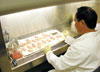
Dr. Tong Zhao, UGA Center for Food Safety, inoculates Salmonella onto chicken wings. Researchers discovered using a wash treatment containing levulinic acid together with sodium dodecyl sulfate was effective at killing the pathogen. Photo courtesy of PoultryTech, GTRI.


Studies have revealed that when chickens arrive at processing facilities, they generally have high populations of bacteria, which can include Campylobacter or Salmonella, in their viscera and externally on feathers and skin. During processing, such contamination will inevitably be transferred to the processing equipment, other carcasses and potentially to final products. Many of the pathogen-intervention strategies for poultry involve the use of antimicrobial chemicals in rinses or washes; however, the efficacy of most chemical intervention treatments is reduced by the presence of organic matter. More effective antimicrobial treatments are desired that are practical, cost-effective, safe to use and not neutralized by organic matter.

With funding from Georgia’s Traditional Industries Program for Food Processing, researchers with the University of Georgia’s Center for Food Safety, under the direction of Dr. Michael Doyle, recently completed the first year of a two-year study to develop an alternative chemical treatment to reduce Salmonella (in particular, Salmonella Enteritidis) contamination on poultry skin and features during production and transport while not adversely affecting animal health, growth rates or product quality.

“A major limitation of many chemical treatments used to kill harmful bacteria in animal-growing operations is the high organic load present that neutralizes their antimicrobial activity. Hence, many disinfectants like hypochlorite and ozone are not effective, so alternate treatments are needed,” explains Doyle.

According to Doyle, results obtained from the team’s first-year studies revealed that chemicals, including acetic acid, acidic calcium sulfate, lactic acid, levulinic acid and sodium dodecyl sulfate, when tested individually using concentrations that are practical, did not reduce 5 log of Salmonella Enteritidis/ml in pure culture within 20 minutes.

However, he notes, using a wash treatment containing levulinic acid together with sodium dodecyl sulfate was effective at killing the pathogen. Results showed that the combination treatment could kill more than 5 log Salmonella/ml within 15 seconds of contact time when evaluated in pure culture. Further studies with Salmonella on chicken skin revealed similar results, especially when the treatment liquid was agitated, with reductions within 2 minutes of greater than 5 logs of Salmonella on the surface of chicken skin (cm2) or in water (ml) contaminated with chicken feces.

“Levulinic acid was selected as the primary focus of this study because it can be produced at low cost and in high yield from renewable feedstock. Its safety for humans has been widely tested, and it has [generally regarded as safe] status for direct addition to food as a flavoring substance or adjunct,” explains Doyle.

“The application of levulinic acid plus sodium dodecyl sulfate as a wash solution may have commercial application because of its efficacy in killing foodborne pathogens, relatively low cost and environmentally friendly aspects,” adds Doyle.

The team next plans to evaluate treatment approaches for the wash solution, including application by pump-up foamer technology, electrostatic spraying and low-pressure aerosolizers, as well as application at scalding temperatures (50-60°C) with different agitation rates.

A patent application on antimicrobial composition and use has been submitted. Doyle says more than 40 companies, both nationally and internationally, have expressed an interest in the treatment, and the University of Georgia Research Foundation is in the process of negotiating licensing the technology. NP

Share This Story

Looking for a reprint of this article?
From high-res PDFs to custom plaques, order your copy today!


This article was reprinted from PoultryTech, a publication of the Agricultural Technology Research Program of the Georgia Tech Research Institute, a program conducted in cooperation with the Georgia Poultry Federation, with funding from the Georgia Legislature.

Recommended Content

JOIN TODAY
to unlock your recommendations.

Already have an account? Sign In

  • A cow eating grass and a chicken standing next to it in a field.

    The Top 100 Meat & Poultry Processors of 2026

    The 2026 Top 100 Meat & Poultry Processors highlights...
    Processor Profiles
    By: Fred Wilkinson
  • Breaded chicken nuggets on a white plate.

    Food safety programs prioritize prevention, verification, and traceability

    Across processing operations, food safety strategies are...
    Meat and Poultry Processing
    By: Sammy Bredar
  • An open double cheeseburger on a white plate, the top bun beside it, along with a side of seasoned fries.

    How convenience is driving summer grilling innovation in 2026

    Demand for high-quality, convenience-driven formats...
    Special Reports
    By: Sammy Bredar
You must login or register in order to post a comment.

Report Abusive Comment

Manage My Account
  • eMagazine Subscriptions
  • Manage My Preferences
  • Newsletters
  • Online Registration
  • Subscription Customer Service
  • Connect with The National Provisioner

More Videos

Sponsored Content

Sponsored Content is a special paid section where industry companies provide high quality, objective, non-commercial content around topics of interest to the The National Provisioner audience. All Sponsored Content is supplied by the advertising company and any opinions expressed in this article are those of the author and not necessarily reflect the views of The National Provisioner or its parent company, BNP Media. Interested in participating in our Sponsored Content section? Contact your local rep!

close
  •  two individuals standing by a farm gate
    Sponsored byPIC

    When PRRS Hits Home: The Chinn Family’s Story and a Hopeful Future

  • A smiling man carrying a grocery basket is reaching down to pick up a package of meat in a grocery store.
    Sponsored byPIC

    The Green Light: New Data Shows 12-to-1 Support for Pork from PRRS-Resistant Pigs

  • Close up of a grocery cart full of groceries, a cropped image of a couple pushing the cart and a blurred background of the vegetable aisle.
    Sponsored byPIC

    New Market Research Finds Consumers in Eight Key Pork Markets Are Likely to Purchase Pork from Gene-Edited Pigs

Popular Stories

Butchers processing hanging beef carcasses in meat processing plant

Meat Institute says meatpacking industry restructuring won’t lower beef prices

Kroger logo

Kroger to acquire Giant Eagle for $1.65B

Corporate headquarters groundbreaking

PS Seasoning and Pro Smoker reveal new parent company at headquarters groundbreaking

2026 Top 100 Meat & Poultry Processors Report

Events

January 1, 2030

Webinar Sponsorship Information

For webinar sponsorship information, visit www.bnpevents.com/webinars or email webinars@bnpmedia.com.

View All Submit An Event

Products

Food Crime: An Introduction to Deviance in the Food Industry

Food Crime: An Introduction to Deviance in the Food Industry

See More Products
The National Provisioner 2026 Food Safety Report

Related Articles

  • Germ Warfare: New wash reduces Salmonella in poultry

    See More
  • The National Provisioner Supplier News

    Phage technology reduces Salmonella in ground turkey

    See More
  • USPOULTRY logo

    Researchers compare approaches to regulating Salmonella in poultry

    See More

Related Products

See More Products
  • salmonela.jpg

    Controlling Salmonella in Poultry Production and Processing

  • Handbook of Meat, Poultry and Seafood Quality, second edition

  • Handbook of Poultry Science and Technology, Volume 2, Secondary Processing

See More Products
×

Stay ahead of the curve. Unlock a dose of cutting-edge insights.

Receive our premium content directly to your inbox.

SIGN-UP TODAY
  • RESOURCES
    • Advertise
    • Contact Us
    • Directories
    • Store
    • Want More
  • SIGN UP TODAY
    • Create Account
    • eMagazine
    • Newsletter
    • Customer Service
    • Manage Preferences
  • SERVICES
    • Marketing Services
    • Reprints
    • Market Research
    • List Rental
    • Survey/Respondent Access
  • STAY CONNECTED
    • LinkedIn
    • Facebook
    • YouTube
    • X (Twitter)
  • PRIVACY
    • PRIVACY POLICY
    • TERMS & CONDITIONS
    • DO NOT SELL MY PERSONAL INFORMATION
    • PRIVACY REQUEST
    • ACCESSIBILITY

Copyright ©2026. All Rights Reserved BNP Media, Inc. and BNP Media II, LLC.

Design, CMS, Hosting & Web Development :: ePublishing