Provisioner logo
Provisioner logo
search
cart
facebook twitter linkedin youtube
  • Sign In
  • Create Account
  • Sign Out
  • My Account
Provisioner logo
Provisioner logo
  • NEWS
    • Industry News
    • Supplier News
    • Case Studies
    • Recalls
    • Regulations
    • New Consumer Products
  • EXCLUSIVES
    • Newsletters
    • Source Book
    • Sponsored Insights
    • Events
    • Webinars
    • Classifieds
    • White Papers
    • Provisioner Store
    • Market Research
  • MEAT PROCESSING
    • SUSTAINABILITY
    • Processing
    • Packaging
    • Ingredients
    • Formulation
    • Food Safety
    • Special Reports
    • Commentary
  • PROFILES
    • Processor Profiles
    • Processor of the Year
    • Top 100 Processors
  • MEDIA
    • Videos
    • Podcasts
  • DIRECTORY
  • MIHOF
  • INDEPENDENT PROCESSOR
  • EMAG
    • eMagazine
    • ARCHIVE ISSUES
    • Contact
    • Advertise
  • JOIN!
Meat and Poultry Industry News

Groups file petition for safer meat processing line speeds; meat industry responds

News Brief Feature
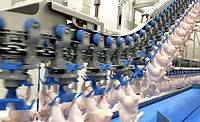
Image credit: Perdue
September 4, 2013

The Southern Poverty Law Center and a coalition of civil rights groups filed a formal petition urging the U.S. Occupational Safety and Health Administration (OSHA) and the U.S. Department of Agriculture (USDA) to better protect workers in poultry and meatpacking plants, where federal policies “allow workers to operate in hazardous conditions that often leave them with disabling injuries, illnesses and pain,” the SPLC says.

A release from the group states, “The groups petitioned OSHA to issue new work speed standards to protect the workers responsible for making the United States the largest producer of poultry and beef in the world. OSHA has general health and safety rules for workplaces but does not regulate processing line speeds that often operate at a punishing pace. 

“The only federal agency regulating line speed is the USDA, which is solely focused on food safety and maximizing production for the industries. Though there is ample evidence that work speed is a primary contributor to injuries, the USDA has proposed increasing poultry processing line speeds from a maximum of 140 birds per minute to 175. The groups’ petition also calls on the USDA to reconsider its proposed rule change.”

“Meatpacking and poultry processing line jobs are among the most notoriously dangerous jobs in the United States,” the group’s petition states. It notes that “OSHA’s current failure to regulate poultry and meat processing plant work speed puts plant workers at significant risk of permanently disabling cumulative trauma disorders,” such as carpal tunnel syndrome.

The coalition includes the SPLC, Nebraska Appleseed Center for Law in the Public Interest, Alabama Appleseed Center for Law and Justice, Coalition of Poultry Workers, Coalition of Black Trade Unionists, Farmworker Advocacy Network, Heartland Workers Center, Interfaith Worker Justice, Midwest Coalition for Human Rights, National Council for Occupational Safety and Health, North Carolina Justice Center, Northwest Arkansas Worker Justice Center, Refugee Women’s Network, Student Action with Farmworkers and Western North Carolina Workers’ Center.

The groups urge OSHA to implement the following changes to protect workers:

  • Establish a standard that limits work speeds.
  • Create standards that address the specific injuries caused by keeping up with the line speeds.
  • Ensure that existing safety guidelines are enforceable.

The groups also ask USDA to engage in thorough interagency consultation about worker safety before implementing its proposed poultry rule changes that would increase work speeds in poultry processing.

The American Meat Institute issued a response to the petition, pointing to the industry’s current safety records.

“Ensuring the safety of our workers is a top priority for meat and poultry companies. Occupational Safety and Health Administration (OSHA) data speaks for itself:  we have a sustained record of improved worker safety during the last two decades. Claims that our industries are ‘notoriously dangerous’ simply can’t be supported by federal data; our worker safety records are consistent with safety records for ‘all manufacturing’” said AMI Senior Director of Worker Safety J. Dan McCausland.

“USDA regulates line speeds and plants must continuously comply with these regulations. It’s important to remember that when considering line speeds, one must consider more factors than just speed; one must consider how that line is crewed. A line operating at a particular speed with a crew of three may be moving too quickly, but that speed may be perfectly safe with two additional crew members. 

“In addition, it is not in meat companies’ best interests to operate at speeds that cannot produce high quality product. ‘Miscuts’ are very expensive and injuries to workers are precisely what we work to avoid every day.

“Our record, as evidenced by OSHA data, shows an industry that is committed to worker safety and continuously improving in this area. USDA has the authority it needs today to adjust line speeds as necessary to ensure both food safety and also worker safety,” McCausland added.

Source: Southern Poverty Law Center, AMI

KEYWORDS: AMI line speed safety

Share This Story

Looking for a reprint of this article?
From high-res PDFs to custom plaques, order your copy today!

Recommended Content

JOIN TODAY
to unlock your recommendations.

Already have an account? Sign In

  • Double Charburger

    Premiumization drives burger category

    Shoppers seek out premium meat offerings to fulfill...
    Ingredients
    By: Sammy Bredar
  • JJS Adult Pekin duck

    Poultry Report 2025: Convenience propels poultry at retail

    Despite continued economic pressures, the poultry...
    Turkey
    By: Sammy Bredar
You must login or register in order to post a comment.

Report Abusive Comment

Manage My Account
  • eMagazine Subscriptions
  • Manage My Preferences
  • Newsletters
  • Online Registration
  • Subscription Customer Service
  • Connect with The National Provisioner

More Videos

Sponsored Content

Sponsored Content is a special paid section where industry companies provide high quality, objective, non-commercial content around topics of interest to the The National Provisioner audience. All Sponsored Content is supplied by the advertising company and any opinions expressed in this article are those of the author and not necessarily reflect the views of The National Provisioner or its parent company, BNP Media. Interested in participating in our Sponsored Content section? Contact your local rep!

close
  • A smiling man carrying a grocery basket is reaching down to pick up a package of meat in a grocery store.
    Sponsored byPIC

    The Green Light: New Data Shows 12-to-1 Support for Pork from PRRS-Resistant Pigs

  • Close up of a grocery cart full of groceries, a cropped image of a couple pushing the cart and a blurred background of the vegetable aisle.
    Sponsored byPIC

    New Market Research Finds Consumers in Eight Key Pork Markets Are Likely to Purchase Pork from Gene-Edited Pigs

  • Close up of a young pig with a blurred background.
    Sponsored byPIC

    New Research Forecasts Significant Economic and Market Impacts with PRRS-Resistant Pig Adoption

Popular Stories

Spam Dog

Hormel rolls out Spam hot dog for foodservice applications

Various new Primal snack sticks on a table amongst pencils, apples, a pair of glasses, lunch bags and a water bottle.

Protein demand drives snacking occasions

Several cuts of beef, pork and chicken on a wooden board, cast iron pan and salt.

Validated thermal lethality data and a new tool for ensuring safety of RTE meats

2026 Top 100 Meat & Poultry Processors Report

Events

June 11, 2026

From Fresh to Frozen in 3 Minutes Flat: Unlocking the Secrets to Temperature Control

Join Tony Vacaro, Foods Industry Manager, and Emile Klein, Foods Market Strategy Manager at Air Products and Chemicals, Inc. , as they tackle key questions surrounding heat removal in food processing. 

January 1, 2030

Webinar Sponsorship Information

For webinar sponsorship information, visit www.bnpevents.com/webinars or email webinars@bnpmedia.com.

View All Submit An Event

Products

Food Crime: An Introduction to Deviance in the Food Industry

Food Crime: An Introduction to Deviance in the Food Industry

See More Products
From Fresh to Frozen in 3 Minutes Flat: Unlocking the Secrets to Temperature Control Webinar Sponsored by Air Products

Related Articles

  • USDA announces Farmer Fair Practices Rules; meat industry responds with harsh criticism

    See More
  • Meat industry responds to Hurricane Harvey disaster

    See More
  • poultry processing

    Poultry processing and line speeds

    See More

Related Products

See More Products
  • advanced tech.jpg

    Advanced Technologies for Meat Processing

  • meat.jpg

    Handbook of Meat and Meat Processing, 2nd Edition

  • emerging.jpg

    Emerging Technologies in Meat Processing: Production, Processing and Technology

See More Products
×

Stay ahead of the curve. Unlock a dose of cutting-edge insights.

Receive our premium content directly to your inbox.

SIGN-UP TODAY
  • RESOURCES
    • Advertise
    • Contact Us
    • Directories
    • Store
    • Want More
  • SIGN UP TODAY
    • Create Account
    • eMagazine
    • Newsletter
    • Customer Service
    • Manage Preferences
  • SERVICES
    • Marketing Services
    • Reprints
    • Market Research
    • List Rental
    • Survey/Respondent Access
  • STAY CONNECTED
    • LinkedIn
    • Facebook
    • YouTube
    • X (Twitter)
  • PRIVACY
    • PRIVACY POLICY
    • TERMS & CONDITIONS
    • DO NOT SELL MY PERSONAL INFORMATION
    • PRIVACY REQUEST
    • ACCESSIBILITY

Copyright ©2026. All Rights Reserved BNP Media, Inc. and BNP Media II, LLC.

Design, CMS, Hosting & Web Development :: ePublishing