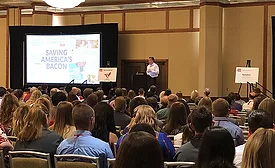
Although new tariffs and multimillion-dollar jury verdicts in North Carolina hog nuisance trials have garnered most of the agribusiness community’s attention over the past several months, there is another matter brewing in a St. Louis courtroom that may have substantial adverse consequences for the meat industry.
There are three main types of communication: Verbal, nonverbal, and written or visual communication. I am going to discuss the first two types of communication in this article.
I want to update you on the progress of some of the regulatory matters that Nelson, AAMP's outreach specialist, and I have been working on. We just received the final version of the Foreign Materials Best Practices paper that has been a work in progress for a few years now.
The Ranchers-Cattlemen Action Legal Fund, United Stockgrowers of America (R-CALF) hopes to convince President Donald Trump to sign an executive order reinstating mandatory COOL labeling for beef products.
Andy Hanacek's October "From the Editor's Desk" video is the first in a special two-part series focusing on employers and employees in the meat and poultry industry.
The American Meat Science Association (AMSA) 71st Reciprocal Meat Conference (RMC) hosted in Kansas City, Mo., this past June was a celebration of barbecue from the very beginning.
When a customer complains, it provides you with the opportunity to turn a dissatisfied customer into a satisfied customer and perhaps into an advocate for your product or brand. This is true whether you are dealing with a retail or wholesale customer.
Apparently, organic, non-GMO, hormone-free, free-range, grass-fed and antibiotic-free meat is no longer good enough. Cultured meat, also referred to as "clean meat" or lab-grown meat, is increasingly garnering more attention.