Exposing recent improvements in X-ray inspection for meat inspection
The tide has turned. With heavyweight grocery retailers now demanding that meat processors utilize X-ray for inspection of product, the switch to X-ray over metal detection for physical contamination has become more a question of “when” rather than “if.”
By now, most meat producers recognize the advantages that X-ray inspection offers over aging technology like metal detectors. The list is extensive, but leads with the fact that X-ray equipment readily identifies stainless steel—the most common metal used in meat processing equipment. X-ray also spots nonmetallic objects such as bones, and even glass. X-rays can even “see” through metalized packaging, and work around other obstacles such as metal retaining clips used in Chub packaging without degrading the ability to find unwanted foreign objects.
All these advantages, and the benefits they bring, are undeniable. So why aren’t more meat processors jumping on the X-ray bandwagon?
Cost no longer ranks as a major issue. Like so many other technologies, competition and improvements in manufacturing efficiency have dropped the price point of X-ray inspectors to within striking distance of high-end metal detectors. Even a spread of $20,000-$30,000 pales in comparison to the potential loss of brand loyalty if just one foreign particle harms or alarms a consumer and its source gets traced back to the food producer.
Instead, feedback gathered over the years from major food producers points to two big issues that still give some of them pause before making the inevitable leap to X-ray: the perceived difficulty in operating these devices; and the feeling that factory technicians are required to maintain and repair them.
In light of the newest X-ray inspection designs, a closer examination of these concerns reveals the fact that these fears are no longer founded.
Shortening the operational learning curve
Traditionally, metal detectors have appealed to meat processors because they are simple systems; hence they appear less complicated to repair. Also, metal detectors are easier to operate and adjust than traditional X-ray machines.
For instance, because X-ray machines currently used in the meat inspection industry are unmanned, they require advanced image processing software to determine if a foreign object is present in the food or its packaging. As a result, they require highly trained personnel to adjust, setup, and maintain the image processing to get optimum performance.
However, any further extrapolation of these legacy assumptions stops at the point where the latest iterations from Novus X-ray come in. With the introduction of new automatic training algorithms, these devices from Novus can now be set up quickly and easily.
Novus X-Ray (www.novusxray.com)—a manufacturer of state-of-the-art x-ray inspection systems—utilizes fully automatic training technology in their X-ray machines to learn what normal product should looks like under the light of x-ray energy and reject anything else. This includes undesired contamination such as stainless steel, glass, and bone but can also be used to identify undesirable process variations.
The one-button “auto learning” system, pioneered by Novus X-Ray, allows a technician to visually inspect an x-ray image that has been falsely detected, and with one button tell the machine to learn from its mistakes. No further adjustments, or even knowledge of how the image processing system works is required, making operation completely intuitive.
These advancements in image processing enable X-ray inspection to run almost on autopilot.
“I have other X-rays here, but the thing I like about the Novus units is their ability to self-train; a guy that doesn’t even know much about X-ray can do it,” says Bob Taylor, Superintendent of Electronics and Controls at Hatfield Quality Meats—a division of the Clemens Food Group.
“Our ability to set them up is faster and a lot less frustrating, so it saves a lot of man hours,” Taylor adds.
Maintenance and repair simplified
Meat processors traditionally shied away from X-ray machines because of the belief that they are complicated, requiring factor-trained technicians for service and repair.
In the past, the breakdowns justified the fear of extended production delays while a specialist had to be called in to repair the device. Hence, food manufactures have traditionally put up with the shortcomings of metal detectors for the simple reason that they were easier to fix.
That was then. Nowadays, the clever modularization of X-ray construction designed and utilized by Novus X-ray has made repairing these devices almost as easy as changing a light bulb.
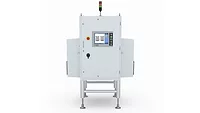
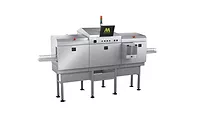
Novus’ CCPX line of X-ray inspection machines groups the various components of the system into just five modules: processing-detection, the human-machine-interface, input-output electronics, X-ray generator, and the cooling system.
To further speed the repair process, embedded software readily identifies which module needs replacement. The worker simply unplugs it from its cabling, unbolts that faulty module, inserts the replacement module, and reconnects the cabling. Any recalibration, mechanical alignment, or settings recovery takes place without worker intervention. Such ability make repair and maintenance a matter of “plug-and-play” lowering the knowledge and training bar to levels commonly found in plant maintenance personnel.
This modularization of the Novus X-ray inspection systems means that any necessary repairs can now take place quickly and easily. Access to replacement modules is available on a 24/7 basis from Novus X-ray, while most food production facilities go the extra step to purchase spare modules in advance for on-the-spot replacement. In the time it takes to change a bearing on a conveyor, for instance, the X-ray critical control point is back up and running again without even calling the factory for parts. The service model changes from factory technicians on-site to mail the defective module back for replacement.
“I have some guys who are specialists on the older X-ray units and they are very familiar with them; whereas I can send just about anybody out to a Novus unit to calibrate it,” says Taylor.
The newfound ease of operating and repairing the Novus X-ray inspection devices means that a food producer can maintain these machines with their own, existing, personnel. Since no special training is required, employee turnover is no longer a problem to ensure that the machine operates at maximum uptime.
“We’re able to maintain the machines on our own, so it makes us very self-sufficient,” adds Taylor.
The best of both worlds
Enabled by new technology, the simplification of operating and maintaining a Novus X-ray inspection system allows meat processors to benefit from all the advantages that X-ray inspection offers, with the same ease and quick repair that legacy metal detection systems offered.
With the lower price differential, and the very recent plug-and-play service model offered by Novus, meat processors still using metal detection have run out of excuses. Now that some of the largest food retailers are demanding X-ray inspection, and competing food producers are adopting X-ray, the question of “when” to make the switch has been answered: now.
For more information, contact Novus X-Ray LLC at 726 Boehms Church Road; Blue Bell, PA 19422; T: 215.962.3171; F: 609.249.5124; sales@novusxray.com or www.novusxray.com.
Looking for a reprint of this article?
From high-res PDFs to custom plaques, order your copy today!