Provisioner logo
Provisioner logo
search
cart
facebook twitter linkedin youtube
  • Sign In
  • Create Account
  • Sign Out
  • My Account
Provisioner logo
Provisioner logo
  • NEWS
    • Industry News
    • Supplier News
    • Case Studies
    • Recalls
    • Regulations
    • New Consumer Products
  • EXCLUSIVES
    • Newsletters
    • Source Book
    • Sponsored Insights
    • Events
    • Webinars
    • Classifieds
    • White Papers
    • Provisioner Store
    • Market Research
  • MEAT PROCESSING
    • SUSTAINABILITY
    • Processing
    • Packaging
    • Ingredients
    • Formulation
    • Food Safety
    • Special Reports
    • Commentary
  • PROFILES
    • Processor Profiles
    • Processor of the Year
    • Top 100 Processors
  • MEDIA
    • Videos
    • Podcasts
  • DIRECTORY
  • MIHOF
  • INDEPENDENT PROCESSOR
  • EMAG
    • eMagazine
    • ARCHIVE ISSUES
    • Contact
    • Advertise
  • JOIN!
Meat and Poultry ProcessingSustainability

Supplier's Perspective

Improving DAF efficiency through feed stream pretreatment
By Scott T. Burr
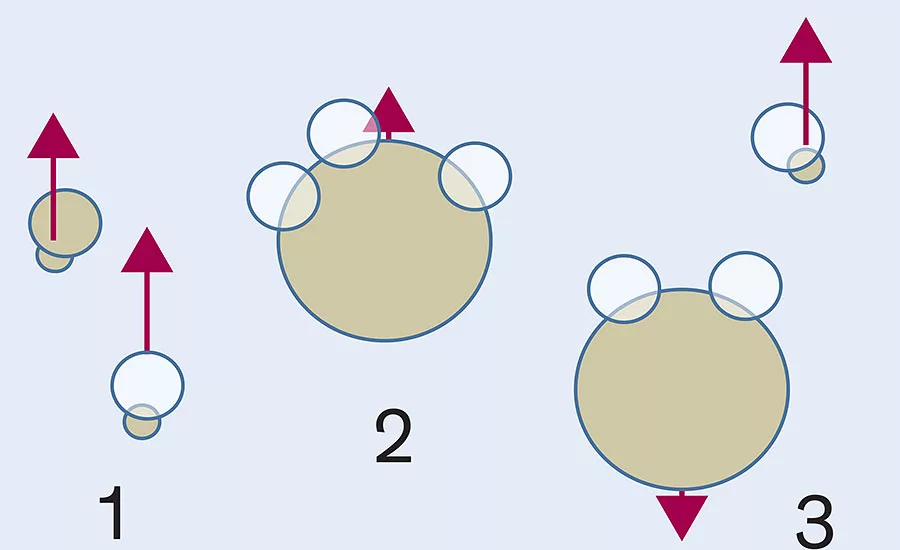
Depiction of impact of relative bubble size to particle size in a DAF unit

Figure 1: Depiction of impact of relative bubble size (clear circles) to particle size (brown circles) in a DAF unit. Arrow lengths indicated relative velocity.

April 20, 2016

Dissolved air flotation (DAF) plays an important role in processing wastewater streams containing heavy loads of fats, oils, greases, and organic and inorganic particles. The critical mechanisms to maintain within the DAF include: a contact zone with high densities of small bubbles (~40-80 micron bubble diameters), conditions within that zone which promote connection of neutralized particles to those bubbles, floating the particle/bubble groups to the surface, and removal of those solid groups in the DAF float. Pretreatment to the DAF system can result in higher DAF treatment capacity, excellent chemical savings, reduced maintenance costs and improved effluent quality. It can also reduce water content in the final solid waste which can potentially lead to significant reductions in sludge disposal costs.

A large body of research regarding DAF theory, operation and efficiency has been published since the 1970s. Key findings with respect to optimum DAF operational conditions have been published by prominent DAF experts And are well summarized by Edzwald.1 The author describes several points, two of which are of particular interest when evaluating the use of a prefilter in front of a DAF.

• For air bubbles between 40 and 80 microns in diameter (common in most DAF systems), the optimum size particle to deliver to the DAF is between 25 and 50 microns when a coagulant is used to neutralize the charges on the particles. When these conditions are met, a single bubble can efficiently attach to a single particle and still achieve maximum rise rates. (See Figure 1-1.)

• When particles become larger (100-200 microns), several air bubbles may be required to float a single particle. This can result in much lower rise rates for the particle-bubble group if the required number of bubbles do not properly attach to the particle, yielding lower flow rates for the DAF. Also, larger particles may require several bubbles to achieve the desired rise rate, and those bubbles can easily become separated as the particle/bubble group interacts with other rising particles, resulting in the large particle settling to the bottom of the DAF. (See Figure 1-2 and 1-3.)

An emerging technology trend in wastewater stream remediation is to place a self-cleaning prefilter before the DAF. This step delivers the desired particle size of 25- 50 microns to the DAF, which facilitates higher contact efficiencies in the contact zone. However, this is a very difficult filtration step as the filter must be able to handle very high levels of fats, oils, and greases (up to 1 percent) and very high levels of soft, sticky solids (commonly 500- 10,000 mg/L), plus remove all particles greater than approximately 50 microns – all in a continuous, high water recovery mode.

When an effective prefiltration technology is used, the solids loading to the DAF is typically reduced by 20-40 percent and the resulting DAF chemical usage can be decreased by more than 40 percent. Additionally, the resulting floatant has a higher solids content and less sludge sinks to the bottom -- reducing maintenance and disposal costs. With a return on investment of one year or less achievable, it is anticipated that prefiltration for DAF will grow in popularity.


  1. Edzwald, James K., “Dissolved air flotation and me”, Water Research, 44, 2010, pp. 2077-2106.
KEYWORDS: processing plant effluent supplier perspectives wastewater

Share This Story

Looking for a reprint of this article?
From high-res PDFs to custom plaques, order your copy today!
Scott Burr is Research, Development, & Engineering Director for Clean Filtration Technologies LLC & THe Dow Chemical Co. He can be reached at stburr@dow.com.

Recommended Content

JOIN TODAY
to unlock your recommendations.

Already have an account? Sign In

  • Double Charburger

    Premiumization drives burger category

    Shoppers seek out premium meat offerings to fulfill...
    Ingredients
    By: Sammy Bredar
  • JJS Adult Pekin duck

    Poultry Report 2025: Convenience propels poultry at retail

    Despite continued economic pressures, the poultry...
    Meat and Poultry Industry News
    By: Sammy Bredar
You must login or register in order to post a comment.

Report Abusive Comment

Manage My Account
  • eMagazine Subscriptions
  • Manage My Preferences
  • Newsletters
  • Online Registration
  • Subscription Customer Service
  • Connect with The National Provisioner

More Videos

Sponsored Content

Sponsored Content is a special paid section where industry companies provide high quality, objective, non-commercial content around topics of interest to the The National Provisioner audience. All Sponsored Content is supplied by the advertising company and any opinions expressed in this article are those of the author and not necessarily reflect the views of The National Provisioner or its parent company, BNP Media. Interested in participating in our Sponsored Content section? Contact your local rep!

close
  • A smiling man carrying a grocery basket is reaching down to pick up a package of meat in a grocery store.
    Sponsored byPIC

    The Green Light: New Data Shows 12-to-1 Support for Pork from PRRS-Resistant Pigs

  • Close up of a grocery cart full of groceries, a cropped image of a couple pushing the cart and a blurred background of the vegetable aisle.
    Sponsored byPIC

    New Market Research Finds Consumers in Eight Key Pork Markets Are Likely to Purchase Pork from Gene-Edited Pigs

  • Close up of a young pig with a blurred background.
    Sponsored byPIC

    New Research Forecasts Significant Economic and Market Impacts with PRRS-Resistant Pig Adoption

Popular Stories

Various new Primal snack sticks on a table amongst pencils, apples, a pair of glasses, lunch bags and a water bottle.

Protein demand drives snacking occasions

Several cuts of beef, pork and chicken on a wooden board, cast iron pan and salt.

Validated thermal lethality data and a new tool for ensuring safety of RTE meats

Cargill logo

Cargill initiates lockout at Fort Morgan beef plant after union rejects contract

2026 Top 100 Meat & Poultry Processors Report

Events

January 1, 2030

Webinar Sponsorship Information

For webinar sponsorship information, visit www.bnpevents.com/webinars or email webinars@bnpmedia.com.

View All Submit An Event

Products

Food Crime: An Introduction to Deviance in the Food Industry

Food Crime: An Introduction to Deviance in the Food Industry

See More Products
From Fresh to Frozen in 3 Minutes Flat: Unlocking the Secrets to Temperature Control Webinar Sponsored by Air Products

Related Articles

  • Dorner equipment

    Optimizing plant efficiency through automated systems

    See More
  • Shopping carts

    Grocery chain enhances operational efficiency through Vusion 360

    See More
  • Beef

    Improving meat plant efficiency with real-time weighing and data integration

    See More

Related Products

See More Products
  • The 10 Principles of Food Industry Sustainability

  • Microbiology of Thermally Preserved Foods: Canning and Novel Physical Methods

  • meat quality.jpg

    Meat Quality: Genetic and Environmental Factors

See More Products

Events

View AllSubmit An Event
  • March 1, 2010

    Food Plant of the Future: Advancing Food Safety through Sanitary Design

    On demand Food and beverage companies work hard to consistently deliver safe products because they understand that the stakes are extremely high for the public and for their companies.
View AllSubmit An Event

Related Directories

  • ScottPec Inc.

    ScottPec is a North American manufacturer and distributor of premium meat processing equipment, specializing in smokehouses and value-added production systems. We help processors increase yields, improve efficiency, and expand product lines through innovative technology, hands-on support, and industry expertise. ScottPec delivers performance, reliability, and growth-focused solutions built for modern processing operations.
×

Stay ahead of the curve. Unlock a dose of cutting-edge insights.

Receive our premium content directly to your inbox.

SIGN-UP TODAY
  • RESOURCES
    • Advertise
    • Contact Us
    • Directories
    • Store
    • Want More
  • SIGN UP TODAY
    • Create Account
    • eMagazine
    • Newsletter
    • Customer Service
    • Manage Preferences
  • SERVICES
    • Marketing Services
    • Reprints
    • Market Research
    • List Rental
    • Survey/Respondent Access
  • STAY CONNECTED
    • LinkedIn
    • Facebook
    • YouTube
    • X (Twitter)
  • PRIVACY
    • PRIVACY POLICY
    • TERMS & CONDITIONS
    • DO NOT SELL MY PERSONAL INFORMATION
    • PRIVACY REQUEST
    • ACCESSIBILITY

Copyright ©2026. All Rights Reserved BNP Media, Inc. and BNP Media II, LLC.

Design, CMS, Hosting & Web Development :: ePublishing