Provisioner logo
Provisioner logo
search
cart
facebook twitter linkedin youtube
  • Sign In
  • Create Account
  • Sign Out
  • My Account
Provisioner logo
Provisioner logo
  • NEWS
    • Industry News
    • Supplier News
    • Case Studies
    • Recalls
    • Regulations
    • New Consumer Products
  • EXCLUSIVES
    • Newsletters
    • Source Book
    • Sponsored Insights
    • Events
    • Webinars
    • Classifieds
    • White Papers
    • Provisioner Store
    • Market Research
  • MEAT PROCESSING
    • SUSTAINABILITY
    • Processing
    • Packaging
    • Ingredients
    • Formulation
    • Food Safety
    • Special Reports
    • Commentary
  • PROFILES
    • Processor Profiles
    • Processor of the Year
    • Top 100 Processors
  • MEDIA
    • Videos
    • Podcasts
  • DIRECTORY
  • MIHOF
  • INDEPENDENT PROCESSOR
  • EMAG
    • eMagazine
    • ARCHIVE ISSUES
    • Contact
    • Advertise
  • JOIN!
Meat and Poultry ProcessingPork

Meat Science Review

Definition of factors that impact fresh pork tenderness
By Kelsey Carlson, Ken Prusa, Chris Fedler, Amanda Outhouse, Elisabeth Lonergan, PhD, Steven Lonergan, PhD
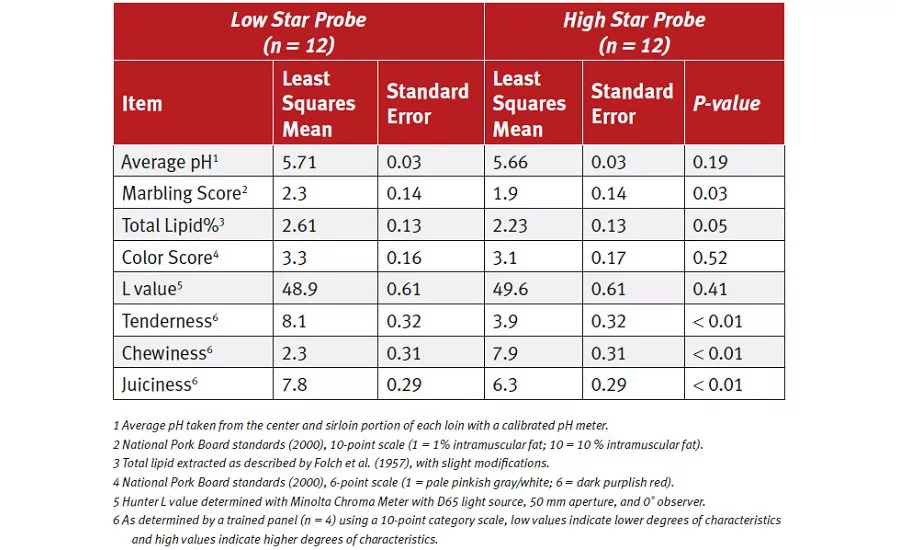
Summary of the fresh pork loin quality and sensory characteristics from samples selected for low and high star probe groups

Table 1. Summary of the fresh pork loin quality and sensory characteristics from samples selected for low and high star probe groups. Characteristics that are significantly different from each other are designated with a P-value of <0.05.

October 11, 2016

Inconsistency in pork tenderness is an issue consumers, chefs and purveyors are challenged with every day. Tenderness is imperative to meat quality, but methods to measure tenderness in large-scale processing facilities have not yet been established. There is value in defining the features of fresh pork loins that contribute to variation in sensory quality.  It is understood that pH, color and marbling can influence pork quality. It also is known pork quality can vary even when these traditionally defined quality determinants are held constant. The objectives of this study were to determine the explanation for variation in fresh pork tenderness when pH, color and marbling are not different.

Fresh pork loins (n = 159) were collected one day postmortem from carcasses of commercial Duroc-sired pigs. After aging loins approximately 13 days, chops (1 inch thick) were fabricated and evaluated for purge, cook loss, ultimate pH, visual color and marbling, Hunter L, a, b values, sensory, star probe (kg) and total lipid. Loins that had extreme star probe measurements were selected if in range for ultimate pH (5.54-5.86), visual marbling score (1.0-3.0), and total lipid (1.61-3.37 percent). These ranges were selected because previous research shows ultimate pH and lipid content can influence measured tenderness in fresh pork. A trained sensory panel (n = 4) was used to evaluate tenderness, chewiness, juiciness and flavor of chops. Instrumental tenderness was measured with an Instron fitted with a star probe attachment (Figure 1). This measures the peak force necessary to compress and puncture a chop with a programmed cycle of an 80 percent compression. Star probe analysis has a strong negative correlation to sensory tenderness and a strong positive correlation with sensory chewiness. Selected samples were grouped into either a low star probe (LSP, n = 12) or high star probe (HSP, n = 12) group.   The average star probe value for the LSP group was 4.95±0.25 kg and the average star probe value of the HSP group was 7.75±0.74 kg.

SDS-PAGE and Western blots were used to identify degradation differences in the proteins troponin-T, desmin and filamin between LSP and HSP samples. SDS-PAGE gels were evaluated for titin degradation differences.

Results showed LSP and HSP samples exhibited similar ultimate pH and color scores. Marbling and lipid were statistically greater in the LSP group, but the difference was subtle. Table 1 also summarizes notable advantages in sensory tenderness, chewiness and juiciness observed in the LSP group compared with the HSP group. Therefore, this sample group provides the opportunity to understand why tenderness can vary a great deal when pH, color and marbling do not vary widely. Biochemical evaluation of these aged pork loins showed the LSP samples exhibited 100 percent more degradation products of troponin-T, 255 percent more degradation products of desmin, and 33 percent less intact filamin than the HSP samples, which likely influenced why LSP chops were evaluated more tender from star probe and sensory analysis. Evaluation of titin SDS-PAGE gels showed presence of intact titin in some HSP samples (a novel observation because titin is typically degraded very early postmortem), which may contribute to the toughness measured in HSP chops.

Results from this study demonstrate even when ultimate pH, total lipid and color are similar in samples, there can still be extreme differences in measured tenderness. The notable degradation differences in troponin-T, desmin, filamin, and titin show proteolysis greatly affects tenderness.  The results demonstrate that we can search for biomarkers linked to protein degradation to characterize fresh pork to give more consistent eating experiences.  It is also important to continue to determine the explanation for the observed differences in postmortem degradation of structural proteins that can affect fresh pork tenderness.  NP

KEYWORDS: American Meat Science Association (AMSA) meat science review

Share This Story

Looking for a reprint of this article?
From high-res PDFs to custom plaques, order your copy today!


Kelsey Carlson, Iowa State University
Ken Prusa, Iowa State University
Chris Fedler, Iowa State University
Amanda Outhouse, Iowa State University

Elisabeth Lonergan, Ph.D., of Iowa State University, is the editor-in-chief of Meat and Muscle Biology.

Dr. Steven Lonergan is a Professor at Iowa State University.

Recommended Content

JOIN TODAY
to unlock your recommendations.

Already have an account? Sign In

  • Double Charburger

    Premiumization drives burger category

    Shoppers seek out premium meat offerings to fulfill...
    Meat and Poultry Industry News
    By: Sammy Bredar
  • JJS Adult Pekin duck

    Poultry Report 2025: Convenience propels poultry at retail

    Despite continued economic pressures, the poultry...
    Chicken
    By: Sammy Bredar
You must login or register in order to post a comment.

Report Abusive Comment

Manage My Account
  • eMagazine Subscriptions
  • Manage My Preferences
  • Newsletters
  • Online Registration
  • Subscription Customer Service
  • Connect with The National Provisioner

More Videos

Sponsored Content

Sponsored Content is a special paid section where industry companies provide high quality, objective, non-commercial content around topics of interest to the The National Provisioner audience. All Sponsored Content is supplied by the advertising company and any opinions expressed in this article are those of the author and not necessarily reflect the views of The National Provisioner or its parent company, BNP Media. Interested in participating in our Sponsored Content section? Contact your local rep!

close
  • A smiling man carrying a grocery basket is reaching down to pick up a package of meat in a grocery store.
    Sponsored byPIC

    The Green Light: New Data Shows 12-to-1 Support for Pork from PRRS-Resistant Pigs

  • Close up of a grocery cart full of groceries, a cropped image of a couple pushing the cart and a blurred background of the vegetable aisle.
    Sponsored byPIC

    New Market Research Finds Consumers in Eight Key Pork Markets Are Likely to Purchase Pork from Gene-Edited Pigs

  • Close up of a young pig with a blurred background.
    Sponsored byPIC

    New Research Forecasts Significant Economic and Market Impacts with PRRS-Resistant Pig Adoption

Popular Stories

Various new Primal snack sticks on a table amongst pencils, apples, a pair of glasses, lunch bags and a water bottle.

Protein demand drives snacking occasions

Spam Dog

Hormel rolls out Spam hot dog for foodservice applications

Several cuts of beef, pork and chicken on a wooden board, cast iron pan and salt.

Validated thermal lethality data and a new tool for ensuring safety of RTE meats

2026 Top 100 Meat & Poultry Processors Report

Events

January 1, 2030

Webinar Sponsorship Information

For webinar sponsorship information, visit www.bnpevents.com/webinars or email webinars@bnpmedia.com.

View All Submit An Event

Products

Food Crime: An Introduction to Deviance in the Food Industry

Food Crime: An Introduction to Deviance in the Food Industry

See More Products
From Fresh to Frozen in 3 Minutes Flat: Unlocking the Secrets to Temperature Control Webinar Sponsored by Air Products

Related Articles

  • raw goat meat

    Impact of biochemical factors that affect Asian consumer palatability preference for stewed goat meat

    See More
  • ADM logo

    ADM identifies four factors that can drive expansion of the alternative protein ecosystem

    See More
  • Close-up of a pink pig's head in a pen, looking left, with a bright light in the background.

    Dietary fat sources and levels of vitamin E isoforms impact carcass traits and fresh pork quality of heavy slaughter weight pigs

    See More

Related Products

See More Products
  • meat quality.jpg

    Meat Quality: Genetic and Environmental Factors

  • GlobalData_logo_blue_header.png

    Fresh Meat (Counter) (Meat) Market in the United States of America - Outlook to 2023...

  • Handbook of Meat, Poultry and Seafood Quality, second edition

See More Products

Events

View AllSubmit An Event
  • April 25, 2013

    Food Plant of the Future: Global Food Safety Impact on Facilities

    On demand SQF 2000, FSMA, ISO 22000/PAS220 and other standards continue to gain traction in an attempt to create safer foods and beverages.
View AllSubmit An Event

Related Directories

  • National Pork Board

    The U.S. pork industry has had a 100 percent legislative checkoff program since 1986. Congress created the Pork Checkoff as part of The Pork Promotion, Research and Consumer Information Act of 1985. Pork producers had requested the legislation so they could take advantage of having all producers and importers participate in a checkoff program designed to strengthen the position of pork in the marketplace.
×

Stay ahead of the curve. Unlock a dose of cutting-edge insights.

Receive our premium content directly to your inbox.

SIGN-UP TODAY
  • RESOURCES
    • Advertise
    • Contact Us
    • Directories
    • Store
    • Want More
  • SIGN UP TODAY
    • Create Account
    • eMagazine
    • Newsletter
    • Customer Service
    • Manage Preferences
  • SERVICES
    • Marketing Services
    • Reprints
    • Market Research
    • List Rental
    • Survey/Respondent Access
  • STAY CONNECTED
    • LinkedIn
    • Facebook
    • YouTube
    • X (Twitter)
  • PRIVACY
    • PRIVACY POLICY
    • TERMS & CONDITIONS
    • DO NOT SELL MY PERSONAL INFORMATION
    • PRIVACY REQUEST
    • ACCESSIBILITY

Copyright ©2026. All Rights Reserved BNP Media, Inc. and BNP Media II, LLC.

Design, CMS, Hosting & Web Development :: ePublishing