Provisioner logo
Provisioner logo
search
cart
facebook twitter linkedin youtube
  • Sign In
  • Create Account
  • Sign Out
  • My Account
Provisioner logo
Provisioner logo
  • NEWS
    • Industry News
    • Supplier News
    • Case Studies
    • Recalls
    • Regulations
    • New Consumer Products
  • EXCLUSIVES
    • Newsletters
    • Source Book
    • Sponsored Insights
    • Events
    • Webinars
    • Classifieds
    • White Papers
    • Provisioner Store
    • Market Research
  • MEAT PROCESSING
    • SUSTAINABILITY
    • Processing
    • Packaging
    • Ingredients
    • Formulation
    • Food Safety
    • Special Reports
    • Commentary
  • PROFILES
    • Processor Profiles
    • Processor of the Year
    • Top 100 Processors
  • MEDIA
    • Videos
    • Podcasts
  • DIRECTORY
  • MIHOF
  • INDEPENDENT PROCESSOR
  • EMAG
    • eMagazine
    • ARCHIVE ISSUES
    • Contact
    • Advertise
  • JOIN!
Meat and Poultry Industry NewsPork

Commentary: AMSA

Dietary fat sources and levels of vitamin E isoforms impact carcass traits and fresh pork quality of heavy slaughter weight pigs

Findings suggest supplementation with 40 ppm GT reduces redness and increased lightness of fresh pork.
By Gregg Rentfrow, Surendranath P. Suman, Ana Paula Salim, Marlee Kelley, Ding Wang, Merlin Lindemann
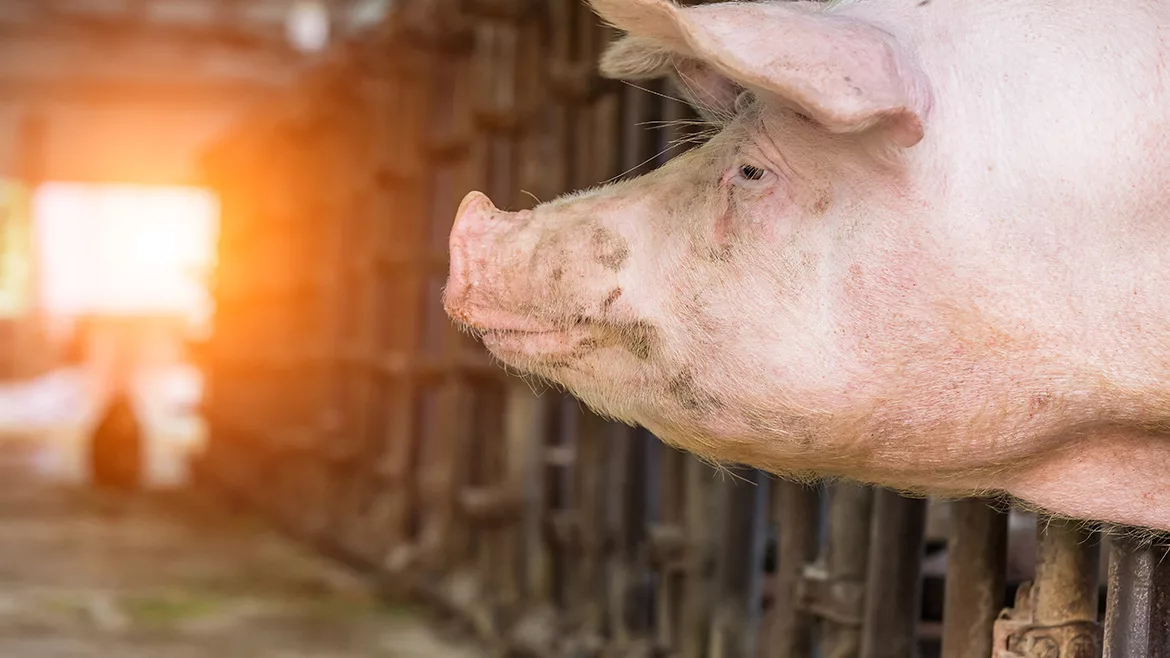
Close-up of a pink pig's head in a pen, looking left, with a bright light in the background.
Image source: zhaojiankang / Getty Images
March 19, 2026

Introduction

The increasing demand for pork can be addressed by increasing slaughter weight and exploring alternative feed ingredients in swine diets. Vitamin E (VE) is an antioxidant and plays an important role in improving the oxidative stability of pork. However, interactions among VE isoforms, dietary fat sources, and pork quality are rarely reported. Therefore, the objective of this study was to evaluate the effects of supplementing the vitamin E isoforms alpha-tocopheryl acetate (ATA) and gamma-tocopherol (GT) in combination with corn oil (CO) and tallow (TW) on the color characteristics of fresh pork loins from heavy-weight pigs (>150 kg).

Materials and methods

The experiment was conducted in accordance with protocols approved by the Institutional Animal Care and Use Committee of the University of Kentucky. A total of 72 individually fed pigs (n = 72) were blocked by sire, body weight, and sex and randomly assigned to individual pens. Dietary vitamin E treatments consisted of four levels of ATA (11, 40, 100, and 200 ppm) and two levels of mixed tocopherols, primarily GT (40 and 100 ppm). Pigs were humanely slaughtered at approximately 150 kg live weight at the University of Kentucky USDA-inspected Meat Laboratory. At 24 h postmortem, a 2.54-cm chop was collected from the longissimus thoracis, placed on foam trays, and overwrapped with polyvinyl chloride (PVC) film for instrumental color evaluation. Instrumental color measurements included lightness (L*), redness (a*), yellowness (b*), hue angle (H*), and chroma (C*), which were obtained from three random locations on the light-exposed surface using a HunterLab MiniScan XE colorimeter (HunterLab Associates, Reston, VA) equipped with a 2.54-cm diameter aperture, illuminant A, and a 10° standard observer. Measurements were conducted on days 1, 3, 5, and 7 of retail display under 1,300 lux. Data was analyzed using SAS by least squares analysis of variance with the generalized linear model (GLM) as a randomized complete block design, with the individual pig serving as the experimental unit. Statistical significance was declared at P ≤ 0.05, and tendencies were identified at P ≤ 0.10.

Results

Overall, chops from pigs supplemented with GT tended to exhibit greater lightness (P ≤ 0.10) throughout retail display compared with chops from pigs fed equivalent levels of ATA. Pigs supplemented with TW also tended to have greater lightness (P ≤ 0.10) by the end of the retail display period compared with those fed CO. Supplementation with GT at 40 ppm resulted in greaterlightness (P < 0.05) and hue angle (P < 0.05), along with lower redness (P < 0.05) and chroma (P < 0.05), indicating a paler and less red color compared with 40 ppm ATA. In contrast, supplementation with GT at 100 ppm resulted in lower lightness (P < 0.05) and hue angle (P < 0.05), and greater redness (P < 0.05) and chroma (P < 0.05) during the first 7 d of retail display, indicating a darker and redder color compared with 100 ppm ATA. Chops from pigs fed TW exhibited greater lightness and yellowness values (P < 0.05) during extended retail display compared with chops from pigs fed CO.

Conclusions

These findings demonstrated that supplementation with 40 ppm GT reduced redness and increased lightness of fresh pork. In contrast, supplementation with 100 ppm GT resulted in a darker appearance during the first seven days of retail display compared with ATA. The combined use of GT and TW may be exploited as a pre-harvest strategy to enhance color stability of fresh pork from heavy-weight pigs during retail display.

Acknowledgments

This work was supported by the National Pork Board, Fats and Proteins Research Foundation, and DSM.

Ana Paula Salim, Marlee Kelley, Ding Wang, Gregg Rentfrow, Merlin Lindemann and Surendranath P. Suman are with the Department of Animal and Food Sciences, University of Kentucky, Lexington (e-mail apaulasalim@uky.edu).

KEYWORDS: American Meat Science Association (AMSA) animal health animal science

Share This Story

Looking for a reprint of this article?
From high-res PDFs to custom plaques, order your copy today!

Ana Paula Salim is with the Department of Animal and Food Sciences at the University of Kentucky in Lexington (e-mail apaulasalim@uky.edu).

Marlee Kelley is with the Department of Animal and Food Sciences at the University of Kentucky in Lexington.

Ding Wang is with the Department of Animal and Food Sciences at the University of Kentucky in Lexington.

Merlin Lindemann is with the Department of Animal and Food Sciences at the University of Kentucky in Lexington.

Recommended Content

JOIN TODAY
to unlock your recommendations.

Already have an account? Sign In

  • Double Charburger

    Premiumization drives burger category

    Shoppers seek out premium meat offerings to fulfill...
    Beef
    By: Sammy Bredar
  • JJS Adult Pekin duck

    Poultry Report 2025: Convenience propels poultry at retail

    Despite continued economic pressures, the poultry...
    Meat and Poultry Industry News
    By: Sammy Bredar
You must login or register in order to post a comment.

Report Abusive Comment

Manage My Account
  • eMagazine Subscriptions
  • Manage My Preferences
  • Newsletters
  • Online Registration
  • Subscription Customer Service
  • Connect with The National Provisioner

More Videos

Sponsored Content

Sponsored Content is a special paid section where industry companies provide high quality, objective, non-commercial content around topics of interest to the The National Provisioner audience. All Sponsored Content is supplied by the advertising company and any opinions expressed in this article are those of the author and not necessarily reflect the views of The National Provisioner or its parent company, BNP Media. Interested in participating in our Sponsored Content section? Contact your local rep!

close
  • A smiling man carrying a grocery basket is reaching down to pick up a package of meat in a grocery store.
    Sponsored byPIC

    The Green Light: New Data Shows 12-to-1 Support for Pork from PRRS-Resistant Pigs

  • Close up of a grocery cart full of groceries, a cropped image of a couple pushing the cart and a blurred background of the vegetable aisle.
    Sponsored byPIC

    New Market Research Finds Consumers in Eight Key Pork Markets Are Likely to Purchase Pork from Gene-Edited Pigs

  • Close up of a young pig with a blurred background.
    Sponsored byPIC

    New Research Forecasts Significant Economic and Market Impacts with PRRS-Resistant Pig Adoption

Popular Stories

JBS USA logo

JBS USA closing pair of processing facilities

Various new Primal snack sticks on a table amongst pencils, apples, a pair of glasses, lunch bags and a water bottle.

Protein demand drives snacking occasions

Several cuts of beef, pork and chicken on a wooden board, cast iron pan and salt.

Validated thermal lethality data and a new tool for ensuring safety of RTE meats

2026 Top 100 Meat & Poultry Processors Report

Events

January 1, 2030

Webinar Sponsorship Information

For webinar sponsorship information, visit www.bnpevents.com/webinars or email webinars@bnpmedia.com.

View All Submit An Event

Products

Food Crime: An Introduction to Deviance in the Food Industry

Food Crime: An Introduction to Deviance in the Food Industry

See More Products
From Fresh to Frozen in 3 Minutes Flat: Unlocking the Secrets to Temperature Control Webinar Sponsored by Air Products

Related Articles

  • Cooked bacon on a fork.

    Dietary fat sources and levels of Vitamin E isoforms impact belly and bacon quality of heavy slaughter weight pigs

    See More
  • Sow resting with her three piglets.

    Impacts of in utero heat stress on carcass and meat quality traits of pork loins

    See More
  • Definition of factors that impact fresh pork tenderness

    See More

Related Products

See More Products
  • Handbook of Meat, Poultry and Seafood Quality, second edition

  • GlobalData_logo_blue_header.png

    Fresh Meat (Counter) (Meat) Market in the United States of America - Outlook to 2023...

See More Products

Events

View AllSubmit An Event
  • April 25, 2013

    Food Plant of the Future: Global Food Safety Impact on Facilities

    On demand SQF 2000, FSMA, ISO 22000/PAS220 and other standards continue to gain traction in an attempt to create safer foods and beverages.
  • April 26, 2012

    Food Plant of the Future: Raising the Bar on Plant Air Quality

    On demand Exclusively for thought-leaders in food and beverage processing facility management, Food Plant of the Future webinars are presented by Hixson, a leading design and engineering firm of food processing facilities in North America.
View AllSubmit An Event

Related Directories

  • American Assn. of Meat Processors

    The American Association of Meat Processors (AAMP) is North America’s largest meat trade organization. Membership includes more than 1,600 medium-sized and smaller meat, poultry, and food businesses: slaughterers, packers, processors, wholesalers, in-home food service business, retailers, deli and catering operators, and industry suppliers.
  • Pennsylvania Assn. of Meat Processors

    The Pennsylvania Association of Meat Processors was formed in 1939, when a group of frozen food locker owners formed a support group. Our current members range from Processors, Slaughter, Retail, Catering, Game Processing and Suppliers in the industry. PAMP is affiliated with the American Association of Meat Processors. We hold an annual convention every May with educational classes and a supplier showcase. We would love to have you join and attend our show.
×

Stay ahead of the curve. Unlock a dose of cutting-edge insights.

Receive our premium content directly to your inbox.

SIGN-UP TODAY
  • RESOURCES
    • Advertise
    • Contact Us
    • Directories
    • Store
    • Want More
  • SIGN UP TODAY
    • Create Account
    • eMagazine
    • Newsletter
    • Customer Service
    • Manage Preferences
  • SERVICES
    • Marketing Services
    • Reprints
    • Market Research
    • List Rental
    • Survey/Respondent Access
  • STAY CONNECTED
    • LinkedIn
    • Facebook
    • YouTube
    • X (Twitter)
  • PRIVACY
    • PRIVACY POLICY
    • TERMS & CONDITIONS
    • DO NOT SELL MY PERSONAL INFORMATION
    • PRIVACY REQUEST
    • ACCESSIBILITY

Copyright ©2026. All Rights Reserved BNP Media, Inc. and BNP Media II, LLC.

Design, CMS, Hosting & Web Development :: ePublishing