Provisioner logo
Provisioner logo
search
cart
facebook twitter linkedin youtube
  • Sign In
  • Create Account
  • Sign Out
  • My Account
Provisioner logo
Provisioner logo
  • NEWS
    • Industry News
    • Supplier News
    • Case Studies
    • Recalls
    • Regulations
    • New Consumer Products
  • EXCLUSIVES
    • Newsletters
    • Source Book
    • Sponsored Insights
    • Events
    • Webinars
    • Classifieds
    • White Papers
    • Provisioner Store
    • Market Research
  • MEAT PROCESSING
    • SUSTAINABILITY
    • Processing
    • Packaging
    • Ingredients
    • Formulation
    • Food Safety
    • Special Reports
    • Commentary
  • PROFILES
    • Processor Profiles
    • Processor of the Year
    • Top 100 Processors
  • MEDIA
    • Videos
    • Podcasts
  • DIRECTORY
  • MIHOF
  • INDEPENDENT PROCESSOR
  • EMAG
    • eMagazine
    • ARCHIVE ISSUES
    • Contact
    • Advertise
  • JOIN!
Meat and Poultry ProcessingBeef

Impacts of in utero heat stress on carcass and meat quality traits of pork loins
By Yuan H. Brad Kim PhD, Mariah Nondorf, Jacob Tuell, Jacob Maskal, Jay S. Johnson
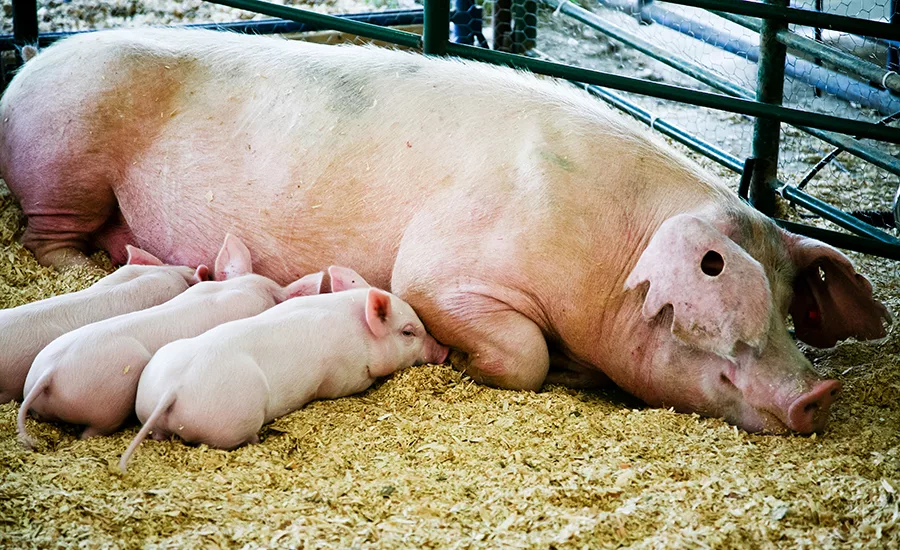
Sow resting with her three piglets.
Getty Images
July 23, 2021

(Note: Mariah Nondorf from Purdue University finished in 1st place in the 2020 ICoMST and RMC Master Research Competition in the Muscle Biology/Fresh Meat Quality Master Section in August 2020.)

Postnatal heat stress costs the U.S. livestock industry approximately $2 billion annually (St-Pierre et al., 2003), with about $1 billion attributed to swine specifically (Pollman et al., 2010).

Swine are particularly prone to experiencing heat stress, because they lack functional sweat glands, have a thick layer of subcutaneous fat, and a large body size. Consequently, heat stress has proven to cause reduced animal performance and typically results in smaller, leaner carcasses (Cruzen et al., 2015). But the impact of heat stress may extend beyond what pigs experience postnatally. Gestating sows are even more susceptible to experiencing heat stress because of increased metabolic heat production that occurs as pregnancy progresses. This in utero heat stress may add to the negative economic outcomes of what is normally considered as heat stress.

The known effects of IUHS are negative impacts on growth and performance (Renaudeau et al., 2012; Cruzen et al., 2015; Johnson et al., 2020), including smaller, leaner carcasses, smaller loin muscle area, increased backfat thickness and altered energy metabolism in swine. This may be related to longer-lasting metabolic changes that result from IUHS, especially in early gestation (Cruzen et al., 2015; Johnson et al., 2018). While some studies have found that offspring that have experienced IUHS may exhibit inferior performance, it is largely unknown what effects IUHS may have on meat quality attributes. 

To address this, researchers from the Purdue Animal Sciences department in conjunction with the U.S. Department of Agriculture’s Animal Research Service (USDA-ARS) Livestock Behavior Research Unit evaluated the impact of IUHS on the carcass and meat quality attributes of gilts having undergone IUHS. For the study, 24 pregnant gilts were either assigned to a thermoneutral (17.5 ± 2.1 °C; 70.2 ± 8.8% relative humidity) or heat stress (35.8 ± 0.2 °C day and 28.4 ± 0.2 °C night; 80.9 ± 6.0% relative humidity) environmental chamber during the first half of their gestation (from day six after insemination to day 59 of pregnancy). All pregnant gilts were then exposed to thermoneutral conditions from day 60 of their pregnancy through farrowing their litters. After the offspring reached market weight, gilts (n=10/treatment) were selected from the in utero thermoneutral group (IUTN) and IUHS group and were harvested. Carcasses were chilled at 2°C for 24 hours prior to evaluation and collection of the right-side loin muscle. From these, sections were cut and assigned to aging treatments of either no further aging or seven days of wet aging at 2°C in vacuum packaging. From the sections, chops were cut to measure Warner-Bratzler shear force (WBSF), surface meat color, water-holding capacity (WHC), and other chemical attributes such as fatty acid profile, lipid oxidation, and protein denaturation.

In comparing the effect of different in utero environments on carcass composition and quality, the carcasses from the IUHS treatment had lower head and heart weights (P < 0.05) compared with the IUTN group. The IUHS treatment also significantly decreased the loin muscle area (P < 0.001). This may be because of impaired muscle development during fetal development, meaning there are fewer muscle fibers in the muscle (Cruzen, 2015). Additionally, the IUHS treatment increased WBSF values (P < 0.05), indicating the meat may be tougher compared with IUTN counterparts. Other measures including temperature and pH decline, WHC, surface color, fatty acid profile, lipid oxidation, and protein denaturation were not affected by in utero environment (P > 0.05).

These results can suggest that IUHS has a negative impact on some carcass and meat quality traits; however, there appeared to be limited impact on other traits including pH, color, WHC, and antioxidative capacity. Taken together, minimizing IUHS during the first half of gestation could be advantageous to producers to produce higher-yielding carcasses with superior meat quality.

References

Cruzen, S. M., R. L. Boddicker, K. L. Graves, T. P. Johnson, E. K. Arkfeld, L. H. Baumgard, J. W. Ross, T. J. Safranski, M. C. Lucy, and S. M. Lonergan. 2015. Carcass composition of market weight pigs subjected to heat stress in utero and during finishing. J. Anim. Sci. 93:2587-2596.

Johnson, J. S. 2018. Heat stress: impact on livestock well-being and productivity and mitigation strategies to alleviate the negative effects. Anim. Prod. Sci. 58(8):1404-1413. 

Johnson, J. S., K. R. Stewart, T. J. Safranski, J. W. Ross, and L. H. Baumgard. 2020. In utero heat stress alters postnatal phenotypes in swine. Theriogenology. 154:110-119.

Pollman, D. S. 2010. Seasonal effects on sow herds: Industry experience and management strategies. J. Anim. Sci. 88:9. (Abstr.).

Renaudeau, D., A. Collin, S. Yahav, V. de Basilio, J.L. Gourdine, and R.J. Collier. 2012.   Adaptation to hot climate and strategies to alleviate heat stress in livestock production. Animal. 6(5):707-728. 

St-Pierre, N. R., B. Cobanov, and G. Schnitkey. 2003. Economic losses from heat stress by US livestock industries. J. Dairy Sci. 86(Suppl.):E52–E77. 

KEYWORDS: livestock production meat science

Share This Story

Looking for a reprint of this article?
From high-res PDFs to custom plaques, order your copy today!


Yuan H. Brad Kim is an Assistant Professor of Animal Sciences in the Meat Science and Muscle Biology Lab, Department of Animal Sciences, Purdue University. Contact him via email at bradkim@purdue.edu.

Mariah Nondorf is part of the Meat Science and Muscle Biology Laboratory, Department of Animal Sciences, Purdue University, West Lafayette 47907, IN, USA

Jacob Tuell is part of the Meat Science and Muscle Biology Lab, Department of Animal Sciences, Purdue University.

Jacob Maskal is part of the Meat Science and Muscle Biology Lab, Department of Animal Sciences, Purdue University.

Jay S. Johnson is part of the USDA-ARS Livestock Behavior Research Unit, West Lafayette, IN 47907 USA

Recommended Content

JOIN TODAY
to unlock your recommendations.

Already have an account? Sign In

  • Double Charburger

    Premiumization drives burger category

    Shoppers seek out premium meat offerings to fulfill...
    Beef
    By: Sammy Bredar
  • JJS Adult Pekin duck

    Poultry Report 2025: Convenience propels poultry at retail

    Despite continued economic pressures, the poultry...
    Chicken
    By: Sammy Bredar
You must login or register in order to post a comment.

Report Abusive Comment

Manage My Account
  • eMagazine Subscriptions
  • Manage My Preferences
  • Newsletters
  • Online Registration
  • Subscription Customer Service
  • Connect with The National Provisioner

More Videos

Sponsored Content

Sponsored Content is a special paid section where industry companies provide high quality, objective, non-commercial content around topics of interest to the The National Provisioner audience. All Sponsored Content is supplied by the advertising company and any opinions expressed in this article are those of the author and not necessarily reflect the views of The National Provisioner or its parent company, BNP Media. Interested in participating in our Sponsored Content section? Contact your local rep!

close
  • A smiling man carrying a grocery basket is reaching down to pick up a package of meat in a grocery store.
    Sponsored byPIC

    The Green Light: New Data Shows 12-to-1 Support for Pork from PRRS-Resistant Pigs

  • Close up of a grocery cart full of groceries, a cropped image of a couple pushing the cart and a blurred background of the vegetable aisle.
    Sponsored byPIC

    New Market Research Finds Consumers in Eight Key Pork Markets Are Likely to Purchase Pork from Gene-Edited Pigs

  • Close up of a young pig with a blurred background.
    Sponsored byPIC

    New Research Forecasts Significant Economic and Market Impacts with PRRS-Resistant Pig Adoption

Popular Stories

JBS USA logo

JBS USA closing pair of processing facilities

Various new Primal snack sticks on a table amongst pencils, apples, a pair of glasses, lunch bags and a water bottle.

Protein demand drives snacking occasions

Several cuts of beef, pork and chicken on a wooden board, cast iron pan and salt.

Validated thermal lethality data and a new tool for ensuring safety of RTE meats

2026 Top 100 Meat & Poultry Processors Report

Events

January 1, 2030

Webinar Sponsorship Information

For webinar sponsorship information, visit www.bnpevents.com/webinars or email webinars@bnpmedia.com.

View All Submit An Event

Products

Food Crime: An Introduction to Deviance in the Food Industry

Food Crime: An Introduction to Deviance in the Food Industry

See More Products
From Fresh to Frozen in 3 Minutes Flat: Unlocking the Secrets to Temperature Control Webinar Sponsored by Air Products

Related Articles

  • newsbriefs

    AMSA announces symposium concurrent speakers on “Current Status of the Meat and Poultry Quality Traits”

    See More
  • Poultry Barn

    Can probiotics help combat heat stress in broiler chickens?

    See More
  • USPOULTRY logo

    Researchers evaluate the effects of heat stress in poults

    See More

Related Products

See More Products
  • meat quality.jpg

    Meat Quality: Genetic and Environmental Factors

  • Handbook of Meat, Poultry and Seafood Quality, second edition

See More Products

Events

View AllSubmit An Event
  • April 26, 2012

    Food Plant of the Future: Raising the Bar on Plant Air Quality

    On demand Exclusively for thought-leaders in food and beverage processing facility management, Food Plant of the Future webinars are presented by Hixson, a leading design and engineering firm of food processing facilities in North America.
View AllSubmit An Event

Related Directories

  • National Pork Board

    The U.S. pork industry has had a 100 percent legislative checkoff program since 1986. Congress created the Pork Checkoff as part of The Pork Promotion, Research and Consumer Information Act of 1985. Pork producers had requested the legislation so they could take advantage of having all producers and importers participate in a checkoff program designed to strengthen the position of pork in the marketplace.
  • Pennsylvania Assn. of Meat Processors

    The Pennsylvania Association of Meat Processors was formed in 1939, when a group of frozen food locker owners formed a support group. Our current members range from Processors, Slaughter, Retail, Catering, Game Processing and Suppliers in the industry. PAMP is affiliated with the American Association of Meat Processors. We hold an annual convention every May with educational classes and a supplier showcase. We would love to have you join and attend our show.
×

Stay ahead of the curve. Unlock a dose of cutting-edge insights.

Receive our premium content directly to your inbox.

SIGN-UP TODAY
  • RESOURCES
    • Advertise
    • Contact Us
    • Directories
    • Store
    • Want More
  • SIGN UP TODAY
    • Create Account
    • eMagazine
    • Newsletter
    • Customer Service
    • Manage Preferences
  • SERVICES
    • Marketing Services
    • Reprints
    • Market Research
    • List Rental
    • Survey/Respondent Access
  • STAY CONNECTED
    • LinkedIn
    • Facebook
    • YouTube
    • X (Twitter)
  • PRIVACY
    • PRIVACY POLICY
    • TERMS & CONDITIONS
    • DO NOT SELL MY PERSONAL INFORMATION
    • PRIVACY REQUEST
    • ACCESSIBILITY

Copyright ©2026. All Rights Reserved BNP Media, Inc. and BNP Media II, LLC.

Design, CMS, Hosting & Web Development :: ePublishing