Exclusive Q&A with Case Farms’ Thomas Shelton
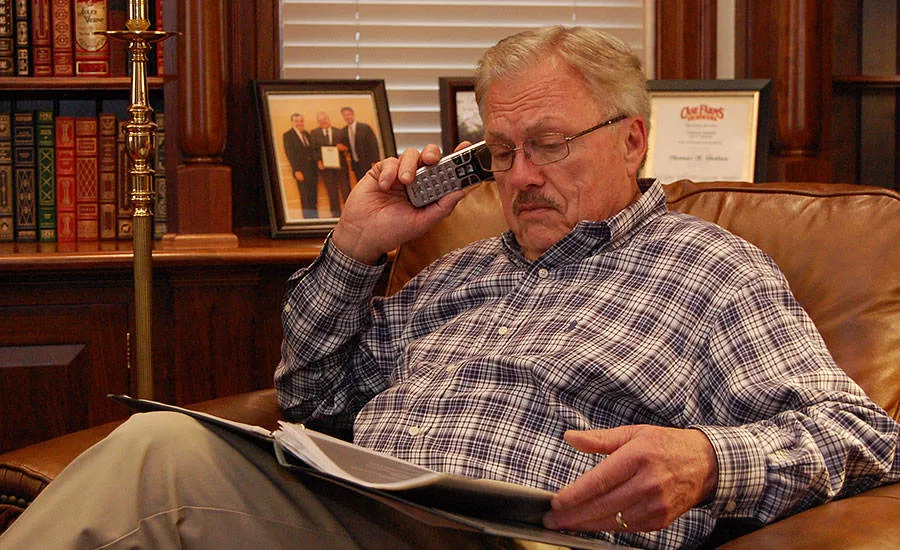
In February 2017, editor-in-chief Andy Hanacek visited with Thomas Shelton, chairman and founder of Case Farms, for an exclusive interview at his home. What follows is a portion of their discussion on the company’s past, present and future:
Hanacek: Let’s begin with the very start of Case Farms. How did the company come to be 30 years ago?
Shelton: We acquired initially the Ohio Complex. I signed that deal in December of 1986. I did the first deal without any outside investors and closed on it in March of '87. It was vertically integrated, processing about a 150,000 birds a week, about 26 million pounds of finished product. I think we had about 114 employees in the processing plant at the time and then we had a distribution center — not only distributing their own poultry but also other meats, pork, beef primarily in the Akron, Ohio, area — but they hadn't really been industry competitive in either business.
Hanacek: Many startup companies obviously go through growing pains. So, early on, were there any struggles that Case Farms had to overcome?
Shelton: Well, the industry had been very profitable starting in August of 1980 and continuing through 1986. We're in a cyclical business and some people were concerned it might be headed in the other direction. Well, in June of ’87 there was a Salmonella scare linked to poultry. Additionally, the industry probably had overproduced at the time, and the chicken market had about six months of pretty heavy losses starting in the fall of ’87. I'd just gotten this company and got nervous about what might happen because we didn't have a huge financial backing at the time. In Atlanta in January of ’87, I met a UK company that wanted to be in the poultry business in the U.S. I told them I wasn’t interested in selling at that time, but by summer, when I began to sense what was happening in the industry, I started discussions with them and by November, they purchased half of the company but I maintained control of the Board.
Hanacek: The late ’80s and early ’90s seem to have been really tumultuous times for Case Farms. What were some of the key pivot points for the company during that time, and how did they shape the culture today?
Shelton: With the new financial backing [of the UK company], we went out and bought three more companies. We bought the North Carolina plant at Morganton. We bought another large distribution company in Indiana that was doing about a 165 million in sales. And then we bought a salad company that made fresh salads, located in Akron. We acquired some quality operations, although I will tell you that neither Ohio nor Morganton at the time of purchase was industry competitive. We were able to change that by bringing in our knowledge and expertise, as well as new management. That really helped us turn those operations around and make them industry competitive. One thing I learned over the years is, it's okay to buy something that's not competitive as long as you know that over time you can correct those areas of deficiency.
The UK company was providing the financing to do these subsequent acquisitions, and their board decided they wanted to go their separate ways. In 1990, they offered me an opportunity to separate and take Ohio and North Carolina, the two poultry operations, while they kept the other two operations.
They didn't give me a lot of time to come up with the equity to take on the poultry operations, but I was able to raise equity on the outside. And what was interesting, this was right at the height of the time of the Savings and Loan debacle. We ended up finding two Dutch banks that did the financing for us on the bank side. It was a huge challenge and I had to raise some outside equity too. However, over the next few years, we were able to return all of that outside equity, so today we don't have any outside shareholders.
But, we didn't really turn the corner until about 1993, when we started doing a lot better. We had a huge fire in 1991 in the Morganton plant that almost took us out, as we still were a fragile company. A lot of other processors helped us out, took live birds, and we had that plant back in operation in 18 process days (not counting weekend days). That, in and of itself, could've easily put us under, but we made it through.
Hanacek: Are there one or two things that you would point to since the early days that has allowed Case Farms to succeed?
Shelton: It's is about people, and that's nothing that's new. Certainly, I learned a lot of the value of good people when I was at Perdue, and we try to do the same thing. We try to take care of our people, in order to minimize turnover, especially in our management group. It has gotten more difficult in the last few years because of competition for labor.
We've had to really work hard to try to keep a stable labor force. We try to be pretty generous with our incentive programs. I mean, I can't take it with me and I believe in sharing. If the company does well, then I want our people to do well.
The other focus has been on our product and our service.
I've always said to give customers the best service and quality possible and that builds customer loyalty. You might not get any more for your product but if the customer has to decide who they buy from, they may choose you over somebody else who may not be giving them the service and quality you can give them.
Hanacek: How do you ensure that the message is received by all employees, especially as Case Farms has grown over the decades?
Shelton: We are a private company with no plans to go public — I made that decision 25 years ago. People like Mike Popowycz and a lot of our senior managers have been with us a very long time — Mike has been with Case Farms almost 30 years — and I want this company to carry on after I'm gone. That way, our people can continue to work for our company — that there will be a job here for them as long as they want it. We’ve spent a lot of time for the last 25 years really fine-tuning a program that will ensure that the company carries on, that there is succession.
Also, we have reinvested heavily in the company. One of the things that we have done is that we plough the profits back in the business. We're a no-nonsense kind of business and have continued to reinvest most of our earnings. And I think we also need to improve technology and be constantly looking for things that have good payback. So we are always looking for new technology that will reduce the labor requirements for the plant — it doesn't put people out of work, but it might fill some troublesome spots. It doesn't mean our plants have fewer people, though, because what's happened over the years is we add more value to the product. Today, most of the meat in our plants is deboned including the dark meat. It takes more people today because we're doing more things to the product.
Hanacek: So in your estimation, successful growth revolves mostly around keeping the customers happy, growing your relationships with them and running efficiently?
Shelton: Well, I've always said that I don't want to be the biggest; I just want to be the best managed, best run chicken company in America. I know that it's hard to stay atop the heap because things change, customers change, competition changes, overproduction occurs. You could lose a key account that could have a huge impact on the end of the day. Because it's like any other industry: It's all about relationships and confidence levels, trust between the customer and the company. That's one reason that we don't want to see a lot of turnover in key positions because customers lose confidence when you're constantly turning people over. I don't necessarily want to grow just for growth's sake or to say I'm bigger, but here's what I will say: It's important, I think, to take care of the customer. [If a customer says], “I need some additional product but I want it in a different format or form,” and that will require some capital investment on our part, we're willing to grow with the customer's needs. We're well capitalized and we're in a position that we can expand internally, and we will grow internally but it will be a disciplined growth. I don't believe in growing out of control. And whether we will acquire anything depends on whether anything becomes available. We're in a position and we could, but we're not going to overpay for something just because it's available.
Hanacek: So within the framework of a little shorter term window, where do you see some of the bigger opportunities for growth for Case Farms?
Shelton: Well, we're never satisfied; I'm never satisfied, and the company's never satisfied. For one, we're looking at further automation in our deboning areas. It requires a lot of people to do the deboning that we do today, but the reason that the industry hasn't gone completely to automation for that is you typically have to give up quality and yield when you go to machines to do something that people are doing. So you test equipment to see if it is what you need and is still cost effective. We've got a better labor situation now in Ohio than we had a year or two ago. It has improved, but we're still motivated to try new technology because we want to add more value by processing more parts and deboned meat.
Looking for a reprint of this article?
From high-res PDFs to custom plaques, order your copy today!