Process Tech
New innovations in slicing: Looking for an edge
Processors continue to investigate innovations in slicing that offer upgrades to the sanitation and efficiency of those operations.
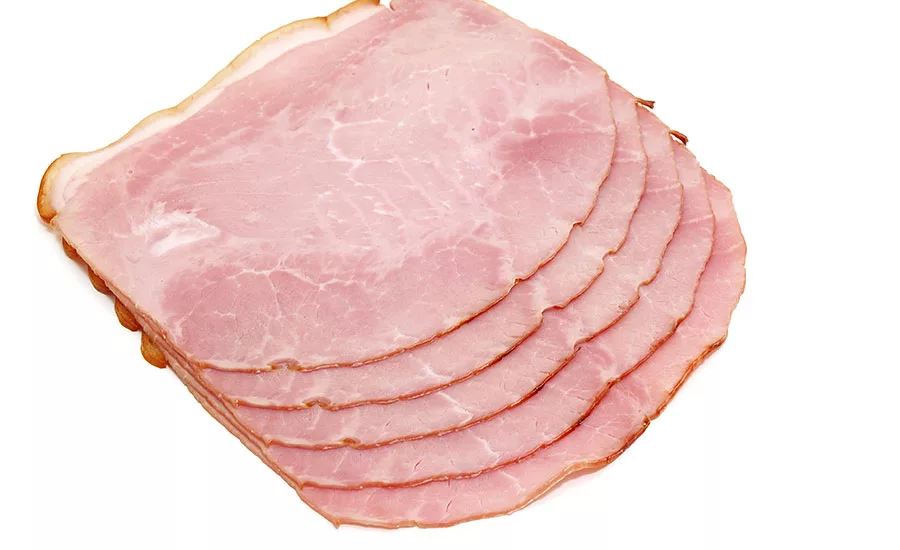
Processors are experimenting with new slicing and sanitizing innovations that rely on water — along with 3D scanning, sensors and increased automation. Slicers are vulnerable to cross-contamination from bacteria and humans. Slicing machines can harbor bacteria when nooks and crannies aren’t cleaned on a timely basis. And employees bear the lion’s share of responsibility for carefully taking apart and properly cleaning these machines, as well.
“We tend to get quite lucky that we don’t get more illnesses from slicers,” says Robert W. Powitz, Ph.D., principal consultant and technical director of Old Saybrook, Conn.-based R.W. Powitz and Associates, forensic sanitarians. “The most effective ways to clean slicers also take the most time.”
Last year, the U.S. Centers for Disease Control and Prevention found that half of the almost 300 randomly selected delis researchers visited had slicers that weren’t cleaned and sanitized as often as recommended by the Food and Drug Administration.
To prevent contamination, slicers have to be cleaned and thoroughly sanitized frequently during operations, but they also require intense cleaning during down time, with solutions such as chemical-free steam cleaners and engineered or electrolyzed water systems.
Under recent formal NSF International protocols and the Food Safety Modernization Act, new standards have been developed for the sanitary devices themselves used in commercial food operations.
Portable dry steam units, for example, quickly remove soils and sanitize processing equipment without lengthy interruptions or clean up, Powitz says. They can also provide additional spot cleaning of clean-in-place (CIP) equipment.
Dry steam cleaners are tested, however, to measure biocidal activity when the dry steam is applied to an environmental surface, so the steam doesn’t release toxic maladies from the slicers during the cleaning process, Powitz says.
Another newer sanitizer, engineered water, features a stronger cleaning agent than bleach with no toxicity — as long as its inherent instability is monitored, Powitz says.
“Engineered water does take more time to clean machines, while steam cleaning is a more rapid process,” he says.
Chemical-free cleaning methods of equipment should increase, however, as consumers expect all aspects of food production to be green.
Designing better safety
“Innovation in sanitation is a critical priority for the industry — particularly for slicing operations because that blade and that mechanism touches every single slice,” says Jay Jandrain, chief operating officer at Butterball, Garner, N.C. “The ability to clean our blades easily is huge and is definitely a major aspect of what we look at when we’re assessing equipment.”
With the broad adoption by the original equipment manufacturers (OEMs) of the American Meat Institute Sanitary Design Standards, processors have an improved basis for common discussion and language in equipment design — and hollow materials and structures in framing and support components are being eliminated.
“These changes and food safety improvements include continued reduction of debris harborage areas and improved electro-mechanical component isolation to support sanitation realities through more open equipment designs with fewer parts to remove during cleaning and sanitation,” says Mike Bartikoski, SVP of Operations at Land O’Frost, in Munster, Ind. “Both of these points have helped progress slicers with respect to food safety issues and, in particular, Listeria control.”
Blades need to be swabbed frequently, so ease of safe access is critical. “The harder it is to access or disassemble a piece of equipment, the less likely it will be properly cleaned,” says Richard F. Stier, consulting food scientist at Stratecon International Consultants, based in Sonoma, Calif. “So good sanitary design and easy cleanup are essential.”
Overall, with food safety being the top priority in all equipment manufacturing, accessibility and blade quality are among the top concerns, says Warren Gilbert, partner, FSS Corp – Food Safety Specialists, based in Elkhorn, Wis.
“With knives it is very important to have a blade control program which includes scheduled inspections, sharpening and sanitizing,” he says. “In order to maintain efficiencies, there are usually multiple blades available with quick disconnects for ease of exchange.”
Cutting with water
Water-jet based trimming machines are capable of sensing and cutting meat and poultry with high-pressure water, but still suffer from higher price points that make heavy throughput and volume essential.
“Water knives are a good option which have been around for awhile,” Gilbert says. “The benefit is a clean cut and no cleaning or sharpening required. From a food safety standpoint, water quality must be managed.”
Water-jet knives work best on products that can be laid flat on food conveyor systems and remain stable during the slicing process, such as steaks, pork chops, chicken breasts and pork bellies, according to the book “Robotics and Automation in the Food Industry: Current and Future Technologies.”
Abrasive water-jet cutting systems, which use water mixed with abrasive chemicals such as salt, have been found to cut deeper — even through bones — and with better quality than plain water, according to the article “Cutting Meat with Bone Using an Ultrahigh Pressure Abrasive Waterjet” in Meat Science.
Improving knives
At Land O’Frost, processors are seeing a lot of advances in sharpening technologies, says Bartikoski.
“For example, these new technologies can track individual blades, assist in assuring that blades get the right edge each sharpening cycle, ensure that cycles are tracked to guarantee optimal blade life and support correlation of blade performance and product attributes,” he says.
Another innovation is the ability to share and link electronically collected mechanical performance data from the slicer. “This improves maintenance, equipment reliability and assists in the formulation of operator and technician training,” Bartikoski says.
Developments in robotic pick and place solutions are an interesting area to watch, he says. Features that integrate weight control and slice thickness to optimize package weight and product attribute delivery are also improving.
“Flexibility between items and changeovers is one area that remains a challenge,” Bartikoski says.
Output continues to increase with slicing systems, however.
“We’ve been able to come up with multi-log configurations to slice several logs of product at one time, increasing the overall output of machines,” says Jandrain. “The machines are also getting faster and increasing throughput, which has been great at driving efficiency.”
Three-dimensional scanner slicing machines are also using updated sensor data to improve meat scanning before slicing to reduce waste and increase product utilization, according to “Robotics and Automation in the Food Industry: Current and Future Technologies.” While production rates are fast, the trade off is that the slicing angle usually remains constant, so some product could be wasted by too much trimming.
“Certainly, larger and faster slicers are coming (but) development of ways to deploy these features on smaller slicers in more flexible set-ups and configurations remains a challenge,” Bartikoski says. NP
Looking for a reprint of this article?
From high-res PDFs to custom plaques, order your copy today!